
Two characters in a drama have been saying 밥 먹었어요? to each other for six episodes. Then one of them says 밥 먹었어?, and the other one goes quiet for a second.
Nothing was translated differently in the subtitles. But everyone watching in Korean knows exactly what just happened.
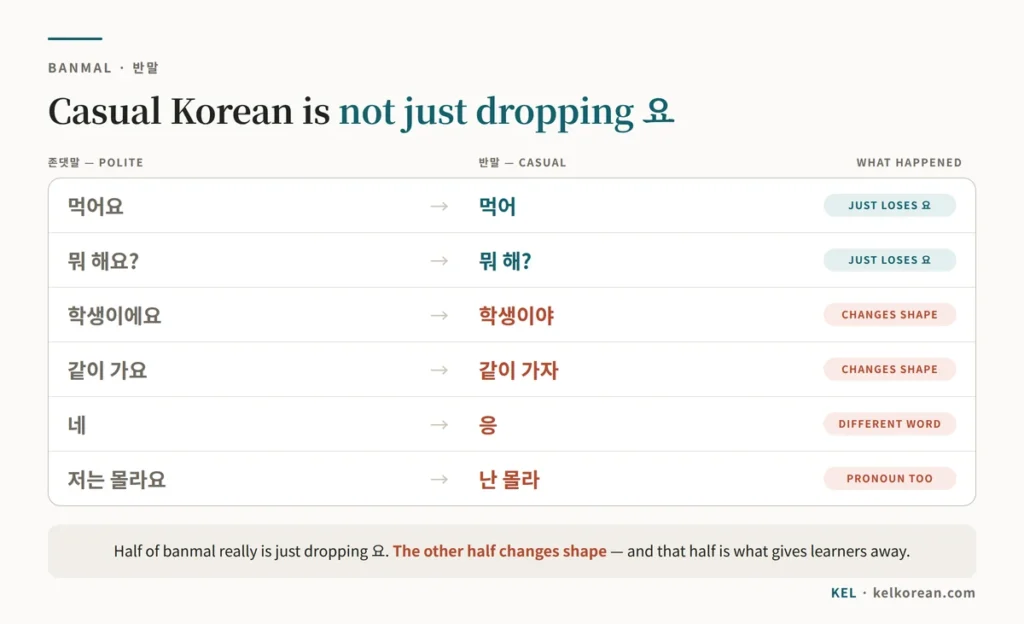
Banmal (반말) is casual Korean, and every learner is told the same thing about it: just drop the 요. That is true for maybe half of what you will say, and wrong for the rest — the pronouns change, “let’s” changes, commands change, and “yes” changes.
What Banmal Actually Is
Korean has two settings for almost every sentence. 존댓말 is the polite one, 반말 is the casual one, and you are always in one of them — there is no neutral.
Banmal is not rudeness. It is closeness. Using it with the right person is warm; using 존댓말 with a close friend is the actual mistake, because it puts a wall between you. A Korean who has been your friend for two years and still gets 존댓말 from you will assume you want distance.
What makes it feel dangerous to learners is that the wrong use of it really is rude. Speaking 반말 to a stranger, a shopkeeper or anyone older is not a small slip — it reads as contempt. The speech levels themselves are laid out in Korean honorifics; this article is about the mechanics of the casual one, and about how you get permission to use it.
The Half That Really Is Just Dropping 요
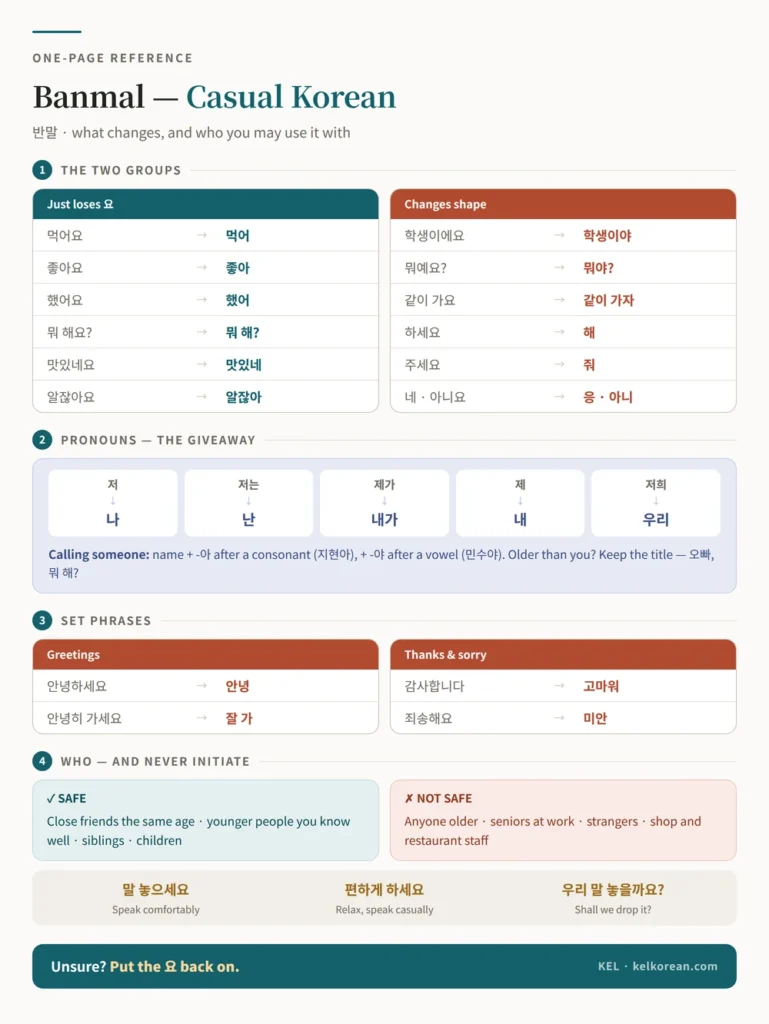
Start with the easy part, because it is genuinely easy. Ordinary statements and questions lose the 요 and nothing else happens.
| 존댓말 | 반말 |
|---|---|
| 먹어요 | 먹어 |
| 가요 | 가 |
| 좋아요 | 좋아 |
| 했어요 | 했어 |
| 있어요 | 있어 |
| 뭐 해요? | 뭐 해? |
Questions work the same way — the sentence is identical to the statement, and your voice going up at the end is what makes it a question.
The sentence endings behave this way too. 맛있네요 becomes 맛있네, 그렇죠 becomes 그렇지, 알잖아요 becomes 알잖아 — all covered in Korean sentence endings, and all of them simply shed the 요.
This is why “just drop 요” gets repeated. It works often enough to feel like a rule.
The Half That Changes Shape
Now the parts that catch people. None of these are optional — a Korean will hear 학생이에요 with the 요 chopped off and know instantly that you learned the rule from a website.
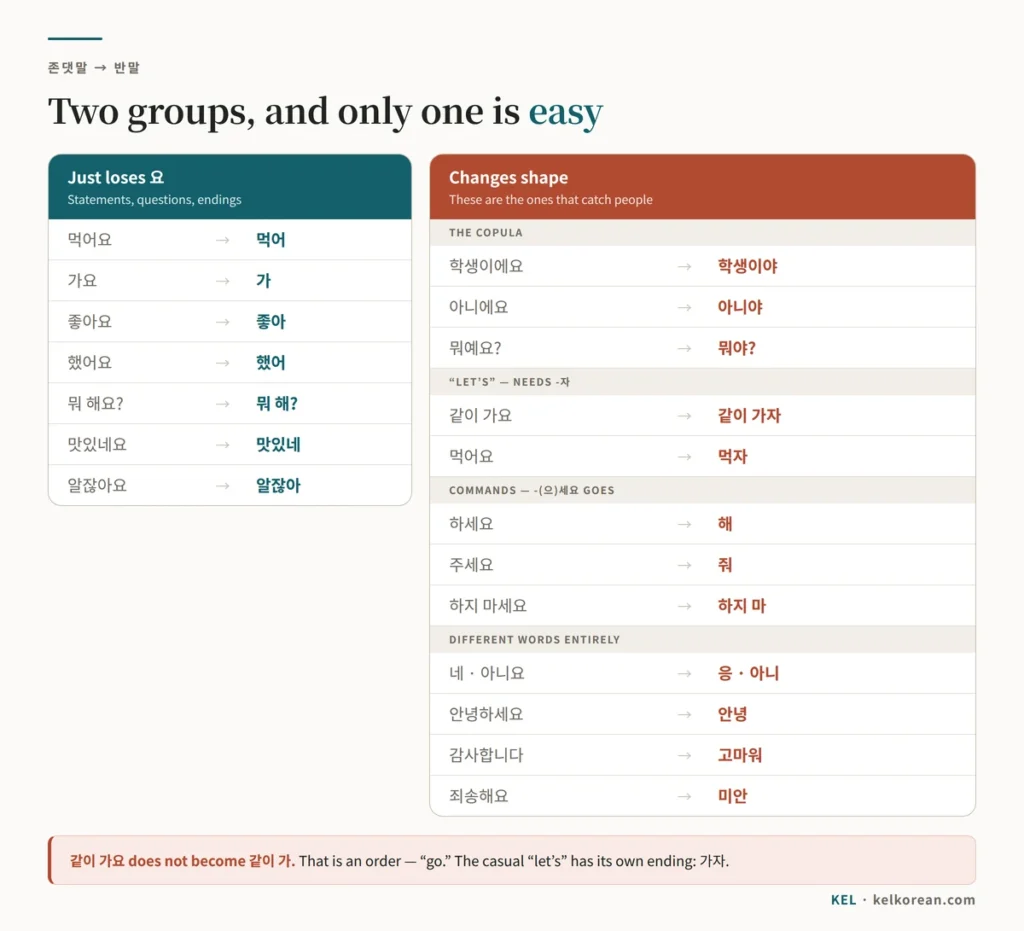
1. 이에요 / 예요 → 이야 / 야
The copula does not just lose its ending, it changes.
- 학생이에요 → 학생이야
- 제 친구예요 → 내 친구야
- 아니에요 → 아니야
- 뭐예요? → 뭐야?
2. “Let’s” is -자, not -아/어요
In 존댓말 you make a suggestion with 같이 가요. In 반말 there is a dedicated ending.
- 가요 → 가자
- 먹어요 → 먹자
- 할까요? → 할까?
3. Commands drop -(으)세요 entirely
- 하세요 → 해
- 앉으세요 → 앉아
- 주세요 → 줘
- 하지 마세요 → 하지 마
You may also meet -아/어라 (해라, 먹어라). It is a harder, more commanding form — parents to children, or written instructions — and you can safely leave it alone.
4. Yes and no change words
- 네 → 응 or 어
- 아니요 → 아니
5. The set phrases have their own casual versions
| 존댓말 | 반말 |
|---|---|
| 안녕하세요 | 안녕 |
| 안녕히 가세요 | 잘 가 |
| 감사합니다 / 고마워요 | 고마워 |
| 죄송합니다 / 미안해요 | 미안 |
| 알겠습니다 | 알겠어 / 알았어 |
If the polite versions of these are still settling, Korean greetings covers when each one is used.
The Change Almost Nobody Mentions: Pronouns
This is the one that gives learners away most reliably, because it is invisible in a conjugation table.
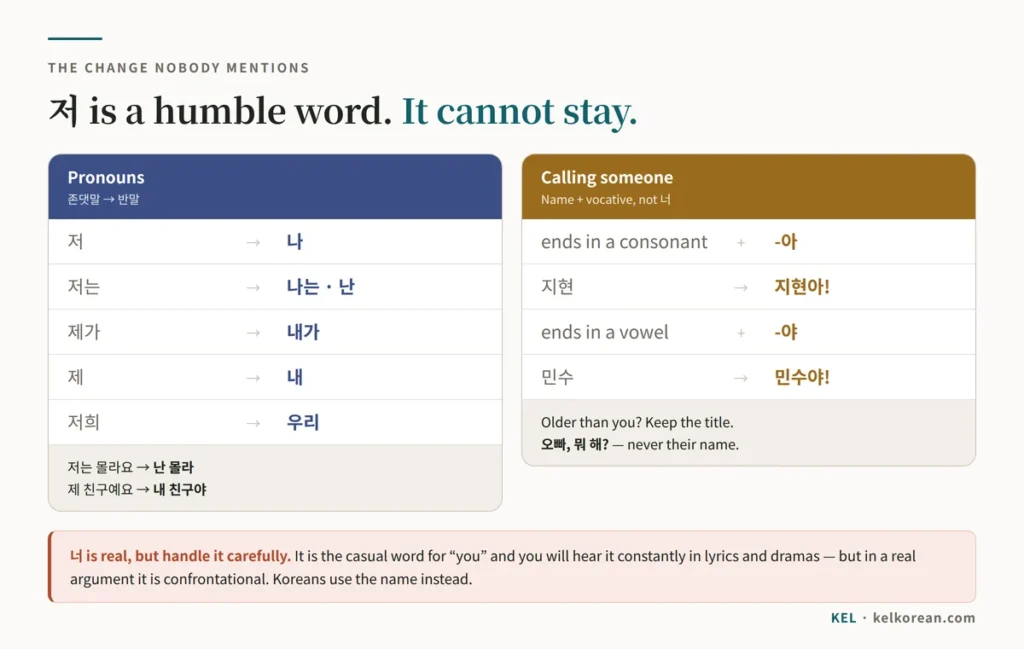
저 is a humble word. It does not belong in a 반말 sentence at all.
| 존댓말 | 반말 |
|---|---|
| 저 | 나 |
| 저는 | 나는 (or 난) |
| 제가 | 내가 |
| 제 | 내 |
| 저희 | 우리 |
So 제 친구예요 becomes 내 친구야, and 저는 몰라요 becomes 나는 몰라 or 난 몰라.
A second warning about the other pronoun. 너 (you) is the 반말 word for “you”, and it is real — you will hear it constantly in dramas and lyrics. But Korean avoids second-person pronouns even between friends, and 너 in an argument is confrontational. In practice Koreans use the person’s name plus a vocative ending:
- Name ending in a consonant → -아: 지현 → 지현아
- Name ending in a vowel → -야: 민수 → 민수야
Calling out 민수야! across a room is completely normal. 너! is not.
Who You Are Allowed to Use It With
The mechanics are the easy part. This is the part that matters.
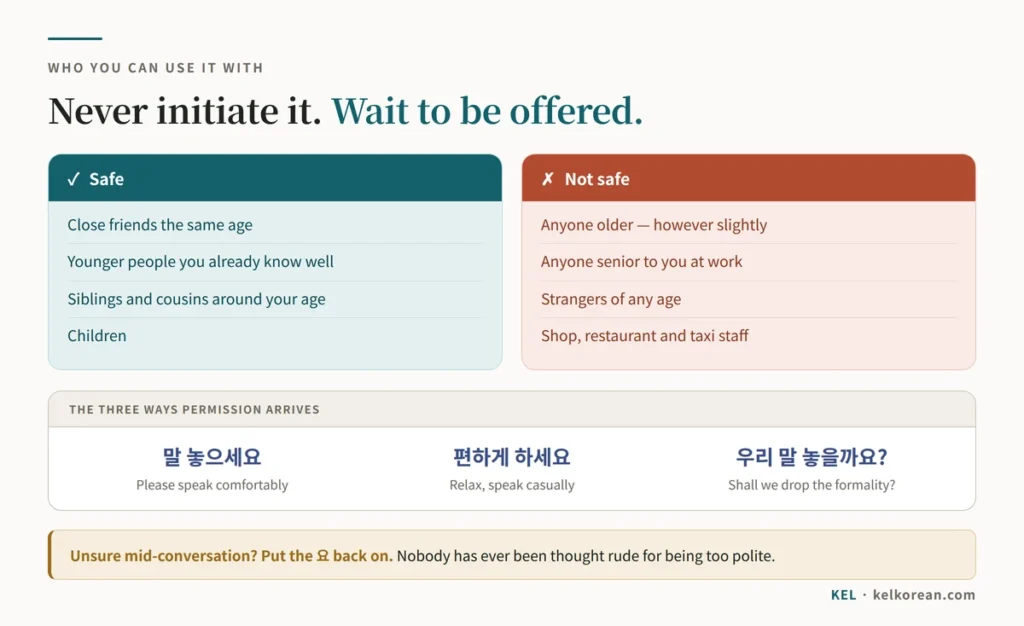
Safe:
- Close friends of the same age
- People clearly younger than you who you already know well
- Children
- Siblings and cousins around your age
Not safe:
- Anyone older, however slightly
- Anyone senior to you at work
- Strangers of any age
- Shop staff, drivers, restaurant staff — even if they are younger
The single rule that keeps you out of trouble: never initiate it. Wait to be offered. The offers sound like this:
말 놓으세요. — Please speak comfortably.
편하게 하세요. — Relax, speak casually.
우리 말 놓을까요? — Shall we drop the formality?
Until one of those arrives, stay in 존댓말. Nobody has ever been thought rude for being too polite.
One thing that surprises learners: you can be in full 반말 with someone and still never use their name. If they are older than you, you keep the title — 오빠, 형, 누나, 언니 — for as long as you know them. 오빠, 뭐 해? is normal. Their actual name is not. The titles themselves are in Korean family terms.
The Setting Is Not a Switch
Here is something textbooks miss: Koreans do not sit on one side all evening. They slide.
Adding 요 back onto a 반말 sentence softens it instantly. 밥 먹었어 and 밥 먹었어요 are the same words with a different temperature, and people move between them within a single conversation — 반말 for the joke, 요 for the request.
You will also hear a senior person using 반말 downward while the junior answers in 존댓말. That asymmetry is normal and not rude in either direction. It is one of the things that makes drama dialogue confusing at first, and one of the fastest things to recognise once you know it is happening. There are more of these patterns in K-drama Korean.
Practical version: if you are unsure mid-conversation, put the 요 back on. It is the one move that is never wrong.
The Same Conversation, Both Ways
Rules are easier to trust once you have seen them run. Here is one short exchange twice over.
In 존댓말
A: 안녕하세요. 어디 가세요?
B: 아, 저는 학교에 가요. 같이 갈까요?
A: 네, 좋아요. 그런데 시간 있으세요?
B: 네, 있어요. 천천히 가요.
In 반말
A: 안녕. 어디 가?
B: 아, 나는 학교에 가. 같이 갈까?
A: 응, 좋아. 근데 시간 있어?
B: 응, 있어. 천천히 가자.
Look at what moved. 안녕하세요 → 안녕 is a different phrase, not a shortened one. 저는 → 나는. 네 → 응. 가세요 → 가. And the last line went to 가자, because “let’s go” needs its own ending.
And look at what did not move. 어디, 학교에, 시간, 좋아, 천천히 — the vocabulary is untouched. This is the reassuring part: 반말 is a set of endings and two pronouns, not a second language.
5 Mistakes Worth Avoiding
1. Saying 저 in banmal. 저는 몰라 is a mixed signal — humble pronoun, casual verb. It is 난 몰라.
2. Dropping 요 from 이에요. 학생이에요 does not become 학생이에. It becomes 학생이야.
3. Using 가요 for “let’s go.” 반말 “let’s” is 가자. Just dropping the 요 gives you 가, which means “go” — an order.
4. Speaking banmal because the other person is younger. Age alone is not permission. A younger stranger, a younger colleague, a younger shop assistant all get 존댓말.
5. Copying it straight out of a drama. Drama characters are usually close friends or family, and they are written to be dramatic. The line that sounds cool on screen may be far blunter than anything you want to say to a real person.
Quick Practice
Convert to 반말. Answers underneath.
- 저는 학생이에요.
- 같이 밥 먹어요.
- 여기 앉으세요.
- 네, 알겠어요.
- 감사합니다.
Answers
- 난 학생이야. — pronoun changes and the copula changes
- 같이 밥 먹자. — “let’s” needs -자
- 여기 앉아. — the command loses -(으)세요 entirely
- 응, 알겠어. — 네 becomes 응
- 고마워. — a different word, not a shortened one
Frequently Asked Questions
Is banmal rude?
Not in itself — it is the normal way close people speak to each other. It becomes rude when it is used across a gap it has not been invited across: with someone older, someone senior, or a stranger.
Can I use banmal with someone the same age as me?
Usually yes once you know them, and Korean age peers often switch quickly. But wait for it to be offered or agreed rather than assuming — 우리 말 놓을까? is a normal thing to ask, and asking is safer than starting.
Do Koreans use banmal with their parents?
Many do, especially younger generations. Grandparents usually still get 존댓말, and some families keep it with parents too. It varies by family more than by rule.
How do I answer if someone speaks banmal to me?
If they are older or senior, keep answering in 존댓말 — that asymmetry is completely normal and not a snub. If they are a peer, it is an invitation, and you can answer in kind.
Why do K-pop lyrics use banmal?
Because lyrics are intimate by design, and because the casual forms are shorter — 사랑해 fits a beat where 사랑합니다 does not. Almost everything you hear sung is 반말.
What is 해라체 then?
A separate plain style used for writing, textbooks, news and parents speaking to small children — 먹는다, 간다, 해라. You will read it far more often than you will say it, so recognising it is enough. The verb conjugation basics cover how the forms are built.
Final Thoughts
Banmal is not a shortcut and it is not a reward for reaching an intermediate level. It is a social position, and Korean makes you choose one in every sentence you speak.
Learn the mechanics now — the copula, the -자 for “let’s”, the commands, and above all 나 instead of 저 — so that when someone says 말 놓으세요 you can actually take them up on it instead of freezing.
And until then, keep the 요 on. Being slightly too polite is invisible. Being casual one step too early is not.
Leave a Reply