
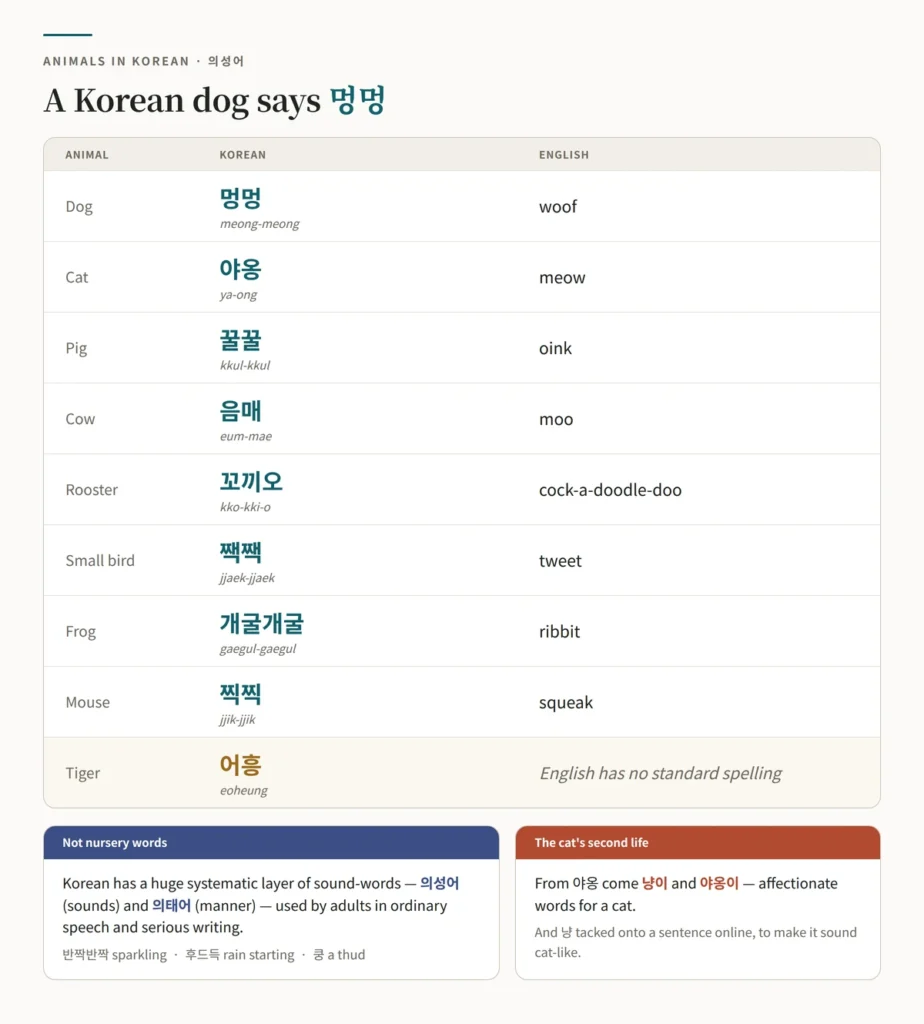
A Korean dog does not say woof. It says 멍멍.
That is not a cute translation quirk — it is a window into how the language works. Animals in Korean come with a second vocabulary attached: the noises they make, and Korean treats those noises as real words with standard spellings, not as baby talk.
And one of these animals is a small landmine. 개 means dog, and it is also the first syllable of a surprising number of things you should not say.
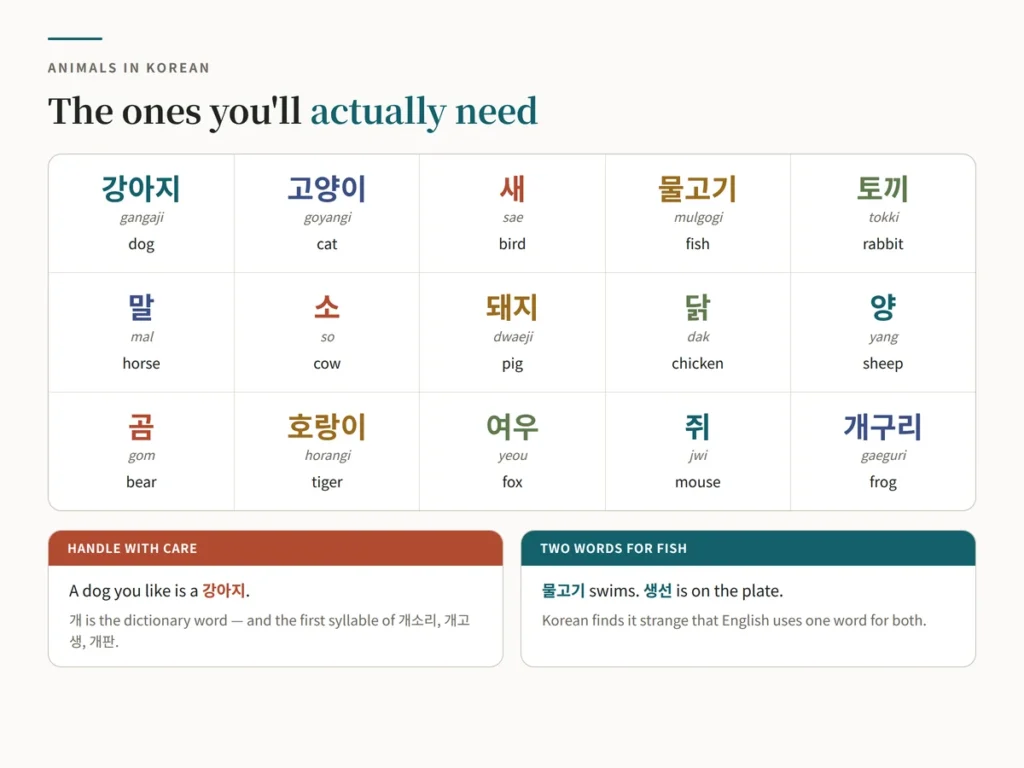
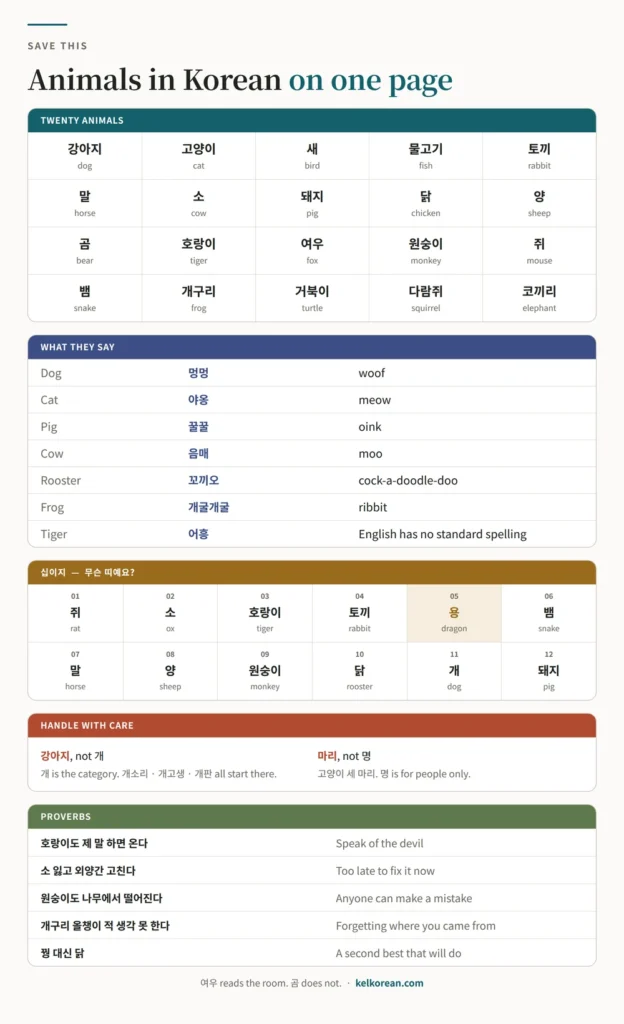
The Animals You Will Actually Need
| Korean | Romanization | English |
|---|---|---|
| 강아지 | gangaji | dog (see below) |
| 고양이 | goyangi | cat |
| 새 | sae | bird |
| 물고기 | mulgogi | fish |
| 토끼 | tokki | rabbit |
| 말 | mal | horse |
| 소 | so | cow |
| 돼지 | dwaeji | pig |
| 닭 | dak | chicken |
| 양 | yang | sheep |
| 곰 | gom | bear |
| 호랑이 | horangi | tiger |
| 여우 | yeou | fox |
| 원숭이 | wonsungi | monkey |
| 쥐 | jwi | mouse, rat |
| 뱀 | baem | snake |
| 개구리 | gaeguri | frog |
| 거북이 | geobugi | turtle |
| 다람쥐 | daramjwi | squirrel |
| 코끼리 | kkokkiri | elephant |
Note 물고기 — “water meat.” Korean distinguishes a fish swimming (물고기) from fish as food (생선). English uses one word for both and Korean finds that mildly strange.
And 말 means both “horse” and “speech.” Identical spelling, different length when spoken. Context sorts it out every time.
강아지 vs 개 — The One to Be Careful With
개 (gae) is the dictionary word for dog. 강아지 (gangaji) technically means puppy.
In practice, Koreans call every beloved dog 강아지, regardless of age — a fourteen-year-old dog is still somebody’s 강아지. It is the warm word.
개 is the neutral one, and it is also where the trouble starts. It sits at the front of a long list of unpleasant vocabulary:
- 개소리 — literally “dog sound,” meaning nonsense or rubbish
- 개고생 — a miserable slog
- 개판 — a shambles, a mess
And in modern slang, 개- has become an intensifier. 개맛있다 (“insanely tasty”), 개좋아 (“love it”). Young Koreans use it constantly in speech and messaging, and it is genuinely vulgar — the equivalent of an English swear word used as “very.” It is the kind of thing you should understand and not say, which is also true of much of Korean texting slang.
Use 강아지 for a dog you like. Use 개 when the dog is a category, not a friend.
⭐ What Korean Animals Say
This is the part nobody expects, and it is the most fun vocabulary in the language.
| Animal | Korean | English |
|---|---|---|
| Dog | 멍멍 meong-meong | woof |
| Cat | 야옹 ya-ong | meow |
| Pig | 꿀꿀 kkul-kkul | oink |
| Cow | 음매 eum-mae | moo |
| Rooster | 꼬끼오 kko-kki-o | cock-a-doodle-doo |
| Small bird | 짹짹 jjaek-jjaek | tweet |
| Chick | 삐악삐악 ppiak-ppiak | cheep |
| Frog | 개굴개굴 gaegul-gaegul | ribbit |
| Mouse | 찍찍 jjik-jjik | squeak |
| Sheep | 매애 mae-ae | baa |
| Tiger | 어흥 eoheung | roar |
어흥 is the one to notice. English has no standard spelling for a tiger’s roar — Korean does, every Korean child knows it, and it appears in folk tales.
These are not nursery words. Korean has an enormous, systematic layer of sound-words — 의성어 (sounds) and 의태어 (manner) — and adults use them in ordinary speech and in serious writing. 반짝반짝 (sparkling), 후드득 (rain starting), 쿵 (a thud). Animal noises are simply the entry point.
The cat has a second life here. From 야옹 comes 냥이 and 야옹이 — affectionate nouns for a cat — and the internet extension 냥, tacked onto sentences to make them sound cat-like. It is the same impulse as saying something is 귀여워.
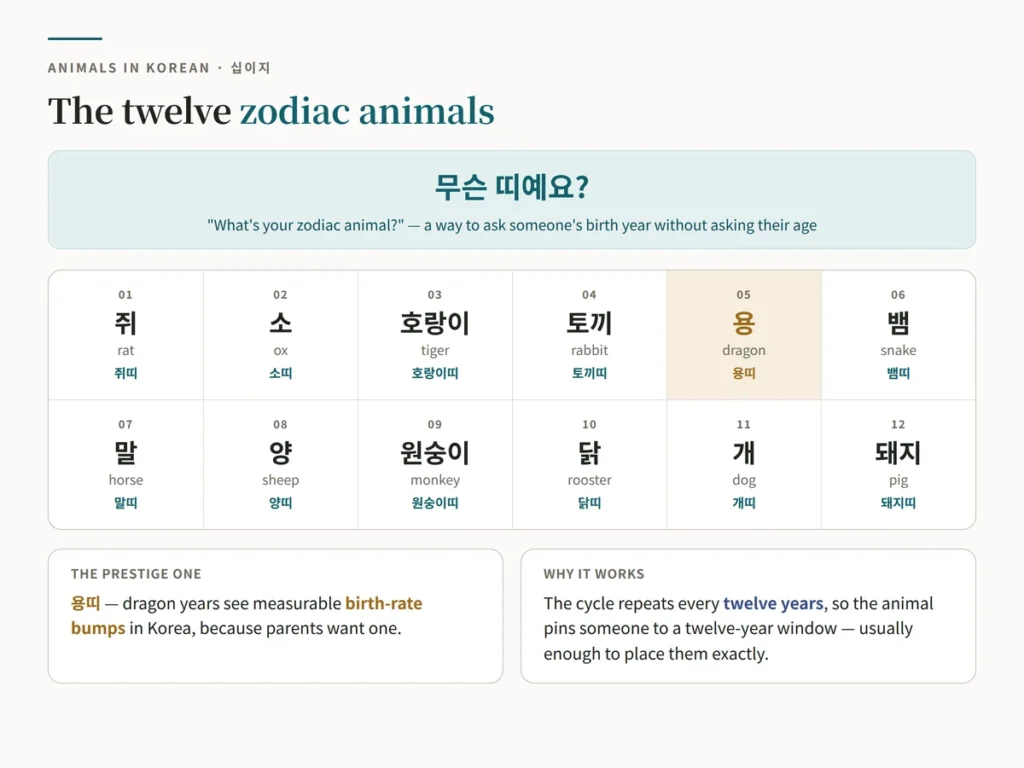
The Twelve Zodiac Animals
Ask a Korean their 띠 and you have asked their birth year without asking their age — which, given how much age matters in Korean, is a useful move.
무슨 띠예요? — “What’s your zodiac animal?”
| Order | Animal | 띠 |
|---|---|---|
| 1 | 쥐 rat | 쥐띠 |
| 2 | 소 ox | 소띠 |
| 3 | 호랑이 tiger | 호랑이띠 |
| 4 | 토끼 rabbit | 토끼띠 |
| 5 | 용 dragon | 용띠 |
| 6 | 뱀 snake | 뱀띠 |
| 7 | 말 horse | 말띠 |
| 8 | 양 sheep | 양띠 |
| 9 | 원숭이 monkey | 원숭이띠 |
| 10 | 닭 rooster | 닭띠 |
| 11 | 개 dog | 개띠 |
| 12 | 돼지 pig | 돼지띠 |
The cycle repeats every twelve years, so the animal pins someone down to a twelve-year window — usually enough, combined with how they look, to place them exactly.
용 (dragon) is the prestige one. Dragon years see measurable birth-rate bumps in Korea, because parents want a 용띠 child.
Counting Animals
You cannot say “three cats” in Korean by putting a number next to a noun. Animals take the counter 마리.
고양이 세 마리 — three cats
강아지 한 마리 — one dog
The noun comes first, then the number, then the counter. That ordering and the rest of the counter system are covered in Korean counters.
People get 명, animals get 마리. Using 마리 for a person is an insult; using 명 for a dog sounds like a joke about treating it as family — which Koreans do say, deliberately.
Animals on the Menu
Three of these words turn into food by adding 고기 (“meat”).
| Animal | Meat |
|---|---|
| 소 cow | 소고기 beef |
| 돼지 pig | 돼지고기 pork |
| 닭 chicken | 닭고기 chicken |
닭 is the one you will see most, because 치킨 — fried chicken — is a national institution with its own vocabulary. Both words exist and mean different things: 닭고기 is the meat, 치킨 is the dish. More of this is in how to order food in Korean.
Calling a Person an Animal
Two of these are used about people constantly, and they mean almost opposite things.
여우 — “fox.” A woman who is clever about people, socially skilled, quietly getting what she wants. Depending on tone it is admiring or catty, and it is never neutral.
곰 — “bear.” Slow to read a situation. Not unkind, not sly — just not noticing. A 곰 misses the signals that a 여우 reads instantly.
Korean says these two as a pair, and the contrast is really about 눈치 — the social radar that most of Korean life runs on. A 여우 has it; a 곰 does not.
One more you will hear: 돼지 as a jab about eating or weight. It is exactly as rude as it sounds. Do not use it about anyone, including yourself as a joke — it lands worse across a language barrier than it does between friends.
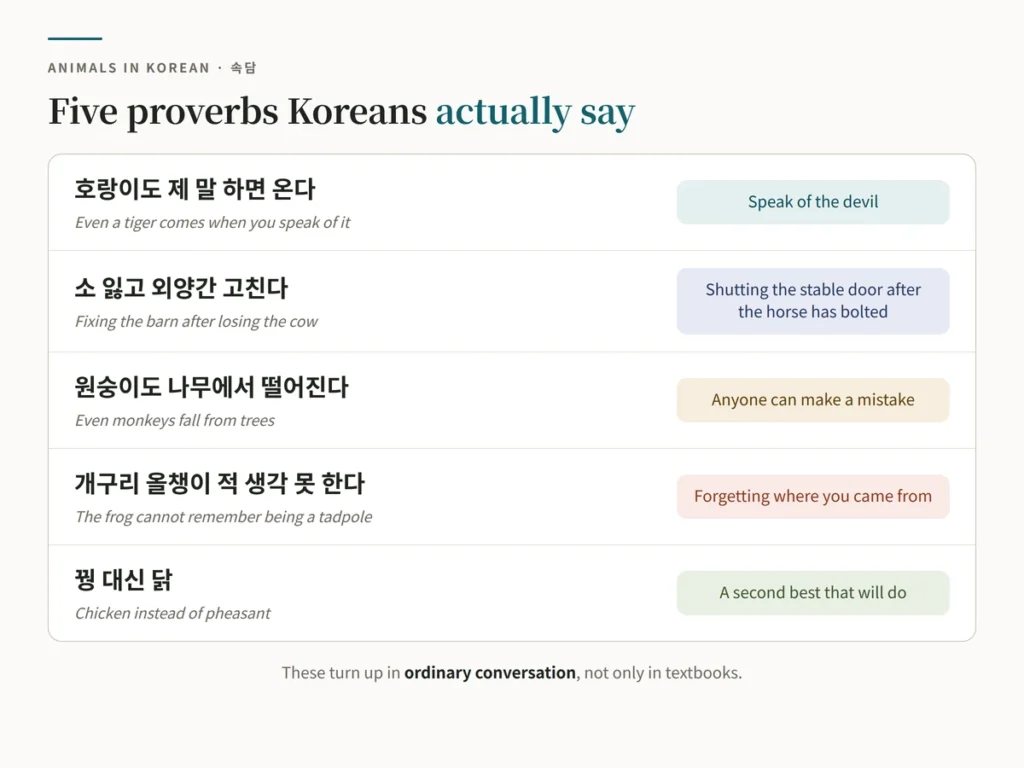
Five Animal Proverbs Koreans Actually Say
These come up in real conversation, not just in textbooks.
호랑이도 제 말 하면 온다.
Even a tiger comes when you speak of it — speak of the devil.
소 잃고 외양간 고친다.
Fixing the barn after losing the cow — shutting the stable door after the horse has bolted.
원숭이도 나무에서 떨어진다.
Even monkeys fall from trees — anyone can make a mistake, however expert.
개구리 올챙이 적 생각 못 한다.
The frog cannot remember being a tadpole — said of someone who has forgotten where they came from.
꿩 대신 닭.
Chicken instead of pheasant — a second-best substitute that will do.
5 Mistakes Worth Avoiding
1. Using 개 for someone’s pet. Say 강아지. 개 is the category, not the friend.
2. Copying 개- slang. 개맛있다 is everywhere and is still vulgar. Recognise it; leave it alone.
3. Counting animals with 명. 명 is for people. Animals take 마리.
4. Mixing up 물고기 and 생선. Swimming is 물고기; on a plate it is 생선.
5. Calling someone 돼지. Not a joke that travels.
Frequently Asked Questions
How do you say cat in Korean?
고양이 (goyangi). Affectionately Koreans also say 냥이 or 야옹이, both built from 야옹 — the sound a Korean cat makes.
How do you say dog in Korean?
강아지 (gangaji) for a dog you are fond of, which is what Koreans say about almost any pet regardless of age. 개 (gae) is the dictionary word and sounds blunter.
What sound do Korean dogs make?
멍멍 (meong-meong). Korean cats say 야옹, pigs say 꿀꿀, cows say 음매 and roosters say 꼬끼오. These have standard spellings and are used by adults, not only by children.
What is 마리 in Korean?
The counter for animals. Korean requires a counter word between the number and the thing being counted — 고양이 세 마리 is “three cats.” People take 명 instead.
What are the 12 Korean zodiac animals?
쥐, 소, 호랑이, 토끼, 용, 뱀, 말, 양, 원숭이, 닭, 개, 돼지 — rat, ox, tiger, rabbit, dragon, snake, horse, sheep, monkey, rooster, dog and pig. Ask 무슨 띠예요? to find out someone’s.
Why is 개 used in Korean slang?
개- attached to the front of a word works as an intensifier in casual speech — 개맛있다 means “extremely tasty.” It is vulgar, extremely common among younger speakers, and better understood than used.
What does it mean to call someone 여우 or 곰?
여우 (“fox”) describes someone socially sharp and quietly strategic; 곰 (“bear”) describes someone who misses social signals. They are used as a contrasting pair, and both are about 눈치.
Final Thoughts
Animals in Korean are two vocabularies for the price of one. The nouns are short and easy — 개, 소, 말, 새 are all a single syllable. The sounds they make are where the language gets interesting, because Korean has written them down and agreed on the spellings.
Learn 강아지, 고양이, 마리 and you can talk about pets. Learn 멍멍 and 야옹 and you have your first two words of Korean onomatopoeia, which turns out to be one of the biggest and most expressive parts of the language.
And remember which word not to reach for. The dog is a 강아지.
Written by Minhyung Cha — 25 years teaching Korean, and 15+ years running an English academy in South Korea. Every example on this site is checked as a native speaker. More about KEL.
Leave a Reply