
How to take a taxi in Korea sounds like a question with a one-word answer: wave. And for the most part it is. Korean taxis are metered, plentiful in every city, cheap by the standards of most rich countries, and take overseas cards without fuss. Where visitors get stuck is in the small things nobody mentions — which light on the windscreen means the car is free, why the black taxi costs more, what happens to the fare after eleven at night, and how to tell the driver where you are going when your hotel’s English name means nothing to him.
I live in Yangsan, just north of Busan, and taxis fill the gaps in my week: to and from the KTX station when I travel to Seoul, to and from Gimhae Airport, and home late at night after dinner with colleagues. I almost always book them through Kakao T rather than flagging one down. Booking by app has its own guide on this site — the Korea travel apps worth installing covers Kakao T, k.ride and Uber, and the phone call drivers make after they accept. This guide is about everything else: the taxis themselves, the fares in Seoul and Busan, the rules in the car, and the Korean that gets you from the kerb to your door.
Which Taxi Is Which
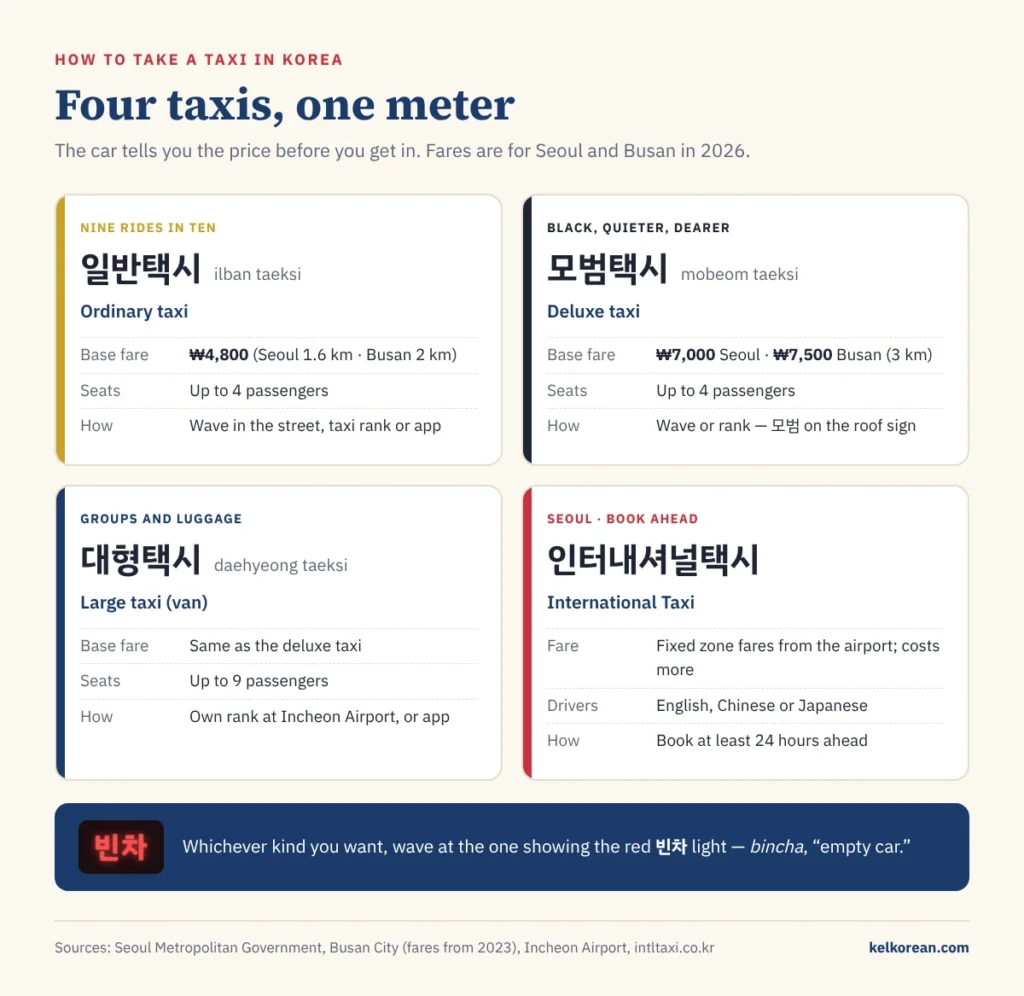
Four kinds of taxi share the road, and the difference between them is mostly the price.
The ordinary taxi, 일반택시 (ilban taeksi). This is the one you will take nine times out of ten. Officially it is a mid-size taxi, 중형택시, and it comes in whatever colour the city or the owner chose — white, silver, orange in Seoul, and more. What makes it a taxi is the sign on the roof and the meter on the dashboard. It takes up to four passengers.
The deluxe taxi, 모범택시 (mobeom taeksi). Usually black, with 모범 on the roof sign, and driven by someone with a long accident-free record. The word means “model,” as in a model citizen. The car is bigger and the ride is quieter, but the fare starts higher — ₩7,000 in Seoul and ₩7,500 in Busan — and climbs faster. There are not many left: Seoul had 573 at the start of 2026, out of more than 71,000 taxis. If one stops for you and you did not mean to hail it, it is fine to wave it on.
The large taxi, 대형택시 (daehyeong taeksi). A van with up to nine seats, charged at the same rates as a deluxe taxi. It is the one to look for if you are a family of five, or two people with four suitcases. At Incheon Airport, large taxis have their own rank.
The International Taxi, 인터내셔널택시. A Seoul service designated by the city, with drivers who speak English, Chinese or Japanese. You book it at least a day ahead, online or through its app, and trips from the airport to Seoul are charged by fixed zones rather than the meter. It costs noticeably more than an ordinary taxi, and for a first-time visitor landing late with no Korean, that can be money well spent.
You will also see premium black cars booked only by app, such as Kakao T Black. They are a different, pricier product, and you cannot hail them in the street.
Flagging One Down: Read the Red Sign
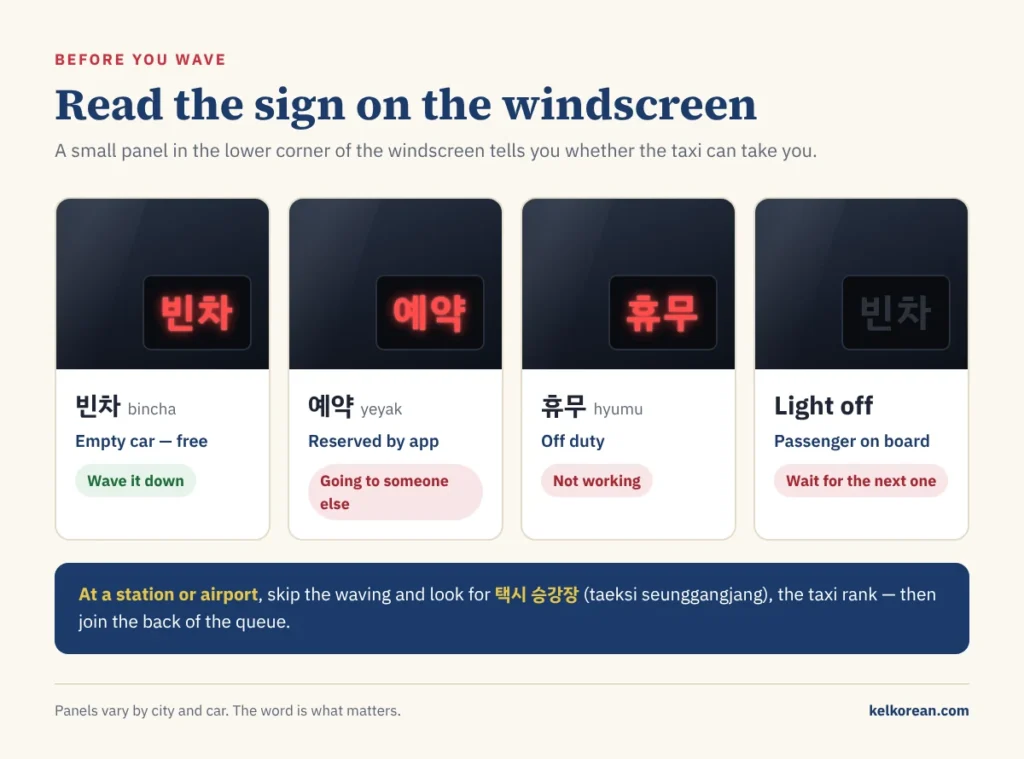
Look at the lower corner of the windscreen. A free taxi shows a small sign that lights up red with two syllables: 빈차 (bincha), literally “empty car.” That is the only sign you need to read. If the light is off, the taxi has a passenger. If it says 예약 (yeyak), “reserved,” the driver has accepted an app booking and is on his way to someone else. 휴무 (hyumu) means off duty.
Stand at the kerb where a car can pull in safely and raise your hand. That is all. Nobody whistles, and nobody steps into the road. At stations, airports and big hotels, there is usually a 택시 승강장 (taeksi seunggangjang), a taxi rank, with a sign and a queue. Join the back of it. Taking the first car that pulls up while a line of people waits is one of the few things that will draw a sharp word from a Korean stranger.
One thing works in your favour. Refusing a passenger, 승차거부 (seungcha geobu), is against the law in Korea. A driver may not turn you away because your trip is short or inconvenient. It still happens, mostly late at night in nightlife districts, and when it does it is worth knowing that it is the driver who is in the wrong, not you. Around midnight on a Friday, empty taxis in those areas can be scarce for other reasons too — everyone wants one at once — and that is exactly when I book through the app instead of standing on the corner.
Getting In: Doors, Seatbelts and the Boot
Open the door yourself. Visitors arriving from Japan, where taxi doors swing open on their own, sometimes stand and wait. In Korea the door is an ordinary car door. Most passengers sit in the back. Sitting up front on your own is not rude, but the back seat is the default.
Wear your seatbelt in the back. Since September 2018, seatbelts have been compulsory in every seat of every car on every road in Korea, taxis included, and drivers are expected to remind you. Many Koreans still skip it in the back seat on a short ride. Do not copy them.
Ask for the boot. If you have a suitcase, say 트렁크 좀 열어 주세요 (teureongkeu jom yeoreo juseyo), “please open the boot.” 트렁크 is the American trunk, borrowed into Korean. Many drivers will get out and lift the case in for you; some will simply pop the lid from inside. Both are normal.
Telling the driver where to go
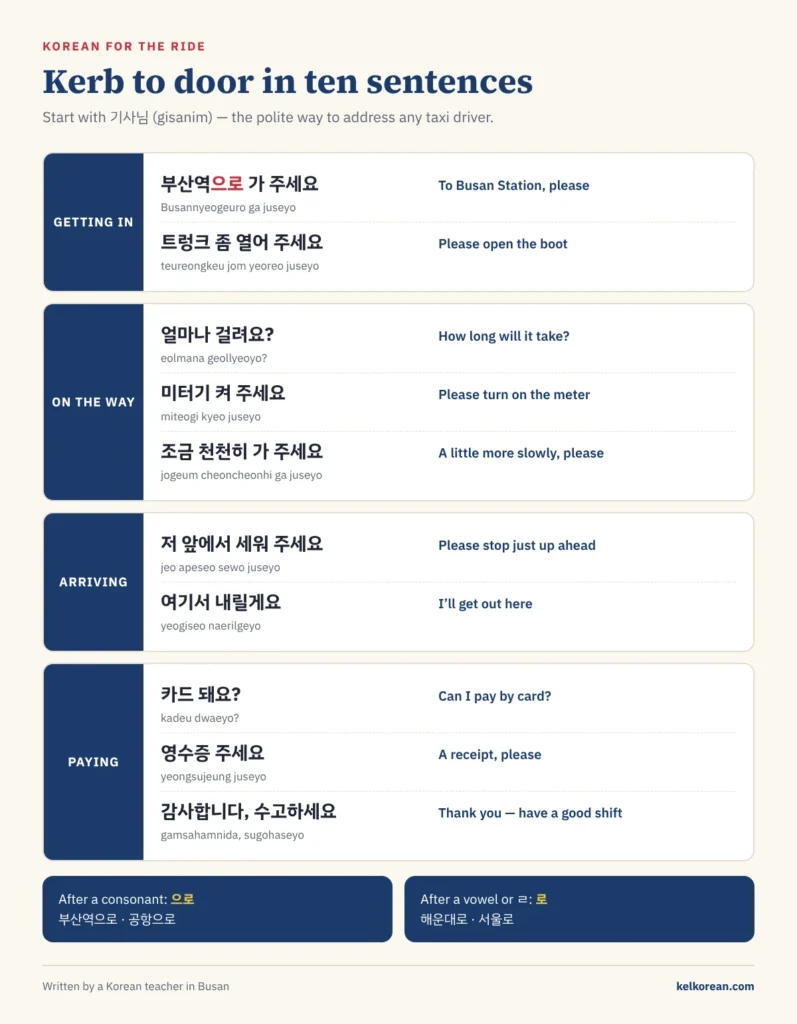
Passengers call any taxi driver 기사님 (gisanim) — the polite title for a professional driver, which our guide to Korean job titles explains. Start with that, then name the place and add 가 주세요, “please go”:
- 기사님, 부산역으로 가 주세요. — Busan Station, please.
- 기사님, 해운대로 가 주세요. — Haeundae, please.
- 기사님, 김해공항 국제선으로 가 주세요. — Gimhae Airport, international terminal, please.
Notice the small word in front of 가 주세요. It is the particle that means “to” or “towards,” and it has two forms. After a syllable ending in a consonant, it is 으로: 부산역으로, 국제선으로. After a vowel, or after ㄹ, it is just 로: 해운대로, 서울로. Get it wrong and the driver will still understand you perfectly, but this is the single piece of grammar you will use in every taxi you take. Our guide to Korean particles covers the rest of the family.
For anywhere smaller than a station or a famous beach, do not try to pronounce it. Show it. Drivers type your destination into a navigation screen, and what they need is the Korean name or the Korean address. Open the place in Naver Map, or keep a screenshot of your hotel’s Korean name, and hold up your phone. An English hotel name read aloud is the most common reason a ride starts with a puzzled silence. If the driver asks a question you do not catch, it is very likely 어디로 가세요? (eodiro gaseyo?) — “where are you going?”
What It Costs in Seoul and Busan
Every Korean city sets its own taxi fares, so the meter in Busan does not tick at the same rate as the meter in Seoul. The structure is the same everywhere: a base fare that covers the first stretch, then a small charge for every bit of distance, plus a charge for time when the car is crawling in traffic. These are the ordinary-taxi fares in the two cities most visitors use.
| Ordinary taxi | Seoul | Busan |
|---|---|---|
| Base fare | ₩4,800 for the first 1.6 km | ₩4,800 for the first 2 km |
| Then, by distance | ₩100 every 131 m | ₩100 every 132 m |
| Or, in slow traffic | ₩100 every 30 seconds | ₩100 every 33 seconds |
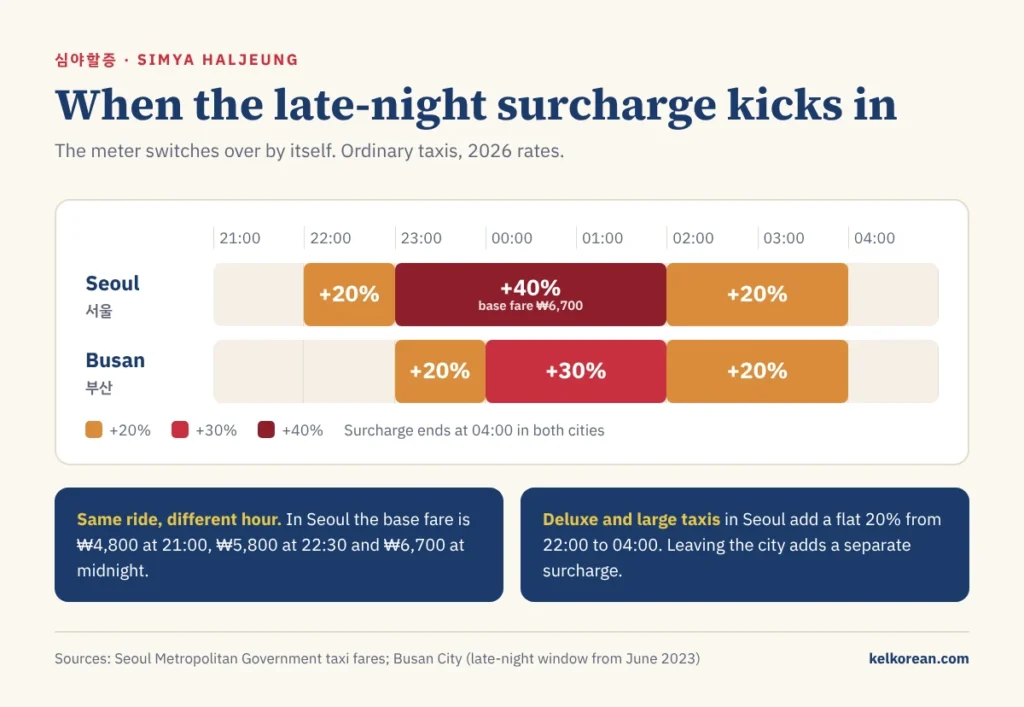
| Late-night surcharge | 22:00–04:00 — 20%, rising to 40% from 23:00 to 02:00 | 23:00–04:00 — 20%, rising to 30% from 00:00 to 02:00 |
| Deluxe and large taxis | ₩7,000 for the first 3 km | ₩7,500 for the first 3 km |
Put into a real trip, a 5 km ride on a clear road in the daytime comes to roughly ₩7,300–7,400 in Seoul and ₩7,000–7,100 in Busan — the same base fare, but Busan’s covers a longer first stretch. Add traffic and the time charge takes over, so the same ride at rush hour can cost noticeably more. That is the trade with taxis in big Korean cities: cheap when the road moves, and slow when it does not, which is often the moment the subway wins.
Three more things can appear on the bill.
- The late-night surcharge, 심야할증 (simya haljeung). The meter switches to it by itself at the set hour. In Seoul, the most expensive window is 23:00 to 02:00, when the base fare alone is ₩6,700. If you are leaving a late dinner, waiting until after 2 a.m. is not a strategy anyone recommends, but it is good to know why the same ride home costs more at midnight than at ten.
- The out-of-city surcharge, 시계외할증 (sigye-oe haljeung). If the taxi takes you beyond the edge of the city it belongs to, a surcharge applies from the boundary onwards — 20% for a Seoul taxi. A ride from the city to a neighbouring town is not just a longer ride; it is a dearer one per kilometre.
- Tolls. If the route uses a toll road, tunnel or bridge, the passenger pays the toll on top of the meter. The ride from Incheon Airport into Seoul is the one most visitors meet.
Our guide to telling time in Korean uses the same 24-hour clock you will see on the surcharge notices inside the cab.
Paying, and Getting Out
When the taxi stops, the fare is on the meter, and the card terminal sits on the dashboard or on the back of the front seat. Overseas Visa and Mastercard cards work in taxis as a matter of routine; you tap or insert the card, and the driver may hand you the terminal. A T-money transit card works too, and so does cash. Our guide to how to pay in Korea explains where foreign cards do and do not get on with Korean machines. A taxi is one of the easy places.
There is no tip, and no rounding up. If you hand over cash, wait for your change; it is coming. What Koreans often do instead is say a few words on the way out. 감사합니다 is always right. Many people say 수고하세요, roughly “keep up the good work,” which our guide to thank you in Korean explains, along with why you would not say it to your boss.
Take the receipt. Say 영수증 주세요 (yeongsujeung juseyo). The receipt carries the taxi’s details, and it is the fastest way to find the car again if you leave something behind. In January 2026, Seoul announced that its taxi receipts would start showing key details in English, including whether a surcharge was applied.
Look before you open the door. Delivery motorbikes squeeze up the inside of traffic in Korean cities, often between the taxi and the kerb. Get out on the pavement side, and glance back before you swing the door.
If you leave something in the taxi
Act quickly. If you booked by app, the ride is in your history with the driver’s details. If you paid by card, the payment can be used to identify the car. In Seoul, the city’s 24-hour helpline, 120, handles lost-property questions for taxis, and items not claimed within about a week are passed to the police, whose national lost-property site is lost112.go.kr. Anywhere in the country, the Korea Travel Hotline, 1330, can help you make the call in English.
Overcharging: Rare, but Here Is What to Watch
Most Korean taxi rides are completely uneventful. The cases that do go wrong follow a small number of patterns, and they cluster around tourist areas and airports: a meter that is never switched on, a surcharge applied when it should not be, or a flat price quoted at the start that turns out to be far above what the meter would have shown.
- Check the meter is running as you pull away. If it is not, say 미터기 켜 주세요 (miteogi kyeo juseyo), “please turn on the meter.”
- Use the official rank at airports, and ignore anyone inside the terminal offering you a ride at a fixed price.
- Know the surcharge hours. A late-night surcharge at four in the afternoon is not a surcharge.
- Report it. Seoul runs a QR-code reporting system, launched in June 2025, with codes posted inside taxis, and complaints can also go through 120. Keep the receipt; it is your evidence.
Taxis in Busan: Notes From Someone Who Lives Here
Gimhae Airport is inside Busan. The name suggests the city of Gimhae next door, but the airport sits in Gangseo-gu, Busan’s western district, so a Busan taxi from the airport into the city runs on the ordinary city meter. The rank is right outside arrivals. Haeundae, on the far eastern side of the city, is a long ride across Busan, and with traffic it can take most of an hour. If you are staying there and travelling light, compare the taxi with the light rail and subway before you commit.
KTX stations. Busan Station has a large taxi rank and a steady supply of cars. If your train stops at Gupo or Mulgeum instead — the two smaller stations on the line, and the ones I use most — I book a taxi through Kakao T rather than counting on one being there. Our guide to booking the KTX explains why those two stations are worth knowing about.
Late at night. The surcharge in Busan starts an hour later than in Seoul, at 23:00, and peaks at 30% between midnight and 2 a.m. After a long dinner — and our guide to Korean drinking etiquette explains why Korean dinners run long — I book from the table before we leave, so the car is waiting when we come out.
The accent. Many Busan drivers speak in the local dialect, and the question that opens the ride may not sound like anything in your phrasebook. You do not need to answer in dialect. Standard Korean works everywhere, and the four Busan words in our Korean phrases for travelers will help you keep up. If Busan is still in the planning stage, here is the best time to visit Busan.
The Korean You Need in a Taxi
Almost every sentence below ends in 주세요, the polite “please do this for me.” Learn that one pattern and you can make most of the requests you will ever need in a car.
| Korean | Romanisation | Meaning |
|---|---|---|
| (place)으로 / 로 가 주세요 | (place)euro / ro ga juseyo | Please go to (place) |
| 트렁크 좀 열어 주세요 | teureongkeu jom yeoreo juseyo | Please open the boot |
| 얼마나 걸려요? | eolmana geollyeoyo? | How long will it take? |
| 미터기 켜 주세요 | miteogi kyeo juseyo | Please turn on the meter |
| 조금 천천히 가 주세요 | jogeum cheoncheonhi ga juseyo | Please drive a little more slowly |
| 저 앞에서 세워 주세요 | jeo apeseo sewo juseyo | Please stop just up ahead |
| 여기서 내릴게요 | yeogiseo naerilgeyo | I’ll get out here |
| 카드 돼요? | kadeu dwaeyo? | Can I pay by card? |
| 영수증 주세요 | yeongsujeung juseyo | A receipt, please |
| 감사합니다, 수고하세요 | gamsahamnida, sugohaseyo | Thank you — have a good shift |
Two of these are worth a closer look. 세워 주세요 comes from 세우다, “to stop something” — you are asking the driver to stop the car. 내릴게요 comes from 내리다, “to get off,” with the -ㄹ게요 ending that announces what you are about to do. Both end the ride; one asks, the other tells. Our guide to essential Korean grammar patterns covers both endings.
And the words on signs, screens and receipts:
| Korean | Romanisation | Meaning |
|---|---|---|
| 빈차 | bincha | Free (taxi available) |
| 예약 | yeyak | Reserved |
| 휴무 | hyumu | Off duty |
| 택시 승강장 | taeksi seunggangjang | Taxi rank |
| 기본요금 | gibon yogeum | Base fare |
| 심야할증 | simya haljeung | Late-night surcharge |
| 시계외할증 | sigye-oe haljeung | Out-of-city surcharge |
| 통행료 | tonghaengnyo | Toll |
| 승차거부 | seungcha geobu | Refusing a passenger |
| 영수증 | yeongsujeung | Receipt |
Red Light, Seatbelt, Receipt
If you keep three things from this guide, make them these. Wave at the taxi with the red 빈차 light. Buckle up in the back. And take the 영수증 when you get out, because it is the one piece of paper that can find your phone, your umbrella or your overcharged fare again. In between, all you need is the name of the place, a little 으로 or 로, and 가 주세요.
Before you go, set up the apps that book the taxi for you, and sort out how you will pay. The ride itself is the easy part.
Written by Minhyung Cha — 25 years teaching Korean, and 15+ years running an English academy in South Korea. I live and work in Busan, and every example on this site is checked as a native speaker. More about KEL.
Leave a Reply