
Korean signs are the cheapest Korean lesson you will ever get. They are short, they repeat the same few building blocks over and over, and most of them come with an English line underneath, so you can check your reading on the spot. On Hangul Day this year, my husband and I spent two hours walking along Haeundae Beach in Busan while we waited for a table, and I photographed every sign we passed. Read together, they cover a surprising amount of real Korean.
This is that walk, sign by sign: what each one says, how it is built, and which pieces you can lift out and use to read the next sign on your own. If you can already sound out Hangul, you will be able to follow every word. If you cannot yet, our guide to learning Hangul in a week gets you there.
Why Signs Are Easier Than They Look
Most Korean signs are written in a compressed, formal style built from Sino-Korean words — vocabulary made from Chinese characters, each syllable carrying its own meaning. That sounds like a reason to give up. It is the opposite. Because each syllable means something, the same syllable turns up again and again in different words, and once you know a dozen of them, signs start to decode themselves. You saw this already if you read our guide to Korean numbers: 일, 이, 삼 are Sino-Korean too.
Signs also drop almost all the grammar that makes spoken Korean hard. No sentence endings, no particles, often no verbs. A sign is usually two or three nouns stacked together: “motorbike bicycle entry prohibition.” Your job is just to recognise the nouns.
Sign 1: 음주 수영 금지 — No Swimming After Drinking
The first sign on the sand was a long banner facing the water:
여러분의 안전을 위해 음주 수영을 금지합니다
For your safety, do not swim after drinking
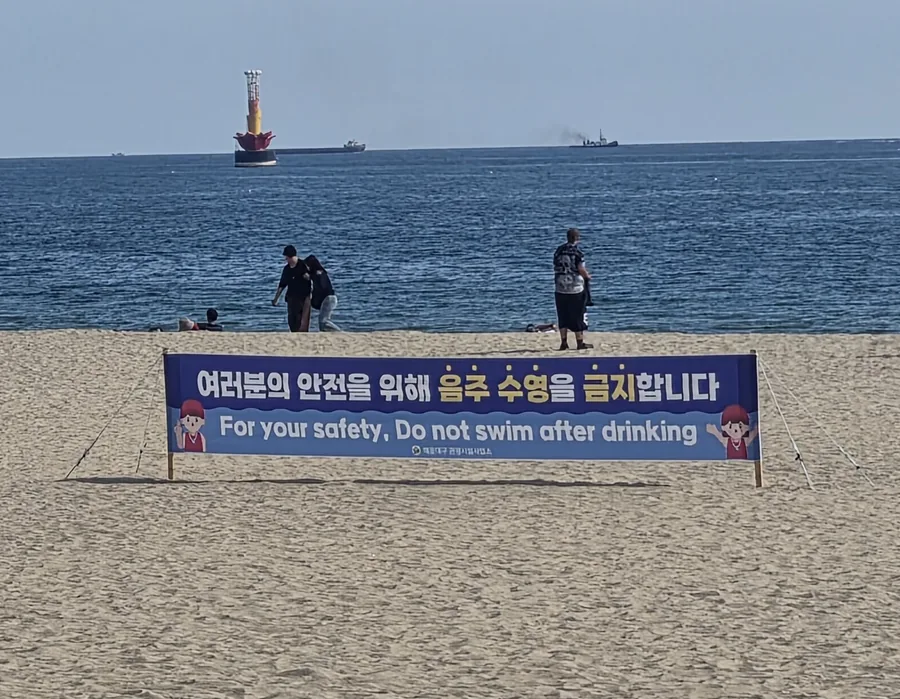
Take it apart and every piece is reusable.
- 여러분 (yeoreobun) — “everyone,” the polite “you” used to address a crowd. Teachers say it to a class, and announcers say it on the subway.
- 안전 (anjeon) — safety. You will see it on construction fences, in lifts and on every ferry.
- 을 위해 (eul wihae) — “for the sake of.” Put any noun in front: 건강을 위해, for your health; 환경을 위해, for the environment. It is one of the most useful patterns on Korean signs.
- 음주 (eumju) — drinking alcohol, literally “drink-alcohol.” The same word is in 음주운전, drink-driving.
- 수영 (suyeong) — swimming.
- 금지합니다 (geumjihamnida) — “we prohibit.” The noun 금지 plus 하다, in the formal ending you will see on official notices.
금지 is the single most valuable word on this walk. On its own, after a noun, it means “no ___.” 흡연 금지, no smoking. 주차 금지, no parking. 촬영 금지, no photography. If you learn one word from this page, make it this one. And if Korean drinking culture is new to you, our guide to Korean drinking etiquette explains why a beach banner needs to say this at all.
Sign 2: 진입금지 — and a ₩50,000 Fine
Where the promenade meets the sand, a yellow-and-black barrier carried a sign with four crossed-out pictures:
오토바이·자전거·전동킥보드 진입금지
위반 시 5만원의 과태료가 부과될 수 있습니다.
Motorcycles, bicycles and electric scooters are not allowed. You may be fined 50,000 won for violating the law.
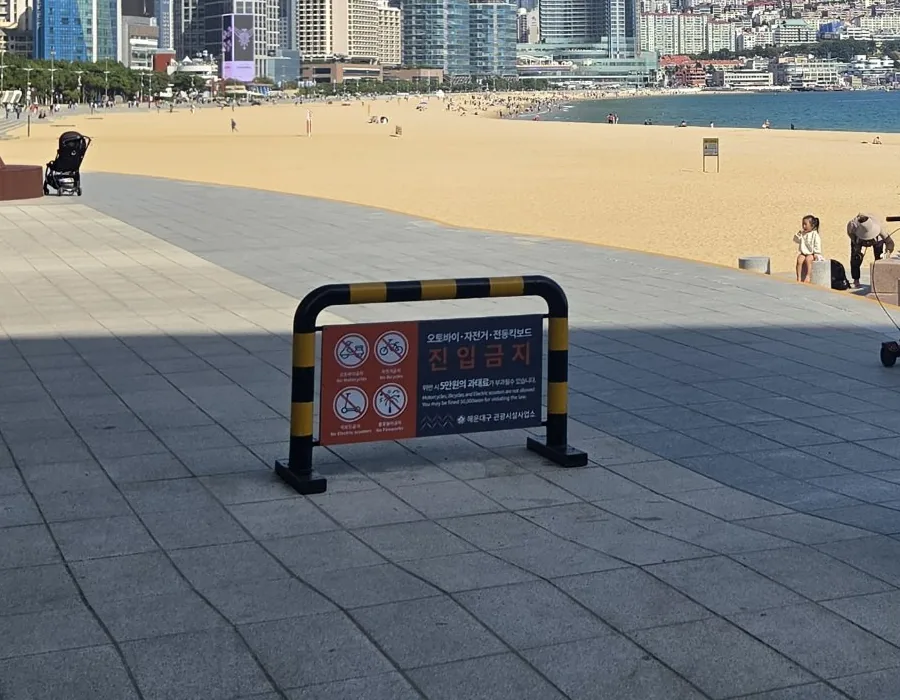
The first line is three loanwords and a compound. 오토바이 is a motorbike, borrowed through Japanese from an English-made word, “auto-bicycle.” 자전거 is a bicycle. 전동킥보드 is an electric kick scooter: 전동, “electric-powered,” plus 킥보드, the Korean name for a kick scooter. Then 진입금지, “entry prohibited”: 진입 means to enter or drive into, and you will see the same two words on road signs at the wrong end of one-way streets. Under the pictures, the small labels follow the same pattern as Sign 1 — 오토바이금지, 자전거금지 — and the fourth one is 불꽃놀이금지, no fireworks. 불꽃 is “flame,” 놀이 is “play.”
The second line is a full sentence, and a useful one:
- 위반 시 — “in case of violation.” 시 after a noun means “when” or “at the time of,” and it is everywhere on notices: 비상 시, in an emergency; 화재 시, in case of fire.
- 5만원 — 50,000 won. Korean groups large numbers in units of ten thousand, 만, not thousands. So 5만 is five ten-thousands. This trips up every visitor reading a price tag.
- 과태료 (gwataeryo) — an administrative fine, the kind you get for a parking offence rather than a crime.
- 부과될 수 있습니다 — “may be imposed.” The -ㄹ 수 있다 pattern means “can” or “may,” and it softens a lot of official warnings.
At the bottom, in small print, is who put the sign there: 해운대구 관광시설사업소, the Haeundae district office that runs the beach’s tourist facilities. Signs in Korea almost always name the office responsible, which is handy if you ever need to complain about one.
Sign 3: 무료 탈의장 — The Free Changing Tents
Two white tents stood at the edge of the sand, one with a blue banner and one with a pink one:
무료 탈의장 男 · 무료 탈의장 女
Free Changing Area
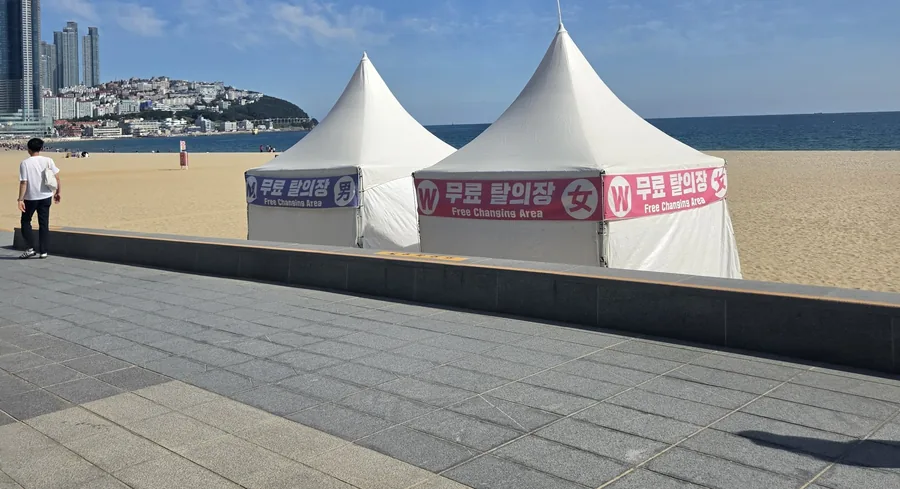
Three lessons in four syllables.
무료 (muryo) means free of charge. Its opposite is 유료, paid. Look closely and you can see why: 무 means “without” and 유 means “with,” and 료 is a fee. Once you know 무, you can read 무선 (wireless), 무인 (unmanned — a 무인 shop has no staff) and 무설탕 (sugar-free). We will meet 무 again at the tourist office.
탈의장 (taruijang) is a changing area: 탈, to take off, plus 의, clothes, plus 장, a place. In a shop, the changing room is a 탈의실 instead — 실 is a room, so a 탈의실 is indoors and private, while a 탈의장 can be a tent on a beach. Our guide to shopping in Korean has the shop version.
And the Chinese characters 男 and 女, man and woman, read 남 and 여 in Korean. They are on public toilets, saunas and changing rooms across the country, often without any Hangul at all, so they are worth knowing on sight.
Signs 4 to 6: The Tourist Information Centre
In the middle of the beach is the building every visitor should know about, and it has more signs on it than anywhere else on the walk. The tower carries a huge blue panel that says 해운대 진짜 좋다 — “Haeundae is really great.” It is the most casual sentence on the beach: 좋다 is the plain dictionary form of “to be good,” the style you use in a diary or a headline, and 진짜, “really,” is everyday speech. Underneath, in small print, is the district slogan: 살기 좋은 도시, 오고 싶은 도시, “a good city to live in, a city you want to come to.” Two patterns in one line: -기 좋다, “good for doing,” and -고 싶다, “to want to.”
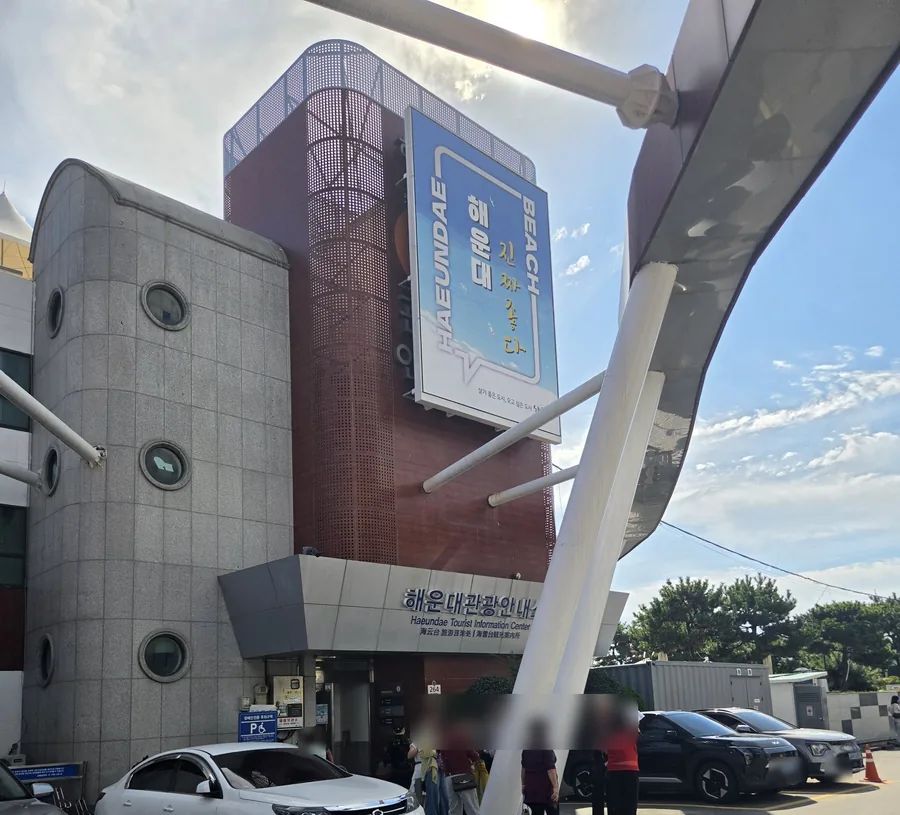
Below it, over the entrance, is 해운대관광안내소, Haeundae Tourist Information Centre. Split it: 해운대 + 관광 (tourism) + 안내 (guidance, information) + 소 (a place, an office). Next door is 해운대여름경찰서, the Haeundae Summer Police Station — 여름 is summer, 경찰 is police, and 서 is an office or station. It is a police post for the beach season, and its name is a nice example of how freely Korean stacks nouns.
By the door were two vertical banners. One read 물품보관함 LOCKER: 물품 (goods, belongings) + 보관 (keeping, storage) + 함 (a box). Coin lockers at stations use the same word. The other said 무자격가이드 불법관광 OUT — “unlicensed guides, illegal tourism: out.” There is our 무 again: 무자격, “without qualification.” And 관광 again, from the building’s own name. You are now reading signs by their parts.
The yellow board: 화장실은 옆으로 20M
In front of the entrance stood a yellow A-board with a big arrow:
화장실은 ← 옆으로 20M!!
The restroom is 20m away.
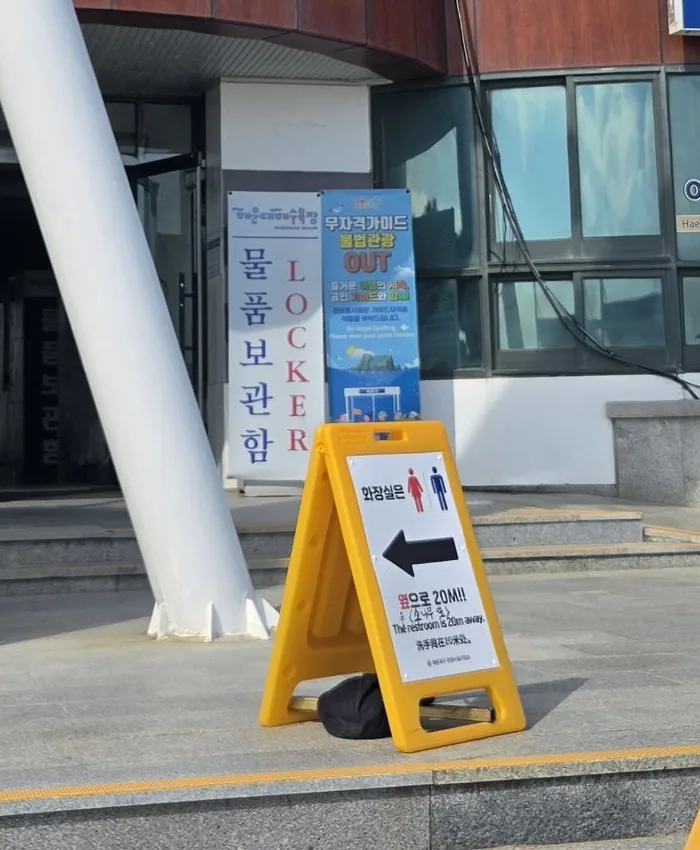
This is the only sign on the walk with real grammar in it, and it is beginner grammar. 화장실 is the toilet — that 실 again, a room. 은 is the topic marker: “as for the toilet…” 옆 means “side” or “next to,” and 으로 means “towards,” the same particle you use to tell a taxi where to go. So: “As for the toilet — to the side, 20 metres!” Someone had added a handwritten note under the arrow, 소나무 옆, “next to the pine tree,” which tells you everything about how helpful Korean beach staff are. Our guide to Korean particles covers 은 and 으로 properly.
Further along we passed the toilet building itself, labelled 해운대 제2호 공중화장실: Haeundae Public Toilet No. 2. 공중 means public, and 제 in front of a number makes it an ordinal, so 제2호 is “number two.”
Signs 7 and 8: 바다황톳길 and 바다수국길
Behind the beach, in the pine trees, two large sculptures name two walking paths: 바다황톳길 and 바다수국길. 바다 is the sea and 길 is a path or road. 수국 is hydrangea, and 황토 is yellow clay — the 바다황톳길 is a path laid with clay for walking barefoot, a kind of walk that has become popular across Korea.
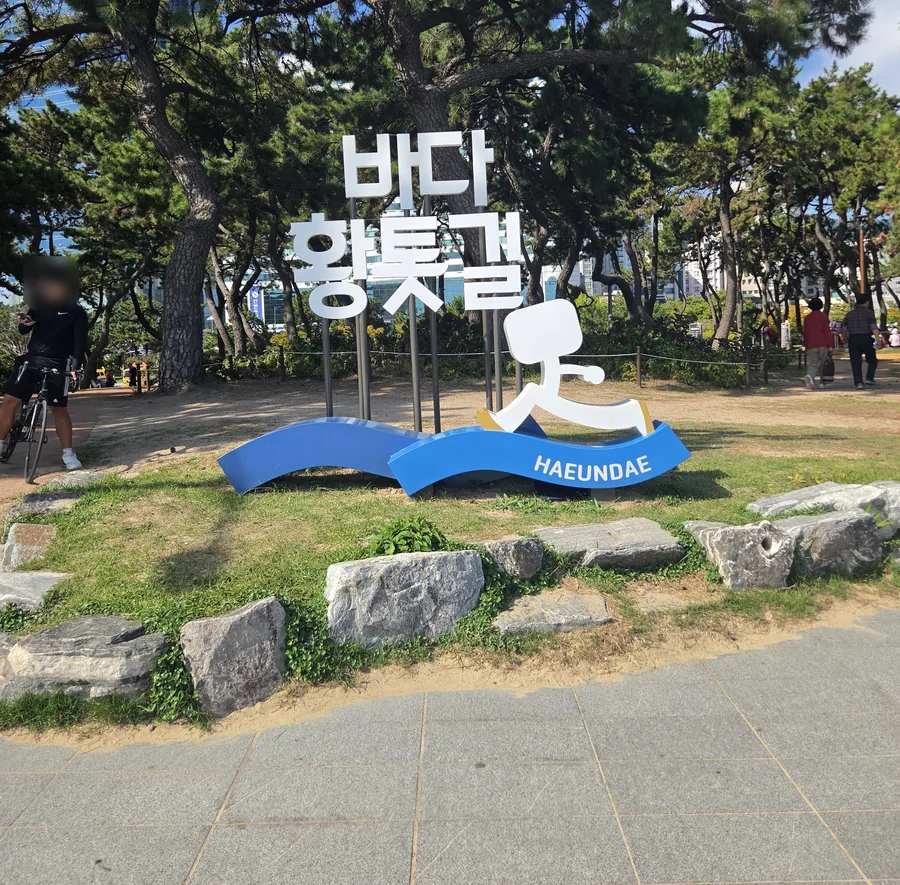
Look at the spelling, though. 황토 plus 길 should give 황토길, but the sign says 황톳길, with an extra ㅅ under 토. That ㅅ is called 사이시옷, the “in-between ㅅ.” When two nouns join and the second one’s first sound gets stronger in pronunciation — here 길 is said more like 낄 — Korean spelling often marks it with a ㅅ under the first noun. You will see it in 바닷가 (seaside), 햇빛 (sunlight) and 촛불 (candlelight). Our guide to Korean pronunciation rules covers the sound changes behind it.
Three More on the Way Out
- 자전거횡단 — on a blue triangle by the crossing: bicycle crossing. 횡단 means to cross, and a pedestrian crossing is a 횡단보도.
- 장애인 전용 주차구역 — on a parking sign at the marina: parking for disabled drivers only. 전용 means “exclusively for,” and you will see it on bus lanes (버스 전용) and women-only spaces (여성 전용).
- 1330 부산관광안내전화 and 120 불편신고전화 — on the city tourist map under the pine trees. 1330 is the Korea Travel Hotline, with English-speaking staff, and 120 is Busan’s complaints and inquiries line. 전화 is a phone, 신고 a report.
The Building Blocks, All in One Place
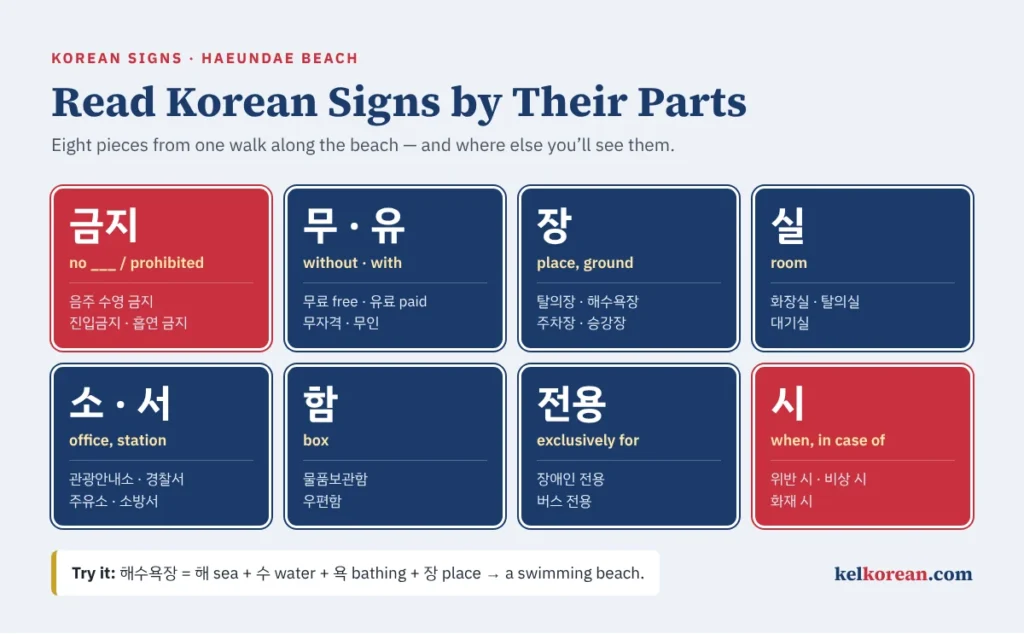
Everything on this walk came down to a small set of pieces. Learn these and you can read a large share of the signs in any Korean city.
| Piece | Meaning | Seen on this walk | Also on |
|---|---|---|---|
| 금지 | No ___, prohibited | 음주 수영 금지, 진입금지 | 흡연 금지, 주차 금지 |
| 무 / 유 | Without / with | 무료, 무자격 | 유료, 무인, 무선 |
| 장 | Place, ground | 탈의장, 해수욕장 | 주차장, 승강장 |
| 실 | Room | 화장실 | 탈의실, 대기실 |
| 소 / 서 | Office, station | 관광안내소, 경찰서 | 주유소, 소방서 |
| 함 | Box | 물품보관함 | 우편함 |
| 전용 | Exclusively for | 장애인 전용 | 버스 전용 |
| 을/를 위해 | For the sake of | 안전을 위해 | 건강을 위해 |
| 시 | When, in case of | 위반 시 | 비상 시 |
| (으)로 | Towards | 옆으로 | 출구로 |
One word from the table deserves a footnote. 해수욕장, the Korean for a swimming beach, is built from the same blocks: 해 (sea) + 수 (water) + 욕 (bathing) + 장 (place). A “sea-water-bathing place.” Haeundae’s official name is 해운대해수욕장, and now you can read it.
Read the Parts, Not the Whole
The trick with Korean signs is not to memorise them whole. Look for the piece you know — 금지, 무, 장, 실, 소 — and let it tell you what kind of sign you are looking at before you work out the rest. Most visitors walk past these signs and read only the English line. Try reading the Korean first and checking the English after. A walk along any beach, station or market in Korea becomes a lesson you did not have to pay for.
If Haeundae is on your list, here is the best time to visit Busan, and the gomtang restaurant we were waiting for is in our guide to Geodae Gomtang in Haeundae.
Written by Minhyung Cha — 25 years teaching Korean, and 15+ years running an English academy in South Korea. I live and work in Busan, and every example on this site is checked as a native speaker. More about KEL.
Leave a Reply