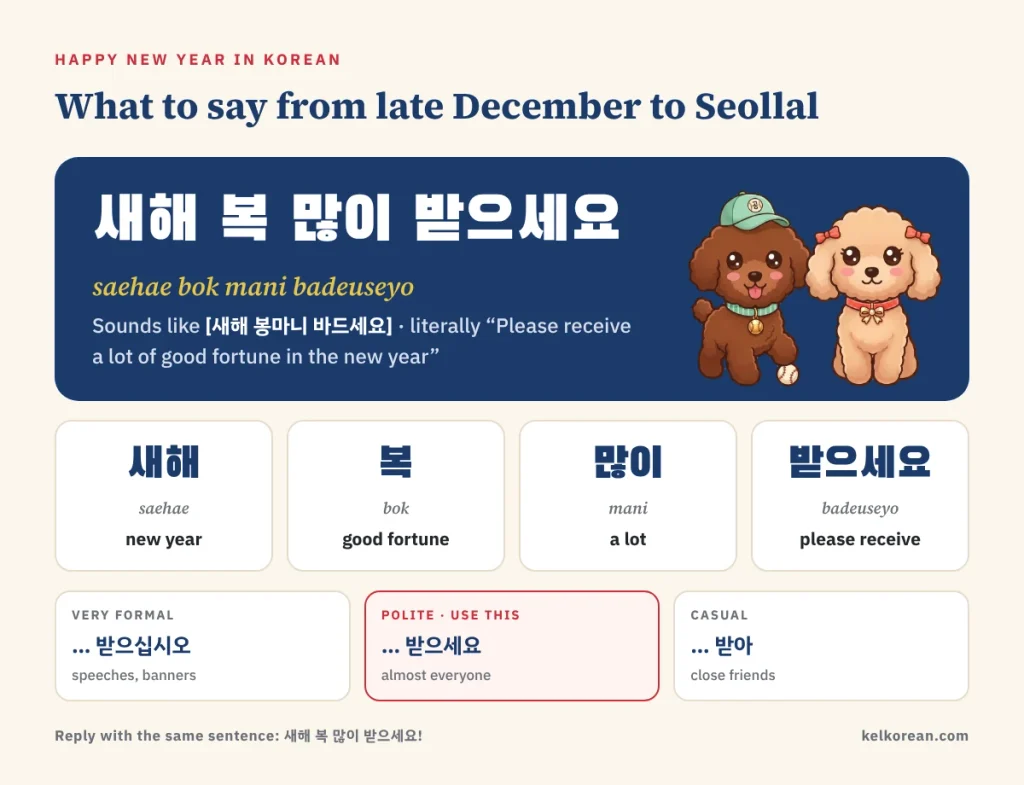
Happy New Year in Korean is 새해 복 많이 받으세요 (saehae bok mani badeuseyo). You will hear it everywhere from the last week of December until well into February, because Korea celebrates the new year twice: once on 1 January and again at 설날 (Seollal), the Lunar New Year. Shop assistants say it, teachers say it, TV hosts say it at midnight, and children say it while bowing to their grandparents.
I have taught Korean for 25 years, and this is the greeting I send every year to my parents, my students’ parents and my colleagues. This guide explains what the phrase really means, how to say it to different people, the other wishes Koreans add, and how the two New Years are spent, from the late-night TV countdown to the crowds at the sunrise spots.
What 새해 복 많이 받으세요 Actually Means
English wishes someone a happy year. Korean wishes them luck, and a lot of it. Here is the phrase word by word:
| Korean | Romanisation | Meaning |
|---|---|---|
| 새해 | saehae | new year (새 “new” + 해 “year”) |
| 복 | bok | good fortune, blessings |
| 많이 | mani | a lot |
| 받으세요 | badeuseyo | please receive (polite) |
So the literal meaning is “Please receive a lot of good fortune in the new year.” The word 복 is everywhere in Korean life. You will see the character 福 on spoons, rice bowls and pillowcases, and 복 is the word inside 행복 (haengbok), “happiness.”
Two sound changes make the spoken version different from the spelling. 복 많이 is pronounced [봉마니], because a ㄱ before ㅁ turns into ㅇ, and the ㅎ in 많이 goes silent. Put together, the phrase sounds like [새해 봉마니 바드세요]. Our guide to Korean pronunciation rules explains both changes, and once you know them you will hear them in every New Year greeting on TV.
Two more things surprise learners. First, you can say it before the new year starts. From about Christmas onwards, it works as “Have a happy New Year,” and people say it on the last working day of December as they leave. Second, the usual reply is the same sentence back: 새해 복 많이 받으세요, or 선생님도 새해 복 많이 받으세요, “You too, teacher.” A simple 감사합니다 is fine too, and our guide to thank you in Korean has the other ways to say it.
Formal, Polite and Casual Versions
Like every Korean sentence, this one changes its ending depending on who you are talking to. The front half stays the same.
| Korean | Level | When to use it |
|---|---|---|
| 새해 복 많이 받으십시오 | Very formal | Speeches, news anchors, banners, company messages |
| 새해 복 많이 받으세요 | Polite | Almost everyone: teachers, neighbours, shop staff, your friend’s parents |
| 새해 복 많이 받아 | Casual | Close friends, younger siblings, people younger than you |
| 새해 복 많이 받아라 | Elder to child | Grandparents and parents to children, often during the New Year bow |
If you are not sure, use 받으세요. It is polite without being stiff, and nobody will think it is odd. The casual 받아 is for people you already speak 반말 with, and our guide to banmal explains who that is. The -시- inside 받으세요 and 받으십시오 is the honorific marker, covered in Korean honorifics explained simply.
You may also see 근하신년 (geunhasinnyeon) on cards and banners. It comes from Chinese characters meaning “respectfully celebrating the new year,” and it is written, not said. Young people also say 해피 뉴 이어 (haepi nyu ieo), the English phrase in Korean letters, to friends.
Other New Year Wishes Koreans Add
새해 복 많이 받으세요 is rarely said alone in a message. Koreans usually add a second wish, and the end of the year has its own phrases too.
- 건강하세요 (geonganghaseyo): Stay healthy. The most common add-on, especially to older people.
- 소원 성취하세요 (sowon seongchwihaseyo): May your wishes come true.
- 좋은 일만 가득하세요 (joeun ilman gadeukaseyo): May your year be full of only good things.
- 올해도 잘 부탁드립니다 (olhaedo jal butakdeurimnida): I look forward to working with you again this year. Used with colleagues, clients and teachers.
- 올 한 해 수고 많으셨습니다 (ol han hae sugo maneusyeotseumnida): Thank you for all your hard work this year. Said in late December.
- 한 해 마무리 잘하세요 (han hae mamuri jalhaseyo): Wrap up the year well. Another December phrase.
The New Year Message I Actually Send
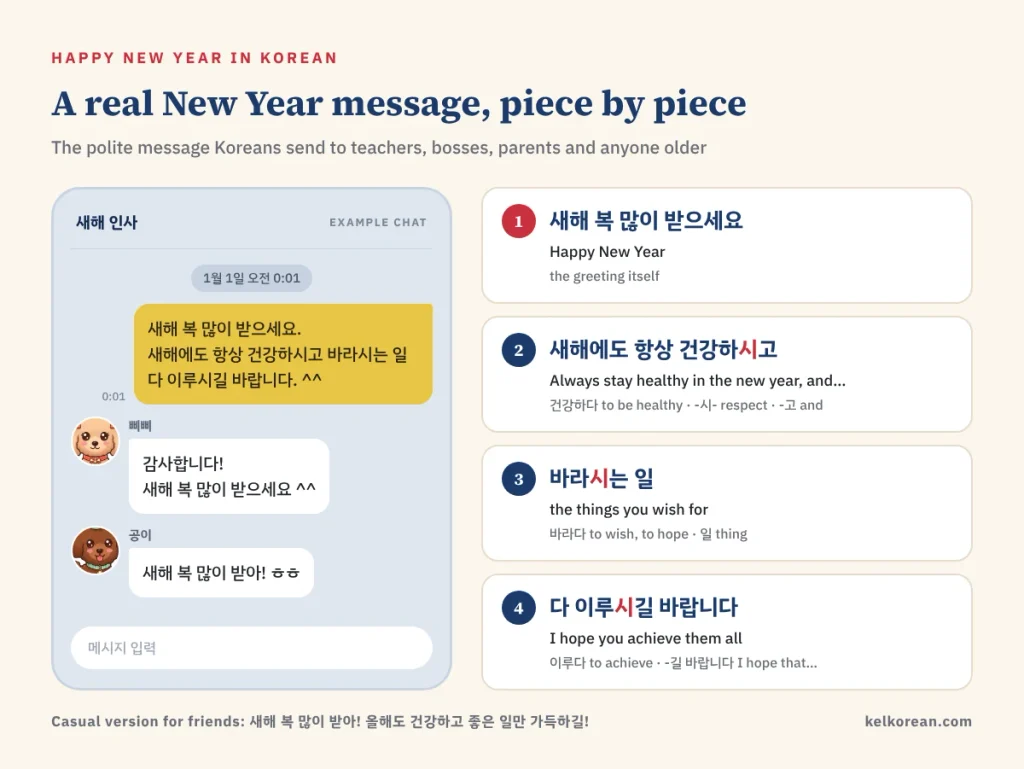
Most New Year greetings in Korea now arrive on KakaoTalk, the messaging app nearly everyone uses, and at midnight on 31 December phones start buzzing with messages. People often send a cute animated sticker with the words. Here is the message I send, word for word:
새해 복 많이 받으세요. 새해에도 항상 건강하시고 바라시는 일 다 이루시길 바랍니다.
Happy New Year. I hope you stay healthy in the new year and that everything you wish for comes true.
It is a very standard message, and that is exactly why it is useful. You can send it to a teacher, a boss, your partner’s parents or anyone older than you. Here is how it is built:
- 새해에도 항상 건강하시고: “Always be healthy in the new year, and…” 건강하다 is “to be healthy,” -시- adds respect, and -고 means “and.”
- 바라시는 일: “the things you wish for.” 바라다 is “to wish” or “to hope,” again with -시- for respect.
- 다 이루시길 바랍니다: “I hope you achieve them all.” 이루다 is “to achieve,” and -길 바랍니다 is a polite way of saying “I hope that…”
For a friend, you would drop the formality: 새해 복 많이 받아! 올해도 건강하고 좋은 일만 가득하길! The texting shortcuts in our guide to Korean texting slang, like ^^ and ㅎㅎ, work here too.
Two New Years: 1 January and Seollal
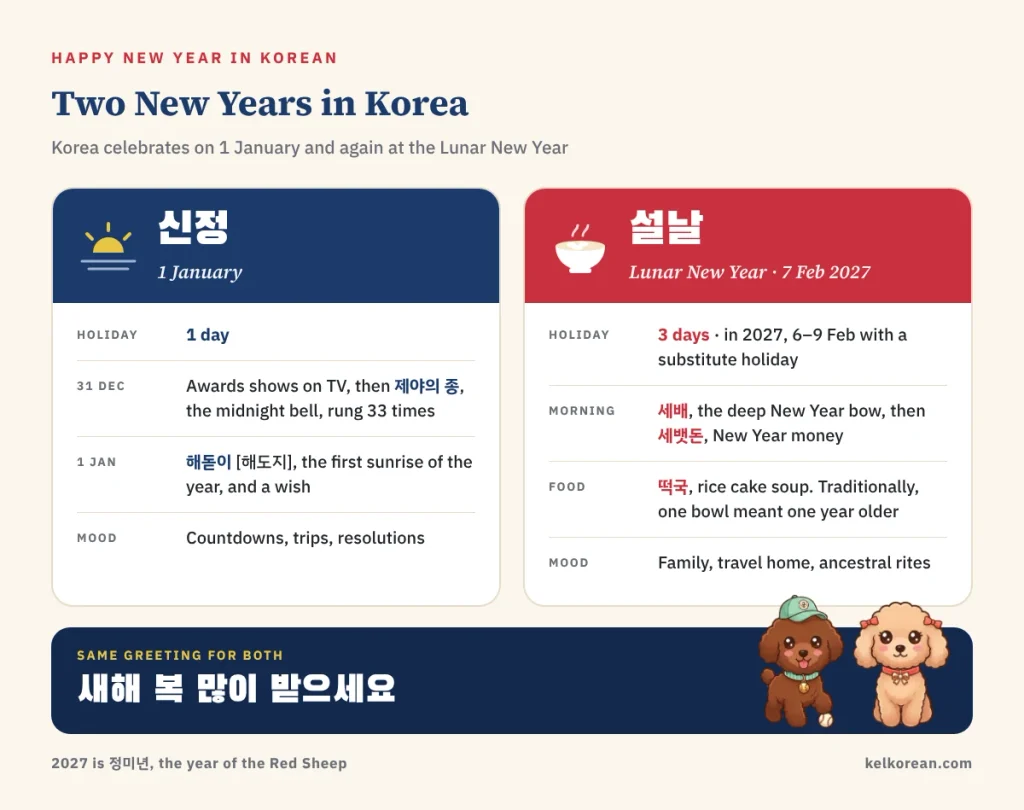
Korea follows the solar calendar, but its biggest family holiday still follows the moon. The two days are often called 신정 (sinjeong, the “new” New Year) and 구정 (gujeong, the “old” New Year), although the official name of the second is 설날.
| 신정: 1 January | 설날: Lunar New Year | |
|---|---|---|
| Date | 1 January | Changes every year. In 2027 it falls on Sunday 7 February. |
| Holiday | 1 day | 3 days. In 2027, 6–9 February, with 9 February as a substitute holiday. |
| Mood | Countdowns, sunrise trips, resolutions | Family gatherings, travel home, ancestral rites |
| Customs | Watching the bell ring at midnight, 해돋이 (the first sunrise) | 세배 (the New Year bow), 세뱃돈 (New Year money), 떡국 (rice cake soup) |
| Greeting | 새해 복 많이 받으세요 for both | |
Because of this, you will say the greeting twice, and nobody minds. If you are in Korea for 설날, book trains early: tickets for the holiday sell out fast, and our guide to booking the KTX explains how. 설날 is also one of the two days for 차례, the holiday ancestral rite, which our Chuseok guide covers in detail.
2027 is the year of 정미년 (jeongminyeon), the Red Sheep, so you will see sheep on cards and shop windows. Strictly speaking, the animal year follows the lunar calendar, so it begins around 설날 rather than on 1 January.
How Koreans See In the New Year
December: 송년회, the year-end party
December is the season of 송년회 (songnyeonhoe), a get-together to “send off the year” with colleagues or friends. Whether it is with the teachers I have worked with or with my friends, we usually go to a 고깃집 (gogitjip), a Korean barbecue restaurant. There is often a glass raised to the year, and our guide to Korean drinking etiquette will help if you are invited.
31 December: awards shows and the bell
My 31 December is spent at home. We order something delicious for delivery and watch TV, because that is the night the big networks show their year-end awards shows for dramas and entertainment programmes. Just before midnight, the awards show cuts away to a special live broadcast of the bell ringing. When the bell finishes, the show comes back, and the actors and hosts on stage turn to each other and say 새해 복 많이 받으세요. It is one of my favourite small moments of the year.
The bell is called 제야의 종 (jeyaui jong), “the bell of New Year’s Eve.” In Seoul it is struck 33 times at Bosingak in Jongno, and in Busan the same 33 strikes ring out from the Citizens’ Bell in Yongdusan Park, with a countdown, a concert and fireworks. Both draw big crowds, and the Busan event has limited the number of people allowed into the park.
1 January: chasing the first sunrise
On the morning of 1 January, a huge number of Koreans go to see 해돋이 (haedoji), the first sunrise of the year, and make a wish. I have watched it from Geoje Island, from Haeundae Beach in Busan and from Ganjeolgot in Ulsan, which is said to see the sun earlier than anywhere else on the mainland. In 2026 the sun rose there at about 7:31.
The trick is getting there. Sometimes we book a room nearby and stay the night before. If we go on the day, we leave home at about 5 in the morning. Even so, the crowds are enormous. At the popular spots, people walk slowly in a single line, step by step, towards the sea.
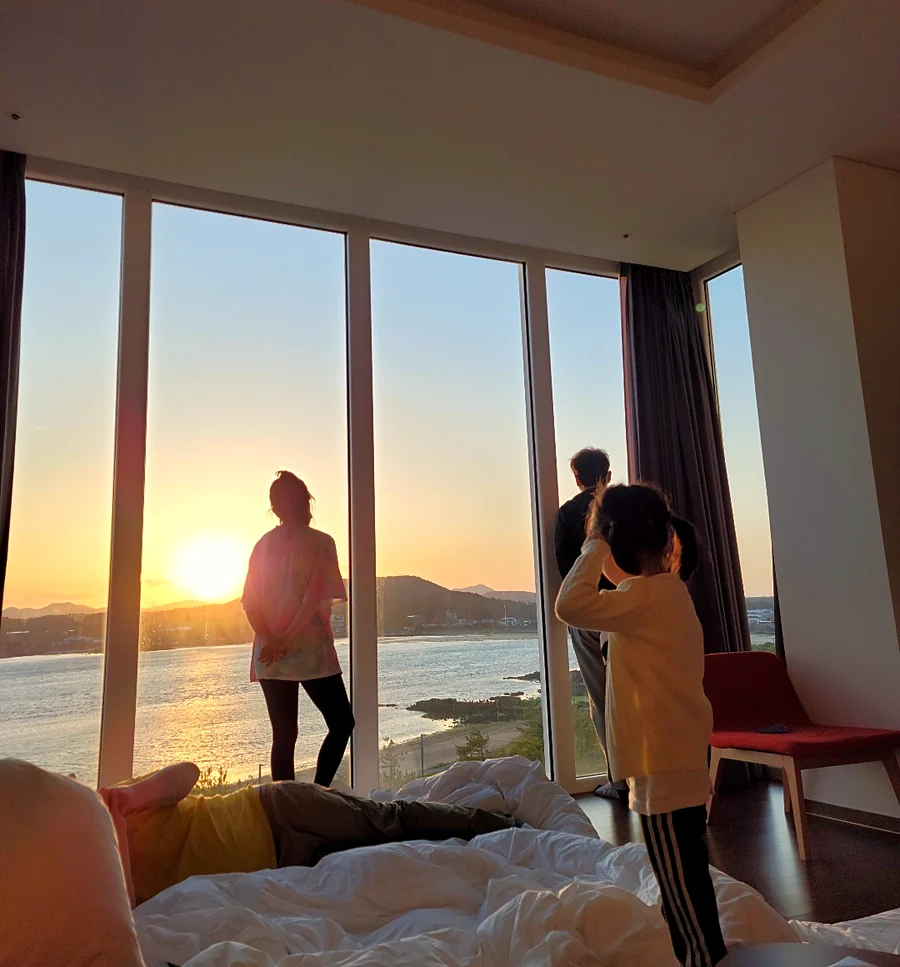
One year we flew to Jeju Island on 31 December and stayed in a hotel by the sea. On the morning of 1 January it was so cold that we did not go outside at all. Instead, we stood at the big windows of our room and watched the first sunrise of the year from there.
If you go, dress for the coldest morning of your trip, arrive at least 30 minutes before sunrise and expect traffic and full car parks. And when you tell a Korean friend about it, remember that 해돋이 is pronounced [해도지].

Seollal: The Bow, the Money and the Soup
On the morning of 설날, younger family members perform 세배 (sebae), a deep bow to their elders, kneeling and touching their hands to the floor. As they bow, they say 새해 복 많이 받으세요. The elders answer with 덕담 (deokdam), words of blessing such as 올해도 건강해라 (stay healthy this year), and give the children 세뱃돈 (sebaetdon), New Year money, usually in a clean envelope.
In my family, I am on both sides of the bow. I bow to my parents and give them 용돈 (yongdon), spending money, which is how grown-up children look after their parents. Then my young nieces and nephews bow to me, and I give them their 세뱃돈. A 2026 survey suggested about ₩10,000 to ₩30,000 for preschool and lower elementary children, ₩30,000 to ₩50,000 for upper elementary, and ₩50,000 to ₩100,000 for teenagers, but every family has its own rules.
Then there is 떡국 (tteokguk), soup with thin slices of rice cake, eaten on New Year’s morning. Traditionally everyone became a year older at the New Year, so eating your 떡국 meant gaining a year. That is why an older relative might ask a child 떡국 몇 그릇 먹었어?, “How many bowls of 떡국 have you eaten?”, as a playful way of asking their age. Since June 2023, official ages in Korea use the international system, but the joke has survived. Our guide to Korean age explains what changed.
New Year Words in Korean
| Korean | Romanisation | Meaning |
|---|---|---|
| 새해 | saehae | new year |
| 연말 | yeonmal | the end of the year |
| 송년회 | songnyeonhoe | year-end party |
| 제야의 종 | jeyaui jong | the New Year’s Eve bell |
| 해돋이 | haedoji | sunrise |
| 신정 | sinjeong | 1 January New Year |
| 설날 | seollal | Lunar New Year |
| 세배 | sebae | the New Year bow |
| 세뱃돈 | sebaetdon | New Year money |
| 덕담 | deokdam | words of blessing |
| 떡국 | tteokguk | rice cake soup |
| 새해 목표 | saehae mokpyo | New Year’s resolution |
Say It Early, Say It Twice
If you remember one thing from this guide, make it 새해 복 많이 받으세요. Start saying it after Christmas, say it again on 1 January, and say it once more at 설날. Add 건강하세요 for older people, switch to 받아 for close friends, and send it on KakaoTalk at midnight like everyone else. If you are in Korea over the holidays, our Christmas in Korea guide covers the week before. And to everyone reading this from wherever you are: 새해 복 많이 받으세요.
Written by Minhyung Cha — 25 years teaching Korean, and 15+ years running an English academy in South Korea. I live and work in Busan, and every example on this site is checked as a native speaker. More about KEL.
Leave a Reply