
I love you in Korean is 사랑해 (saranghae). That part takes one line. The harder part is everything around it: which ending to put on it, who you can say it to, when in a relationship it is supposed to arrive, and why so many Koreans of my parents’ generation went a lifetime without saying it at all.
For Korean parents of that older generation, love was not something you said. It was something you did. It looked like a hot meal on the table when you came home late, a coat pushed into your hands on a cold morning, a phone call that opened with “Have you eaten?” and closed without a single soft word. Today’s young Korean parents are completely different. They say 사랑해 to their children constantly, and the children say it straight back.
I am somewhere in between. I say 사랑해 to my husband often, out loud and by text, and I say it to my two toy poodles more times a day than I would admit in public. This guide covers the four forms of the phrase, the order in which Korean couples use their love words, who can and cannot hear it from you, the everyday phrases that carry the feeling without the word, and how to answer when someone says it first.
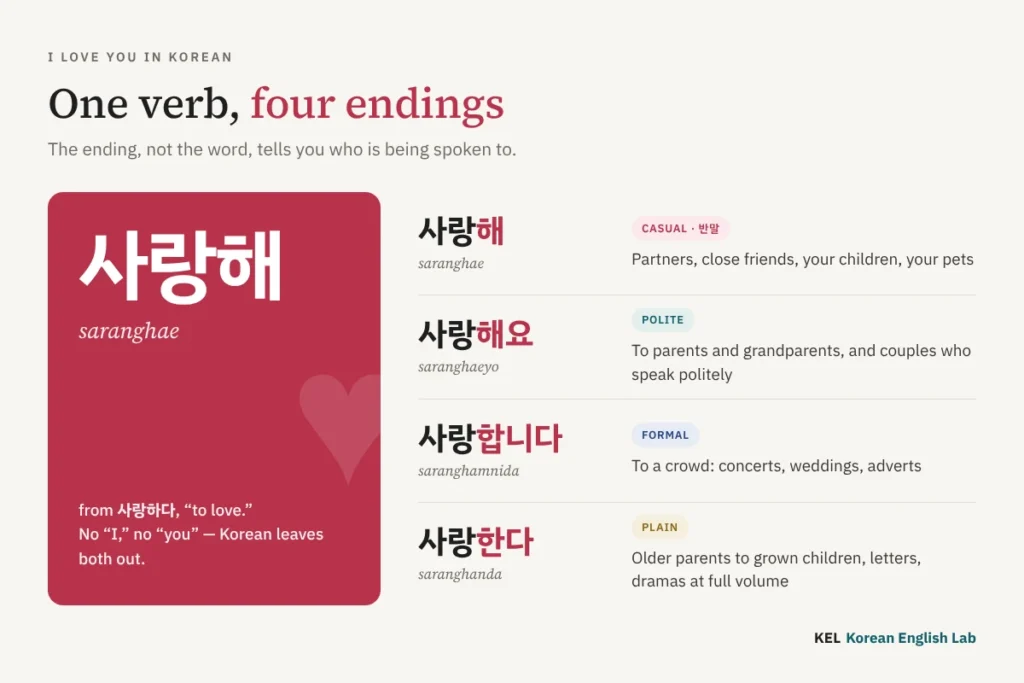
One Verb, Four Endings
사랑해 comes from the verb 사랑하다 (saranghada), “to love.” It is an ordinary 하다 verb, so it conjugates exactly like 공부하다 or 좋아하다 — our guide to Korean verb conjugation walks through the pattern. Notice what is missing: there is no “I” and no “you.” Korean drops both when they are obvious, and in a sentence like this they always are. Adding them, as in 나는 너를 사랑해, sounds like a line from a song or a very serious moment.
What changes is the ending, and the ending tells you who is being spoken to.
| Korean | Romanisation | Who says it to whom |
|---|---|---|
| 사랑해 | saranghae | Partners, close friends, your own children, your pets. The everyday one. |
| 사랑해요 | saranghaeyo | Children to parents, grandchildren to grandparents, couples who speak politely to each other |
| 사랑합니다 | saranghamnida | To a crowd: speeches, fan events, wedding vows, advertising |
| 사랑한다 | saranghanda | Older parents to grown children, letters, film and drama at full volume |
사랑해 is banmal, casual speech, and that is exactly right for the people you love most. Using a polite ending with a partner can even sound distant. This is the one in K-pop choruses, on couple rings and in almost every text you will send.
사랑해요 adds the polite -요, and it is the version for people above you whom you are close to. A grown son phoning his mother on Parents’ Day, 8 May, will often end with 엄마, 사랑해요. Some couples, especially ones who met when they still spoke politely, keep using it with each other for years.
사랑합니다 is formal, and in practice it is aimed at many people at once. A singer says it to the audience at the end of a concert, a groom says it in front of the wedding guests, and a company says it in an advert. It once went further than that: in 2006, Korea’s 114 directory-assistance line began answering every call with 사랑합니다, 고객님 — “I love you, valued customer.” The greeting was dropped after about two and a half years, as people began questioning the emotional labour it demanded of operators, though it has come back for special occasions since. Said to one person face to face, 사랑합니다 sounds like a speech. It is pronounced saranghamnida, not saranghapnida, for reasons our guide to Korean pronunciation rules explains.
사랑한다 is the plain form, the one Korean uses for writing and for declarations. You will hear it from a father who would never say 사랑해 out loud but will put 사랑한다, 아들 at the bottom of a letter, and you will hear it in every drama when a character finally means it. It sounds weighty and a little old-fashioned in conversation, which is the point.
If you are learning Korean and want one form, learn 사랑해 and add 요 for anyone older than you. The other two you only need to recognise.
좋아해 Comes First
In English, “I like you” and “I love you” are close neighbours. In a Korean relationship they are separate stages, and they come in a fixed order. If you watch Korean dramas, you have already seen this happen; our guide to K-drama Korean covers the confession scene itself. Here is the whole sequence it belongs to.
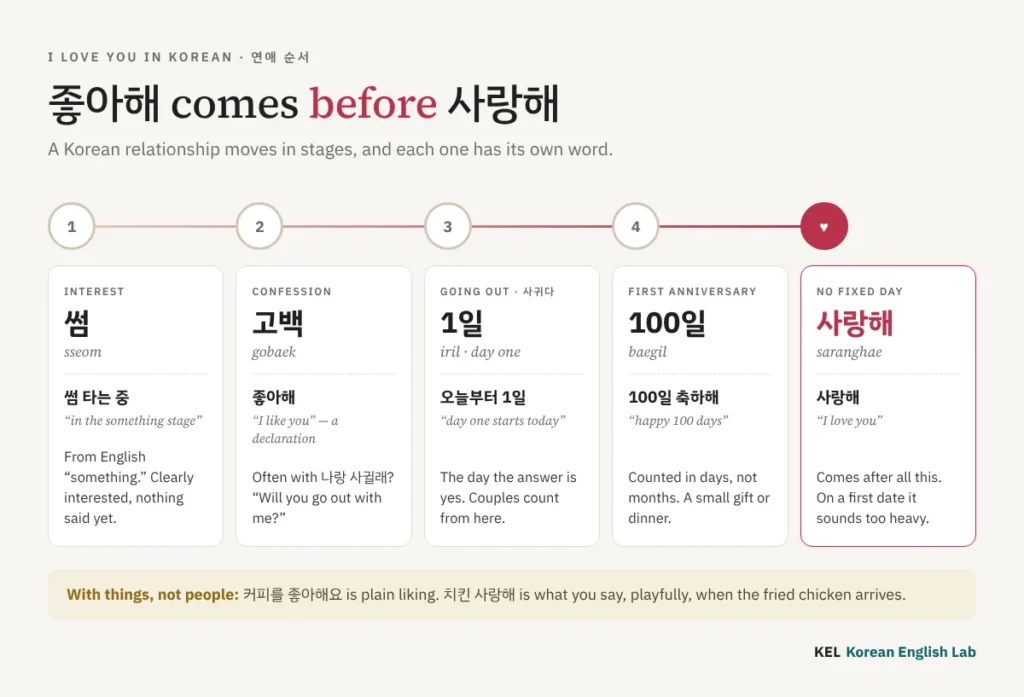
썸 (sseom) comes first. It is borrowed from the English “something,” as in “there’s something between us,” and it means the stage where two people are clearly interested but nothing has been said. You will hear 우리 썸 타는 중이야, “we’re in the something stage,” and 썸남 or 썸녀 for the man or woman on the other side of it.
고백 (gobaek), the confession, ends it. Someone says 좋아해 (joahae), “I like you,” and in this setting it is not mild at all. It is a declaration. Often it comes with a question: 나랑 사귈래? (narang sagwillae?), “Will you go out with me?”
사귀다 (sagwida), “to go out with,” starts the moment the answer is yes. Korean couples count from that day. It is 1일, day one, and the milestones that follow are counted in days rather than months: 100일 is the first big anniversary, often with a small gift or a dinner, and 200일 and 300일 follow. A couple-counting app on both phones is completely normal.
사랑해 arrives somewhere after that, and there is no fixed day for it. What matters is that it is not the confession. Saying 사랑해 on a first date skips two stages and will usually sound too heavy, or not quite sincere. Saying 좋아해 first and letting 사랑해 come later is how most Korean relationships move.
The two verbs also work outside romance, which can confuse learners. 좋아해요 with a thing is plain liking — 커피를 좋아해요, “I like coffee,” and our particles guide explains why it takes 를 here. 사랑해 with a thing, though, sounds playful: 치킨 사랑해 is what you say when the fried chicken arrives.
Who Can Hear It From You
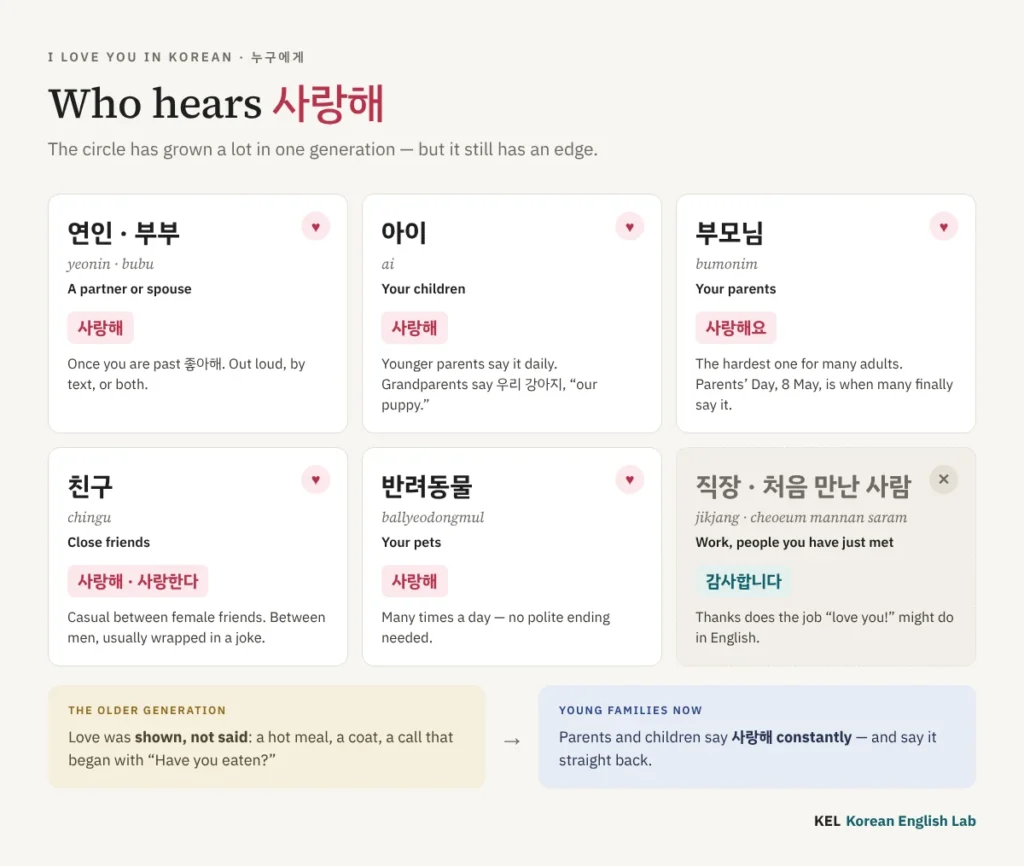
The circle of people who hear 사랑해 in Korea has grown a great deal in one generation, and it is still growing.
A partner, obviously, once you are past the 좋아해 stage. Married couples vary enormously. Some say it every day; some have not said it since the wedding. In our house it is often, in person and in messages.
Children hear it far more than they used to. Younger Korean parents say 사랑해 to their children as naturally as they say good night, and the children say it back — often with a hand making a heart over their head. Grandparents tend to show it in a different register: a grandmother is far more likely to call a grandchild 우리 강아지 (uri gangaji), literally “our puppy,” which is about as affectionate as Korean gets.
Parents are where the older pattern still shows. Plenty of Korean adults find it easier to say 사랑해 to a partner every day than to say 사랑해요 to their own mother once. Parents’ Day is when a lot of people finally say it — and quite often by text.
Friends can hear it too, more than you might expect. Close female friends say 사랑해 to each other casually, and in texts it is everywhere. Between male friends it usually comes wrapped in a joke — 사랑한다, 친구야, “love you, mate,” after someone pays for dinner.
Pets hear it most of all, at least in my house. My two toy poodles get 사랑해 many times a day.
Coworkers, a boss, a teacher, someone you have just met do not. Thanks and appreciation go to these people through thank you in Korean — 감사합니다 does the job that “love you, thanks!” might do at an English-speaking office. The one exception is an audience: a teacher may well hear 선생님 사랑해요 from a class of small children, and that is a different thing entirely.
If you are not Korean and wondering whether 사랑해 will sound odd coming from you: it will not. I have never found it strange to hear a foreigner say it. Korea is used to the word now, and from a friend or a partner it simply sounds like what it is.
“Have You Eaten?” and the Other Ways to Say It
If you only listen for 사랑해, you will miss most of the love in a Korean conversation. A huge amount of it travels in ordinary-looking phrases — the ones that the older generation of parents used instead of the word itself, and that everyone still uses alongside it.
| Korean | Romanisation | What it says | What it means |
|---|---|---|---|
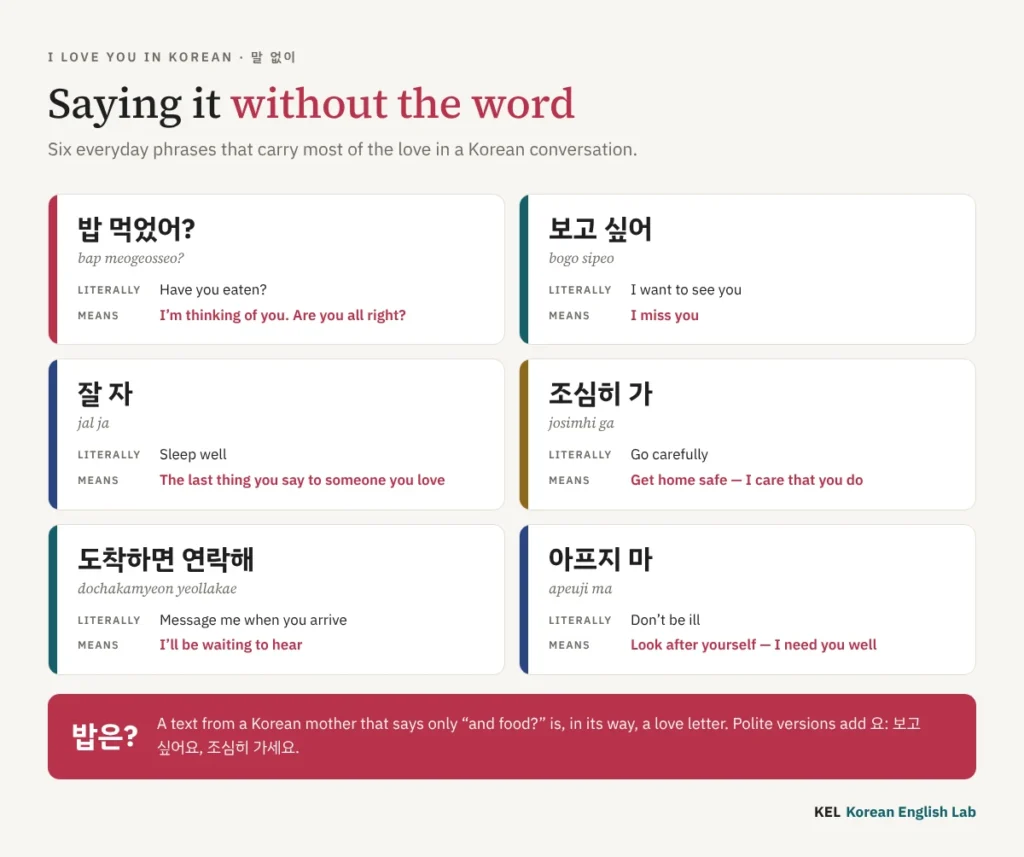
| 밥 먹었어? | bap meogeosseo? | Have you eaten? | I’m thinking about you and I want you looked after |
| 보고 싶어 | bogo sipeo | I want to see you | I miss you |
| 잘 자 | jal ja | Sleep well | The last thing you say to someone you love |
| 조심히 가 | josimhi ga | Go carefully | Get home safe — I care that you do |
| 도착하면 연락해 | dochakamyeon yeollakae | Message me when you get there | I will be waiting to hear |
| 아프지 마 | apeuji ma | Don’t be ill | Look after yourself, because I need you to be well |
밥 먹었어? is the classic. Asked by a parent, it is not a question about food. It is the whole message. The reason 밥 means far more than rice in Korean is that a meal stands for being cared for, and asking whether someone has had one is asking whether they are all right. A text from a Korean mother that says only 밥은? — “and food?” — is, in its way, a love letter.
보고 싶어 is built from 보다, “to see,” and -고 싶다, “to want to.” Korean misses people by wanting to see them. It is warm enough for a partner and fine for a friend or a parent. The polite version is 보고 싶어요, and the past form 보고 싶었어, “I missed you,” is what you say at the arrivals gate.
잘 자 and 조심히 가 look like simple good-night and goodbye phrases, and with acquaintances they are. With someone close, they are the small daily proof. A couple who say 사랑해 rarely will still say 잘 자 every single night. 아프지 마 is the one parents and partners say when someone is overworking or under the weather — a command, technically, that only someone who loves you gets to give. If you are the one who is ill, our guide on saying you’re sick in Korean has the other side of the conversation.
Put together, these are how a lot of Korean families have always said 사랑해. The younger generation simply says both.
자기, 여보 and What Couples Call Each Other
사랑해 rarely travels alone. In front of it there is usually a name, and Korean couples use a small set of them.
자기야 (jagiya) is the standard one for dating couples and many married ones — roughly “honey” or “babe.” 여보 (yeobo) is the word for a husband or wife, and it is what many married couples call each other at home. Plenty of married couples stick with 자기야 instead; you will hear both. Many women call a boyfriend who is older than them 오빠 (oppa), the same word they would use for an older brother — our guide to Korean family terms explains how one word does both jobs.
Put the two together and you have the most typical message in a Korean couple’s phone: 자기야 사랑해, or, at the end of a long day, 여보 사랑해.
Two more words worth recognising. 사랑 (sarang) on its own is the noun, “love,” and it turns up in compounds: 첫사랑 (cheotsarang) is a first love. And 사랑스럽다 (sarangseureopda) means “lovely” or “adorable” — the word for a person or animal who is easy to love. It sits close to the words in our guide to cute in Korean.
사랑해 in a Text, and With Your Hands
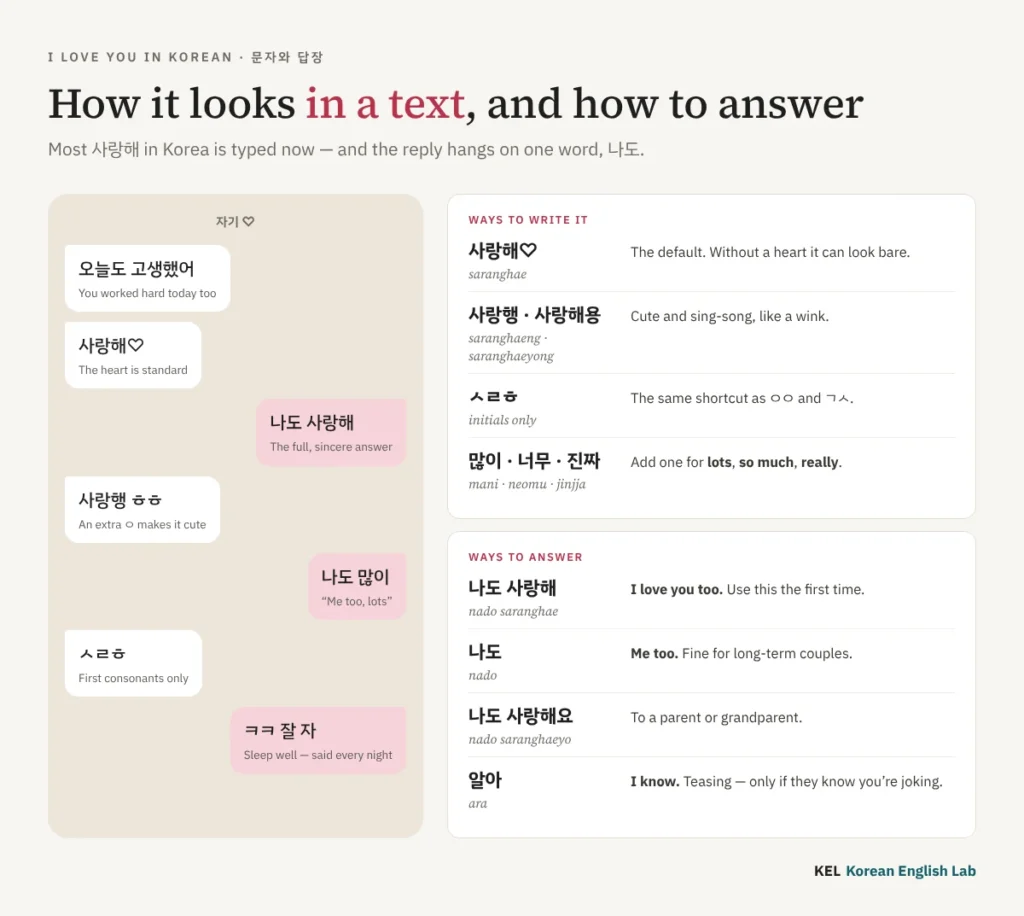
Much of the 사랑해 in Korea now is typed. A few forms you will see:
- 사랑해♡ — the heart symbol is standard, and a 사랑해 without one can look oddly bare.
- 사랑행 or 사랑해용 — an added ㅇ makes it sound cute and a little sing-song, like adding a wink.
- ㅅㄹㅎ — just the first consonant of each syllable, the same shortcut as ㅇㅇ and ㄱㅅ. Our guide to Korean texting slang explains how the consonant-only style works.
- 사랑해 많이 — “love you lots,” with 많이 tagged on the end for emphasis. 너무 사랑해 and 진짜 사랑해 do the same job.
Then there are the hearts you make with your body. The 손가락 하트 (songarak hateu), finger heart — thumb and index finger crossed into a tiny heart — spread across Korea in the 2010s, carried by K-pop idols in photos and on stage, and is now recognised far beyond it. Nobody agrees on who did it first. Alongside it are the 볼하트, two hands curved against the cheeks, and the big heart made with both arms over the head, which is what children do when a parent says 사랑해 across the playground. If you are learning from songs, our guide to K-pop Korean covers why lyrics say 나 너 사랑해 with the particles missing.
When Someone Says It First
The answer to 사랑해 is short, and it hangs on one word: 나도 (nado), “me too.”
| Korean | Romanisation | Meaning and tone |
|---|---|---|
| 나도 사랑해 | nado saranghae | I love you too. The full, sincere answer. |
| 나도 | nado | Me too. Fine in texts and between long-term couples. |
| 나도 많이 | nado mani | Me too, lots. Warm and a little playful. |
| 나도 사랑해요 | nado saranghaeyo | I love you too — to a parent or grandparent |
| 알아 | ara | I know. Teasing, and only safe with someone who knows you are joking. |
나도 does the same work as “me too” or “you too” in English, which is why it can stand alone. Between a couple who have said it a thousand times, a simple 나도 ♡ by text is not cold at all. For a first time, though, say the whole thing.
And if you are not ready to say it back? Korean has an honest middle ground: 고마워 (gomawo), “thank you,” with a smile. It is kind, and it is clear. Just do not use it on a partner of three years.
사랑 Used to Mean “Thought”
One last thing, for anyone who likes where words come from. Five or six hundred years ago, in Middle Korean, the ancestor of 사랑 — written ᄉᆞ랑 — meant something closer to thinking, the meaning that the modern word 생각 carries today. Love, in that older Korean, had its own word: 괴다, which has since disappeared from everyday speech.
You may see the claim that 사랑 comes from the Chinese-character word 思量, “to think and weigh.” That one is not settled, and it is best treated as a nice story rather than a fact. What is on the record is the shift itself: the word for keeping someone in your thoughts became the word for love. Anyone who has ever sent 밥 먹었어? to someone far away will understand why.
Say It, and Ask If They Have Eaten
사랑해 is the word, and it is used more freely in Korea now than at any time before. Use 사랑해 with a partner, a friend or your own children, add 요 for a parent, and save 사랑합니다 for a crowd. Let 좋아해 come first if it is new. And when you want to say it without saying it, do what Korean families have always done: ask whether they have eaten, tell them to get home safe, and say 잘 자 at the end of the day.
If you are collecting the phrases that matter most, the next two in this series are how to say thank you and how to say sorry — between them and this one, you have the three things people most need to say.
Written by Minhyung Cha — 25 years teaching Korean, and 15+ years running an English academy in South Korea. I live and work in Busan, and every example on this site is checked as a native speaker. More about KEL.
Leave a Reply