A Korean convenience store, a 편의점 (pyeonuijeom), is the shop Koreans use most and think about least. It is open all night, it is on almost every corner, and it sells far more than snacks: hot meals you heat yourself, coffee from a machine, drinks on two-for-one deals, socks, medicine, parcel delivery and a place to sit down. For a visitor it is the easiest shop in the country to walk into, because nobody expects you to speak.
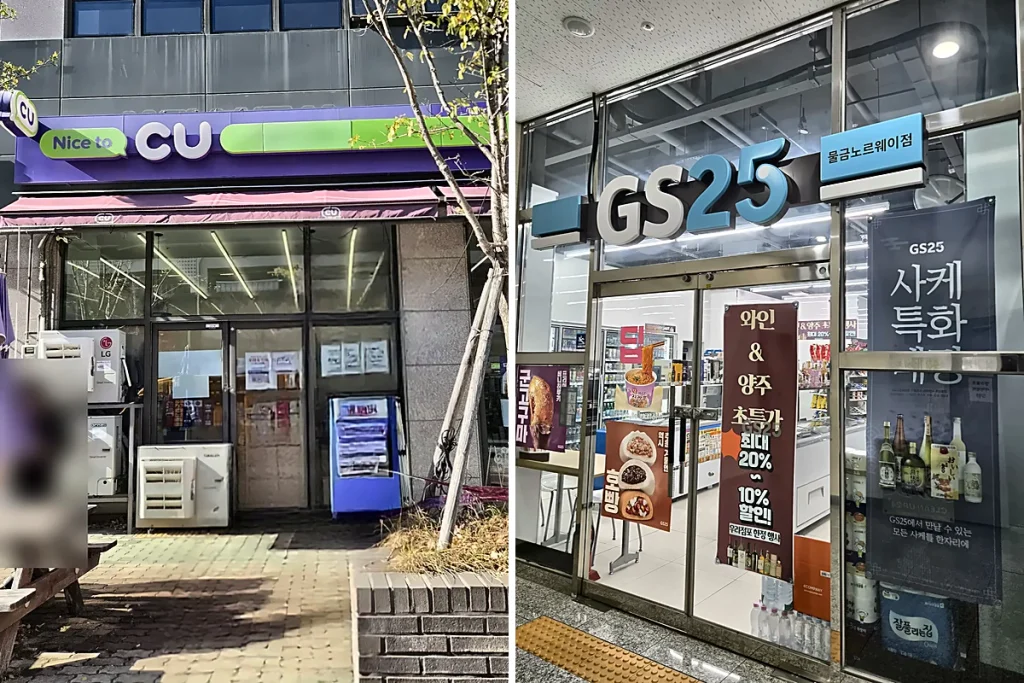
I live in Yangsan, just north of Busan, and within walking distance of my home there is a 7-Eleven, a GS25 and a CU. On 27 November 2026 I visited all three and took photos inside the 7-Eleven, the one I use most. This guide uses those photos to show you how the shelves work, what is worth buying, how to read the 1+1 and 2+1 deals, how to eat in the shop, and the Korean you will hear at the till.
The Big Names: CU, GS25 and 7-Eleven
Korea has four large convenience store chains, and you will see the first three everywhere. At the end of 2025 the four together ran 53,266 stores, according to government figures. That was about 1,600 fewer than a year earlier, the first time the total had ever fallen, but it is still a store for roughly every thousand people.
| Chain | Say it | Notes |
|---|---|---|
| CU | 씨유 (ssi-yu) | The largest by store count, about 18,700 at the end of 2025. Purple and green sign. |
| GS25 | 지에스 이십오 (ji-eseu isibo) | About the same size as CU. Blue sign. People often just say 지에스. |
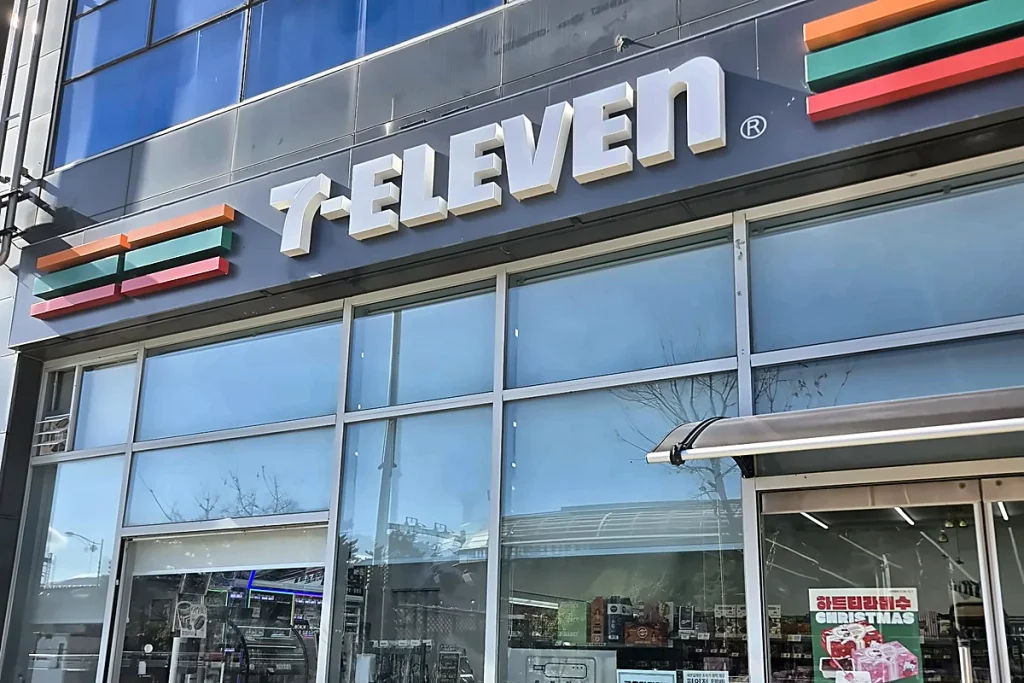
| 7-Eleven | 세븐일레븐 (sebeunillebeun) | Third, with about 12,000 stores at the end of 2024. It took over the Ministop chain in 2022. |
| emart24 | 이마트이십사 (imateu isipsa) | The smallest of the four. |
7-Eleven also has the oldest story. Korea’s very first convenience store was a 7-Eleven that opened on 6 May 1989 at the Olympic athletes’ village apartments in Seoul, and it is still trading. At the time a shop that never closed was a novelty.
Each branch has a name ending in 점 (jeom), “branch.” The GS25 in my photo is 물금노르웨이점, the Mulgeum Norway branch, named after the building it sits in. That is the name to type into a map app.
Why I Go to the 7-Eleven
All three are a short walk from my home, and I could use any of them. I usually choose the 7-Eleven because it is the biggest of the three near me and has the most things, in the most variety. I go on my own, and I go with my husband. Because it is open 24 hours, I never have to think about when it closes.
On this visit I bought corn silk tea on a 2+1 deal, which means three bottles for the price of two, and a cup of ginger tea, the kind you make with hot water in the shop. The bill was 5,800 won. That is very typical of how I shop there. What I buy most often is whatever drink or snack is on a 1+1 or 2+1 deal that month.
How 1+1 and 2+1 Deals Work
These deals are the heart of Korean convenience store shopping. 1+1 (won peulleoseu won) means buy one, get one free. 2+1 (tu peulleoseu won) means buy two, get a third free. They are read in English, so the numbers are “one” and “two,” not 일 and 이.
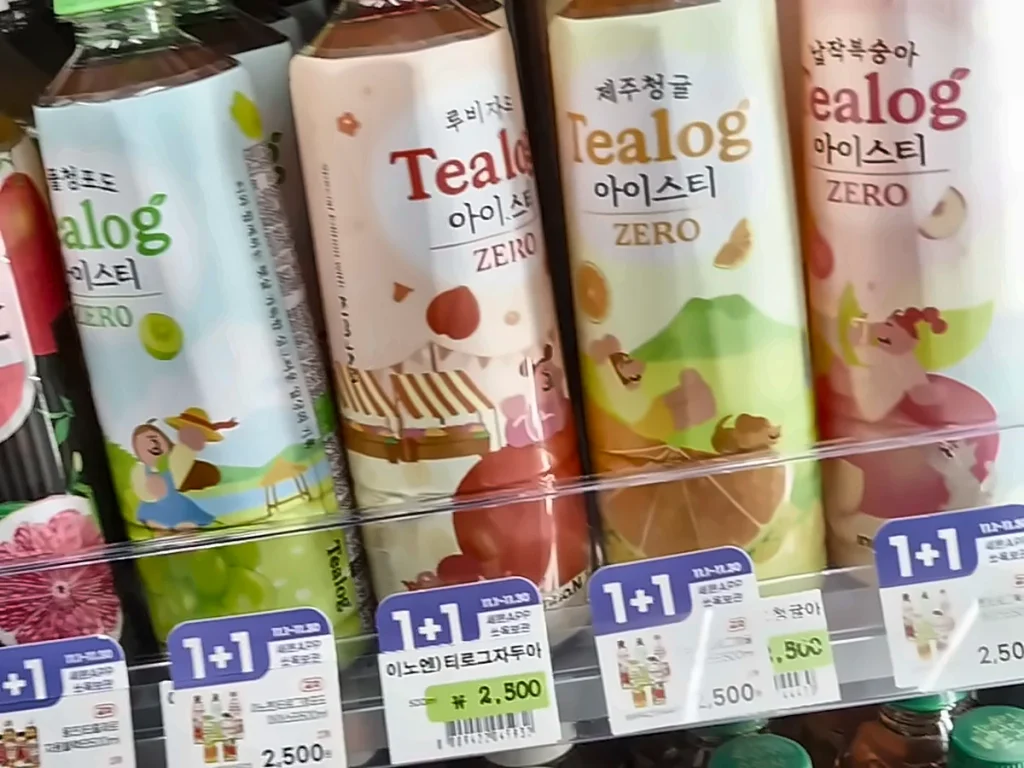
Deals run by the month. In my photos the small purple 1+1 tags say 11.1~11.30, so they ended on the last day of November and new ones start on the first of the next month. The price printed on the tag is the price of one item. So a 2,500-won drink on 1+1 means you pay 2,500 won and leave with two.
You have to bring the free item to the till yourself. If you put down only one, the cashier will often tell you 하나 더 가져오세요, “go and get one more.” Whether you may mix flavours depends on the deal, so if you want a peach and a grape, ask 섞어도 돼요? (seokkeodo dwaeyo?), “can I mix them?”
| On the tag | Romanisation | Meaning |
|---|---|---|
| 1+1 | won peulleoseu won | Buy one, get one free |
| 2+1 | tu peulleoseu won | Buy two, get one free |
| 2개 3,000원 | du gae samcheon won | Two for 3,000 won |
| 할인 | harin | Discount |
| 행사 | haengsa | Promotion, a deal |
| PB | pi-bi | The store’s own brand (7-Eleven’s is 7-SELECT) |
One more line on the 7-Eleven tags is 세븐APP 쏘옥보관. It means you can buy a deal in the 7-Eleven app and keep the free item stored there to collect later, instead of carrying two home. I have never used it myself; I just take both bottles.
Drinks for Every Season
The drinks fridges take up a whole wall, and in a Korean store a big part of that wall is tea that you drink cold, with no sugar. 보리차 (boricha) is roasted barley tea, 옥수수수염차 (oksusu suyeomcha) is corn silk tea, the one I bought, and 녹차 (nokcha) is green tea. They taste toasty and clean, and they are what many Koreans drink instead of water.
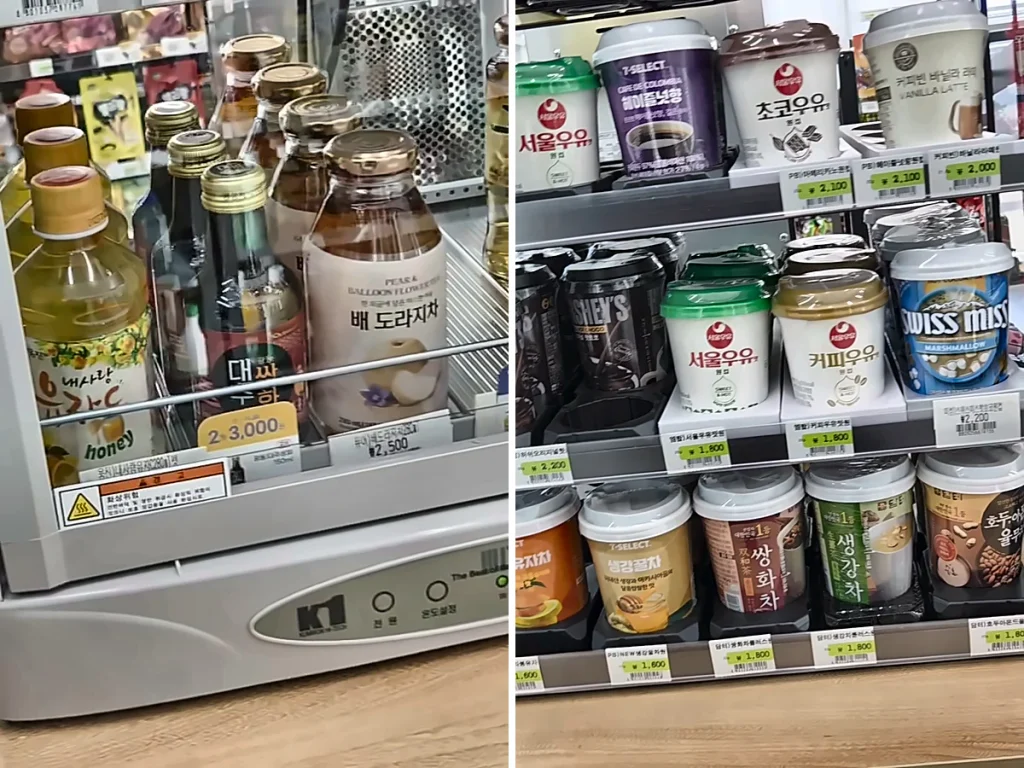
In winter, look by the counter for a glass cabinet that keeps bottles warm. Mine held honey citron tea, jujube tea and pear and balloon flower tea, with a 화상위험 sticker on the front, “burn hazard,” because the bottles really are hot. Next to it was a rack of 원컵 (won-keop), one-cup drinks: a paper cup with powder inside and a lid. You buy it, add hot water from the machine in the shop, stir and drink. In my store there were ginger tea (the one I bought), 쌍화차 (a traditional herbal tea), walnut and almond tea, coffee milk and hot chocolate, mostly between 1,600 and 2,200 won.
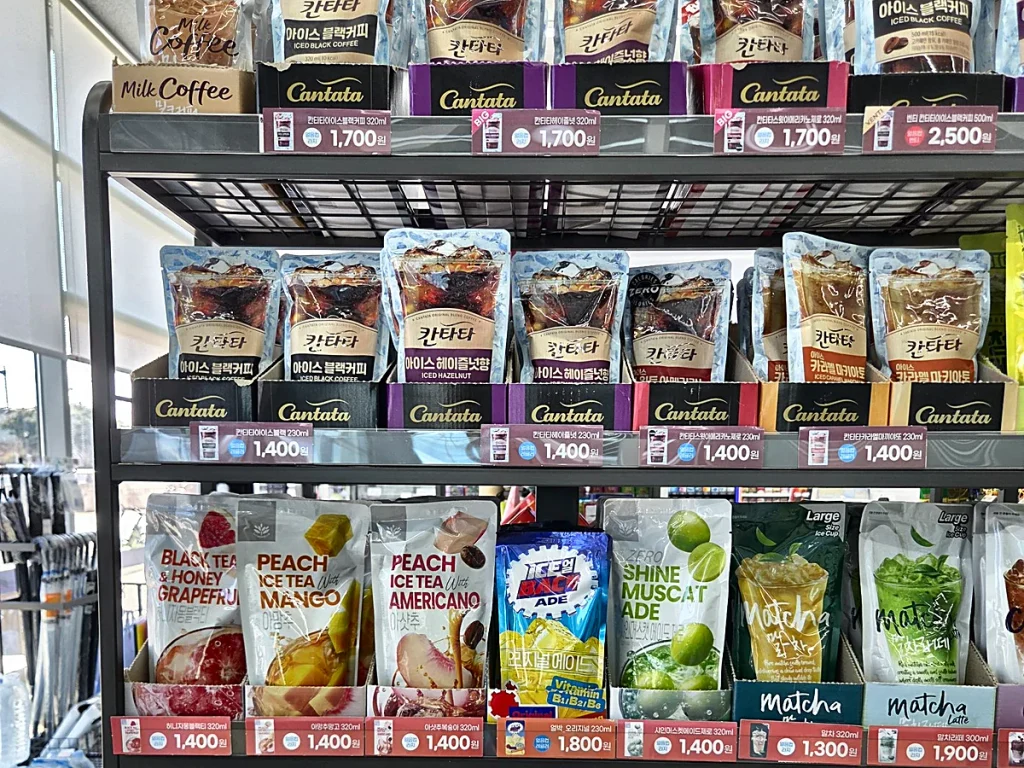
The other system to know is the ice cup. Coffee, iced tea and fruit ades are sold in soft pouches on a rack, and plastic cups full of ice are sold separately in the freezer. You buy one of each, pour the pouch over the ice and close the lid. In my store the pouches were 1,300 to 2,500 won and the ice cups 1,500 to 2,000 won. It is the cheapest iced coffee in Korea, and the rack stays up even in November.
What I Would Tell a Visitor to Buy
When friends from abroad ask what to try, I give the same three answers.
바나나우유: Banana Milk
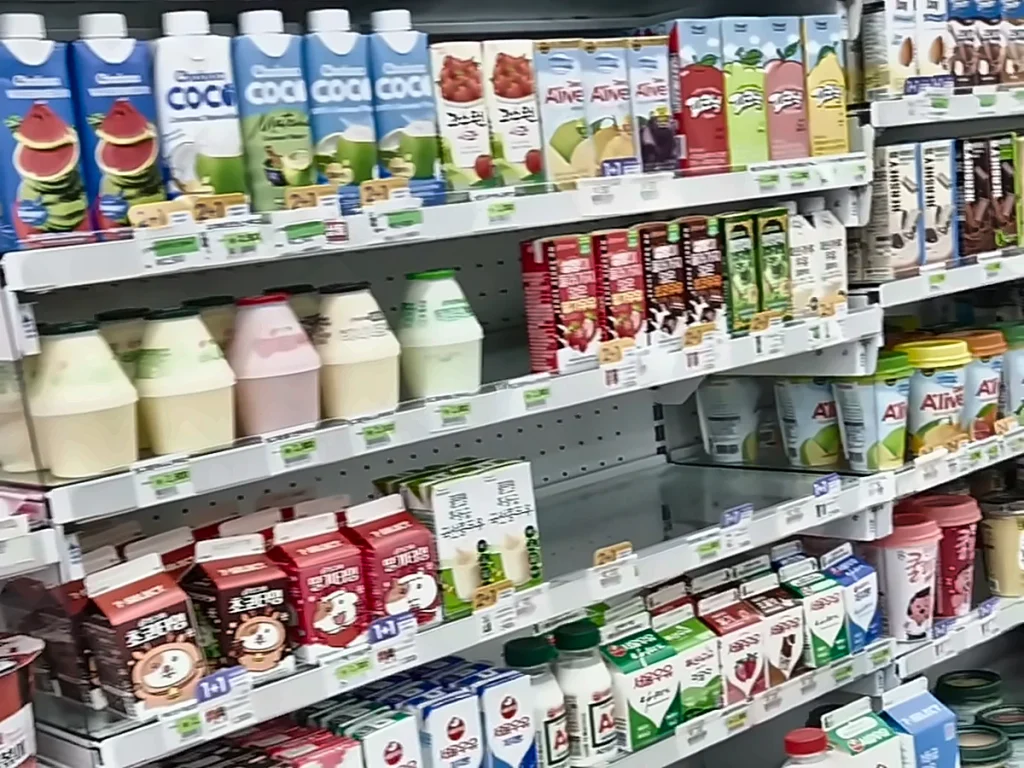
바나나맛우유 (banana-mat uyu), banana-flavoured milk from Binggrae, has been sold since 1974 in the same round yellow bottle, shaped like a traditional Korean moon jar. Koreans call it 단지우유, “jar milk,” and the company says it sells about a million a day. Look for it in the chilled section next to the strawberry and melon versions. Push the straw through the foil top and drink it cold.
삼각김밥: Triangle Kimbap
삼각김밥 (samgak gimbap) is a triangle of rice with a filling, wrapped in seaweed. The classic is 참치마요, tuna with mayonnaise, which 7-Eleven made popular in 1999. The packaging keeps the seaweed dry and separate from the rice until you open it, so follow the printed numbers: pull tab 1 down the middle, then pull corners 2 and 3 off to the sides. Done in that order, the seaweed wraps itself around the rice. Most cost between 1,000 and 2,000 won, so it is the cheapest proper meal in the shop.
1+1 and 2+1 Drinks and Snacks
My third answer is not one product but the deals themselves. Walk the drinks wall and the snack aisle and pick whatever has a 1+1 or 2+1 tag. You get to try two Korean things for the price of one, and the selection changes every month. Snacks are also an easy, light gift to take home.
Ramen, Rice and the Microwave
A Korean convenience store expects you to eat. The aisles carry cup ramen, packets of instant noodles, 즉석밥 (jeukseokbap, microwave rice) and 컵밥 (keopbap), a bowl of rice with a topping that you heat in the microwave. If you want to read the flavours on the packets, our guide to food in Korean covers the words.
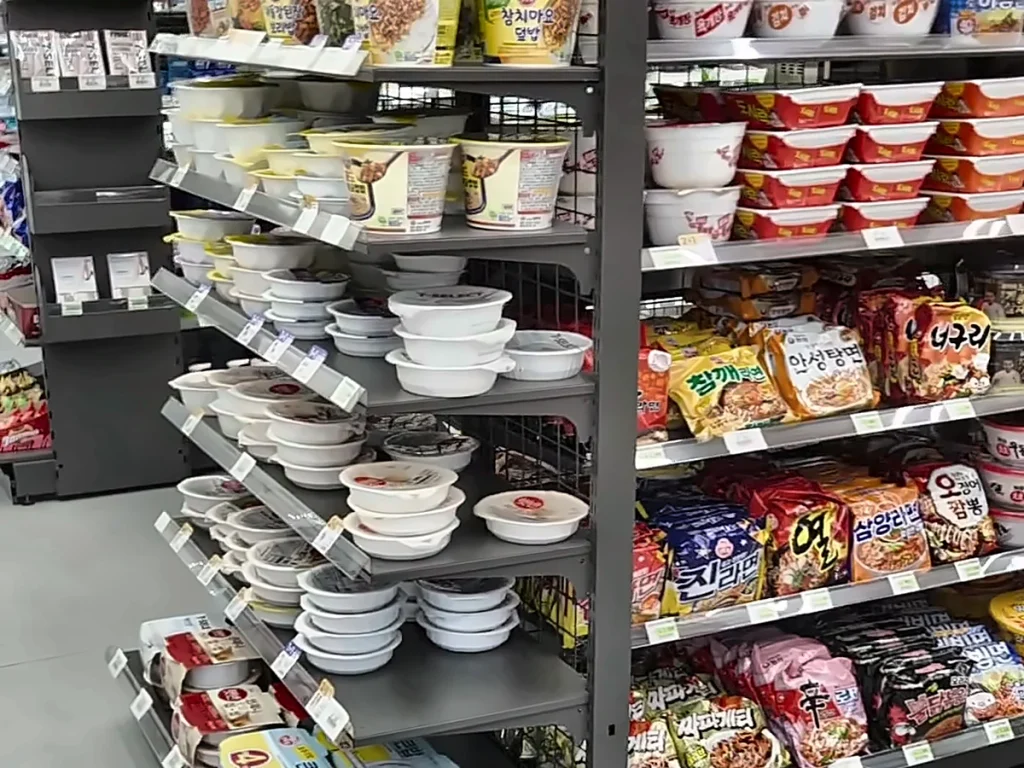
This is where I use the shop most. I have made cup ramen with the hot water from the store’s dispenser, and I often heat a 핫바 (hatba) in the microwave. A hot bar is a fish cake or sausage on a stick, sold in the chilled section, and it takes well under a minute.
My branch has a corner with two microwaves, a hot water dispenser and bins underneath for sorting rubbish, plus tables and a bench seat along the window. The window seats are my favourite. When you finish, clear your own table and sort what is left into the bins, as the signs show.
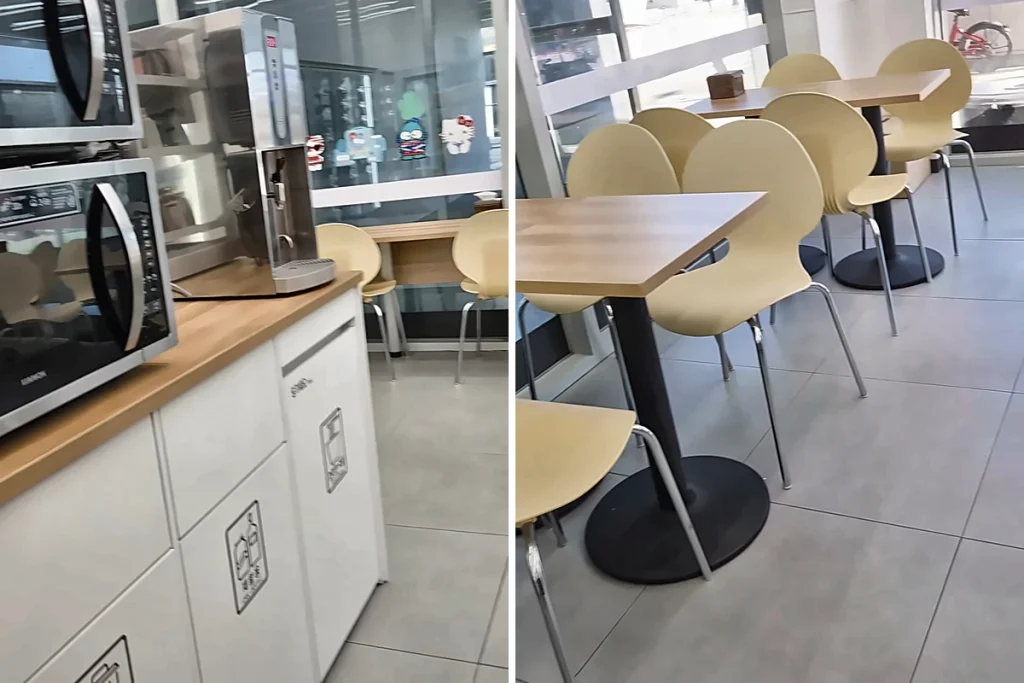
There is also a coffee machine by the counter. You pay at the till for a cup and make it yourself. I have used it, and the coffee is surprisingly good, made from real beans, and cheaper than a café.
More Than a Shop
A convenience store is also where Koreans go for small errands. Several of them are covered in our other guides.
- T-money cards. You can buy a transport card and top it up at the counter, in cash. Our guide to using the Korean subway explains how it works.
- Cash machines. Many stores have an ATM, and some take overseas cards. See how to pay in Korea.
- Basic medicine. There is a small shelf of over-the-counter medicine for headaches, fevers, colds and indigestion. For anything more, see our visit to a Korean pharmacy.
- Hangover drinks. The shelf by the counter is full of hangover drinks and sticks, a reminder of how seriously Koreans take a night out. Our guide to Korean drinking etiquette explains why.
- Parcels. Most stores accept parcels for delivery inside Korea. My 7-Eleven had a 편의점 택배 (pyeonuijeom taekbae), “convenience store parcel service,” poster in the window.
- Daily things. Socks, underwear, tissues, wet wipes, phone chargers and umbrellas, at higher prices than a supermarket but at any hour. For a wider choice at fixed low prices, there is Daiso.
Alcohol and cigarettes are sold too, but not to anyone the law counts as a minor. The rule goes by year of birth, not birthday, so in 2026 anyone born in 2007 or earlier may buy them. Cashiers do check, so carry your passport or ID.
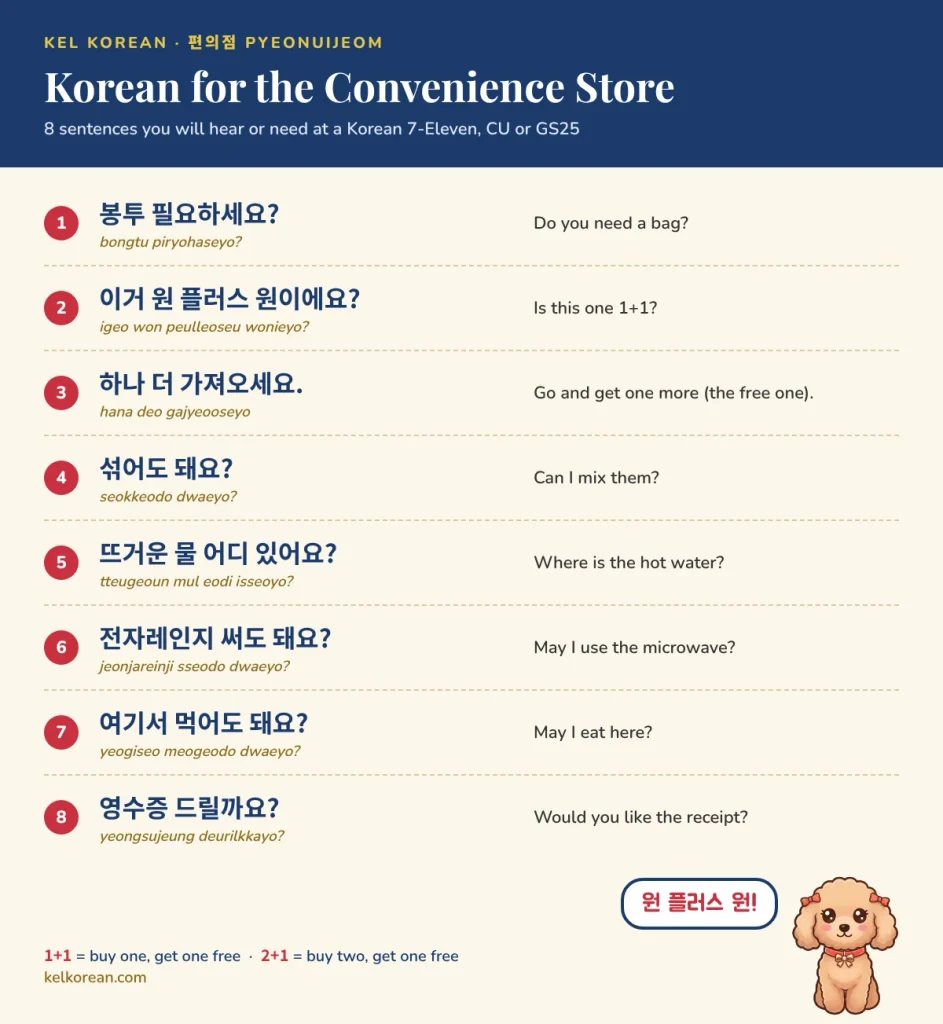
Korean for the Convenience Store
You can shop in silence, and many Koreans do. These are the sentences you are most likely to hear or need.
| Korean | Romanisation | Meaning |
|---|---|---|
| 봉투 필요하세요? | bongtu piryohaseyo? | Do you need a bag? |
| 이거 원 플러스 원이에요? | igeo won peulleoseu wonieyo? | Is this one 1+1? |
| 하나 더 가져오세요. | hana deo gajyeooseyo | Go and get one more (the free one). |
| 섞어도 돼요? | seokkeodo dwaeyo? | Can I mix them? |
| 뜨거운 물 어디 있어요? | tteugeoun mul eodi isseoyo? | Where is the hot water? |
| 전자레인지 써도 돼요? | jeonjareinji sseodo dwaeyo? | May I use the microwave? |
| 여기서 먹어도 돼요? | yeogiseo meogeodo dwaeyo? | May I eat here? |
| 영수증 드릴까요? | yeongsujeung deurilkkayo? | Would you like the receipt? |
For a bag, answer 네, 하나 주세요 (“yes, one please”) or 아니요, 괜찮아요 (“no, I’m fine”). Prices are read with the same numbers you use everywhere else, so our guide to Korean numbers will help with the total, and shopping in Korean covers the rest of the conversation at the till.
Before You Go
- Most stores never close. Many are open 24 hours, but not all, especially inside office buildings or stations. The hours are on the door.
- Check the tag colour. Purple 1+1 and yellow 2+1 tags were easy to spot in my 7-Eleven. Each chain uses its own colours, but the numbers are the same everywhere.
- Deals change on the 1st. If you liked something on 1+1 at the end of the month, buy it before the month is out.
- Same name, different stock. A large branch has far more than a small one. If you cannot find something, try another chain; there is probably one across the road.
- Clean up after yourself. If you eat in, sort your rubbish into the right bin before you leave.
편의점: Open Whenever You Need It
The convenience store is not the most exciting place in Korea, and that is exactly why I would send a visitor there on their first night. It shows you what Koreans actually eat and drink on an ordinary day, and you can try ten new things for the price of a meal. Pick a drink with a 1+1 tag, a banana milk and a triangle kimbap, take a seat by the window, and you are already living like a local. Mine is a few minutes’ walk away, and that is the real luxury.
Written by Minhyung Cha — 25 years teaching Korean, and 15+ years running an English academy in South Korea. I live and work in Busan, and every example on this site is checked as a native speaker. More about KEL.
Leave a Reply