
I have taught Korean for twenty-five years, and for fifteen of those I also ran an English academy, which meant a steady stream of foreign teachers arriving in Korea for the first time. So I have watched a lot of first days. The Korean phrases for travelers that matter most are not the ones phrasebooks put first. Almost nobody gets stuck on “hello.” They get stuck at the restaurant table, looking for a waiter who is never going to come.
This list is built around those moments. There are ten phrases, grouped by where you will actually need them, and for each one I have added what you will hear back — because a phrase is only half useful if the answer surprises you. Where a situation deserves more than a paragraph, I have linked to the full guide.
All Ten on One Screen
| Korean | Say it | Meaning | Where you need it |
|---|---|---|---|
| 안녕하세요 | annyeonghaseyo | Hello | Walking in anywhere |
| 저기요 | jeogiyo | Excuse me! | Calling staff over |
| 주세요 | juseyo | Please give me | Ordering, asking for more |
| 이거 뭐예요? | igeo mwoyeyo? | What is this? | Menus, markets |
| 얼마예요? | eolmayeyo? | How much is it? | Shops, stalls |
| 화장실 어디예요? | hwajangsil eodiyeyo? | Where is the toilet? | Everywhere |
| 도와주세요 | dowajuseyo | Please help me | When you are stuck |
| 네 / 아니요 | ne / aniyo | Yes / No | Every conversation |
| 감사합니다 | gamsahamnida | Thank you | Every conversation |
| 안녕히 계세요 | annyeonghi gyeseyo | Goodbye (when you leave) | Walking out |
Walking In
1. 안녕하세요 (annyeonghaseyo) — Hello
The one greeting that works for everyone, at any time of day. Say it as you walk into a shop, a café or a guesthouse, with a small nod.
What you will hear back: often not 안녕하세요 at all, but 어서 오세요 (eoseo oseyo), “welcome in.” Staff call it out the moment the door opens, sometimes from the kitchen. You do not need to answer it; a nod is enough. Our guide to Korean greetings covers hellos, introductions and what to say next.
At the Table
This is where every newcomer I have watched gets stuck, and it is never the language. It is the unwritten rules. The questions I have been asked most, in order: Is the water self-service? Am I allowed to ask for more side dishes? Where are the spoons? And what is actually in this dish?
The short answers: water is very often self-service — look for a dispenser or a sign saying 셀프 (self). Side dishes, 반찬 (banchan), are free and refilled on request, and asking is completely normal. And the spoons and chopsticks are usually in a shallow drawer built into the side of the table. I have seen people sit through a whole meal of soup without ever finding it.
2. 저기요 (jeogiyo) — Excuse me!
In most Korean restaurants, the staff will not come and check on you. The system is that you call them — out loud, across the room. 저기요 is the standard way; 여기요 (yeogiyo, “over here”) is also common. It feels rude the first time. It is not, and nobody will look up.
Many tables also have a small call button, often labelled 호출 (call). If you see one, press it instead of calling out.
3. 주세요 (juseyo) — Please give me
The most productive word on this list. Put any noun in front of it and you have a polite request: 이거 주세요 (igeo juseyo, “this, please”) while pointing at the menu, 물 주세요 (mul juseyo, “water, please”), and the one people are shy to use, 반찬 좀 더 주세요 (banchan jom deo juseyo, “a few more side dishes, please”).
4. 이거 뭐예요? (igeo mwoyeyo?) — What is this?
Korean menus love photos and rarely list ingredients. A picture of something red tells you nothing about whether it is pork, seafood or tofu, and I have seen more than one visitor order blind and regret it. Point and ask 이거 뭐예요? — and if you have an allergy or do not eat meat, our guide to ordering food in Korean has the exact sentences for that.
Paying
5. 얼마예요? (eolmayeyo?) — How much is it?
Useful at markets and stalls, where prices are not always written. Vendors will often hold up a calculator or their fingers, so you get the number even if you miss the words.
Where prices are written, one thing trips people up: many cafés and restaurants write them in thousands of won, with no zeros.
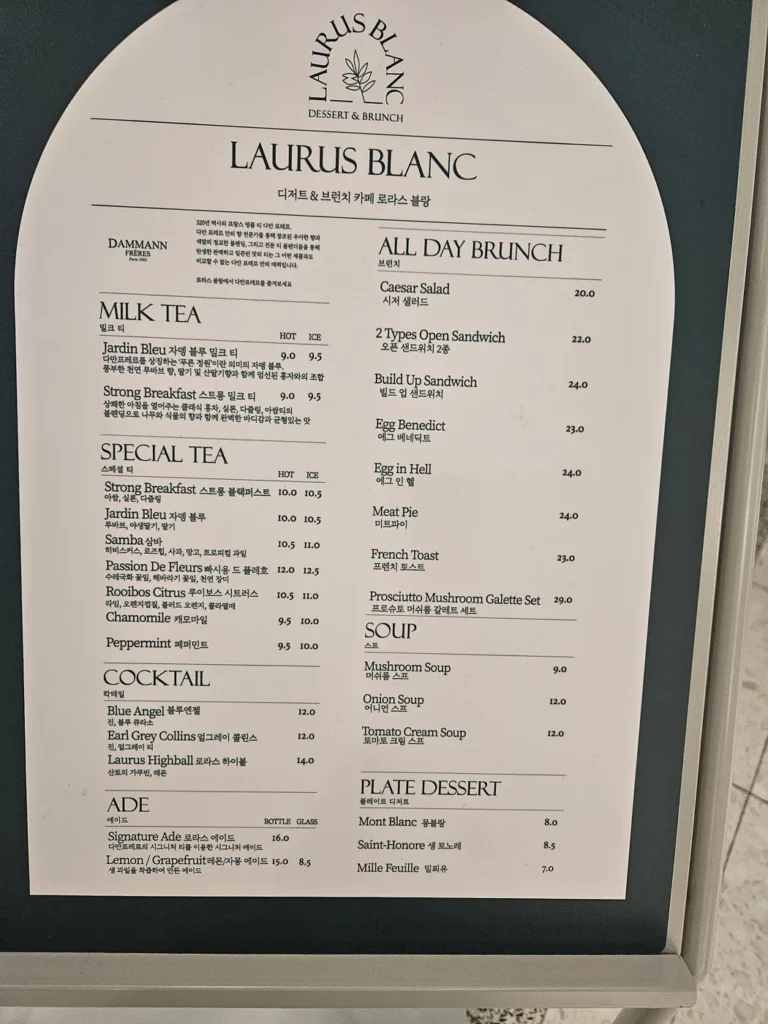
That milk tea is not nine and a half won. It is 9,500. Once you know the convention you will see it everywhere.
The bill: you go to it
This is the mistake I see most often. Visitors finish their meal and sit, waiting politely for the bill to arrive. It will not. In most Korean restaurants you take yourself to the counter by the door and pay there, usually on the way out. If there is a slip of paper on your table, bring it with you. At the counter, 계산해 주세요 (gyesanhae juseyo, “the bill, please”) is all you need — or just stand there with your card. Our guide to shopping in Korean covers what the cashier asks you next.
Getting Around
6. 화장실 어디예요? (hwajangsil eodiyeyo?) — Where is the toilet?
Swap 화장실 for any place and the question still works: ○○역 어디예요? (○○-yeok eodiyeyo?, “where is ○○ station?”). The answer will usually come with pointing, which is more useful than the words.
Korean subway signs will help you more than you expect, because they are written in Korean, English and Chinese characters, and they tell you which direction the train is going.
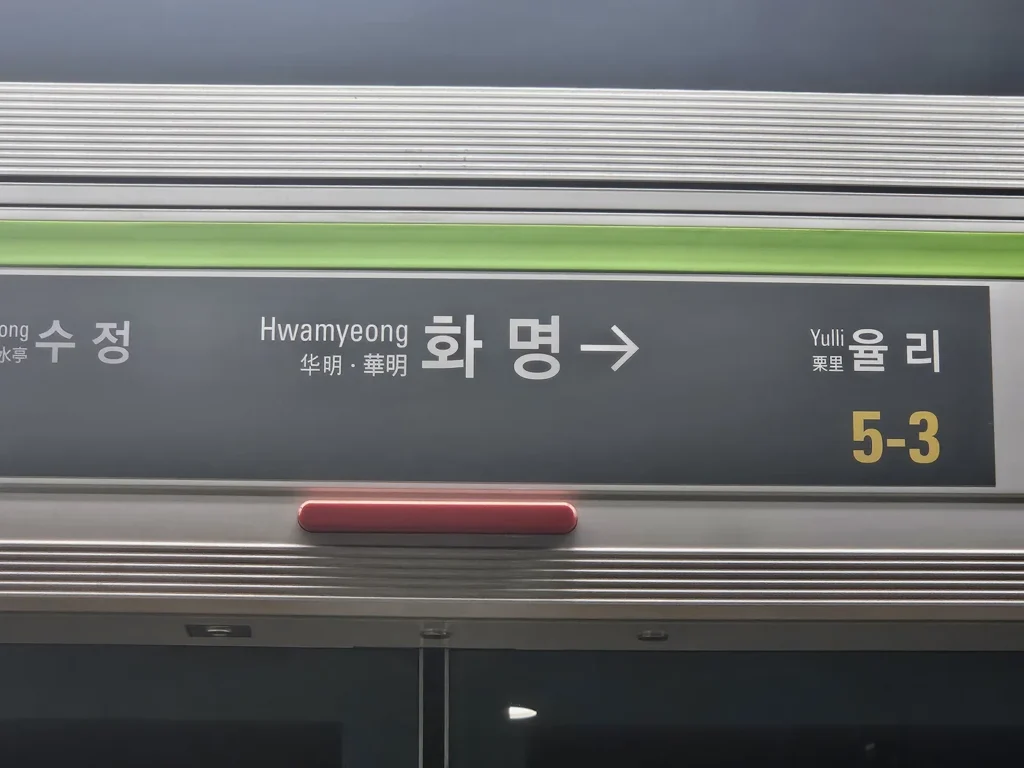
Look at the yellow number on the right. Every platform door has one, like 5-3: car five, door three. Koreans use these to meet up (“I’m at 5-3”) and to line up for the carriage nearest their exit. Our guide to using the Korean subway walks through tickets, transfers and exits.
7. 도와주세요 (dowajuseyo) — Please help me
For the ticket machine that will not take your card, or the moment you realise you are lost. Start with 저기요 to get someone’s attention, then 도와주세요. If it is medical, our guide to being sick in Korean covers pharmacies and clinics.
In Every Conversation
8. 네 / 아니요 (ne / aniyo) — Yes / No
Simple, with one trap. 네 does not mean “yes” so much as “that is right,” so the answer to a negative question flips. If someone asks “you’re not going?” and you are not going, the Korean answer is 네 — “right, I’m not.” This catches out almost everyone, and our guide to yes and no in Korean explains it properly. You will also hear 네 constantly as “I’m listening,” not as agreement.
9. 감사합니다 (gamsahamnida) — Thank you
The safe, polite thank-you for strangers, staff and anyone older than you. You will hear 고맙습니다 (gomapseumnida) just as often, and it is every bit as polite — our guide to thank you in Korean explains how Koreans choose between them.
Walking Out: The Goodbye Everyone Mixes Up
10. 안녕히 계세요 (annyeonghi gyeseyo) — Goodbye, when you are the one leaving
Korean has two goodbyes, and the choice depends on who is leaving. I have heard foreign students swap them for years — it is the most common slip I know, and it is completely understandable.
| Situation | You say | You hear |
|---|---|---|
| You leave a shop; the staff stay | 안녕히 계세요 “stay in peace” | 안녕히 가세요 “go in peace” |
| A guest leaves your place; you stay | 안녕히 가세요 | 안녕히 계세요 |
| You both leave at the same time | 안녕히 가세요 | 안녕히 가세요 |
The trick is to wish the other person well for what they are about to do. The staff are staying, so you tell them to stay well. So when the shopkeeper says 안녕히 가세요 to you, do not repeat it back — answer 안녕히 계세요. If it all goes out of your head at the door, 감사합니다 works as a goodbye too.
Heading to Busan? Listen for These
Everything above is standard Korean, and it works everywhere. But I live and work in Busan, and here people speak 부산 사투리, Busan dialect. You do not need to speak it. You will hear it, though — at markets, in taxis, from the table next to you — and four words will cover a surprising amount.
| Busan | Say it | Standard Korean | Meaning |
|---|---|---|---|
| 맞나? | manna? | 정말? / 그래? | Really? Is that so? |
| 뭐하노? | mwohano? | 뭐 해? | What are you doing? |
| 억수로 | eoksuro | 엄청 / 아주 | Really, very, loads |
| 아이가 | aiga | 아니야? / 잖아 | …isn’t it? / you know |
Notice the endings. Busan dialect ends a yes-or-no question with -나 (맞나?, “is it right?”) but a question with a question word in it with -노 (뭐하노?, “what are you doing?”). Standard Korean makes no such split, and it is one of the reasons Busan speech sounds so distinctive to other Koreans. If a stallholder at Jagalchi says 억수로 맛있다 about the fish, they mean it is really, very good.
Planning the trip itself? My guide to the best time to visit Busan goes month by month, from cherry blossoms to the winter wind.
If You Learn Only Three
If you learn only three Korean phrases for travelers, make them these: 저기요 to get help, 주세요 to ask for anything, and 감사합니다 for everything else. Those three, plus knowing that the bill is at the counter and the spoons are in the drawer, will carry you through more of a Korean trip than a hundred memorised sentences. And if you would like to read the signs as well as say the words, Hangul can be learned in a week.
Written by Minhyung Cha — 25 years teaching Korean, and 15+ years running an English academy in South Korea. I live and work in Busan, and every example on this site is checked as a native speaker. More about KEL.
Leave a Reply