
You have heard 사랑해 a thousand times. You probably know 보고 싶어 and 괜찮아 without ever having studied them.
Then you look up the lyrics, and something is off. The line you hear as niga is written 네가. Half the sentences have no ending. The word order does not match anything in your textbook.
K-pop Korean is not sloppy Korean. It is Korean squeezed into a melody, and the squeezing follows rules. This guide covers the vocabulary that recurs across almost every song, and — more useful — why the grammar looks broken when it is not.
One thing first: lyrics are poetry. Take vocabulary from them freely. Do not take grammar from them.
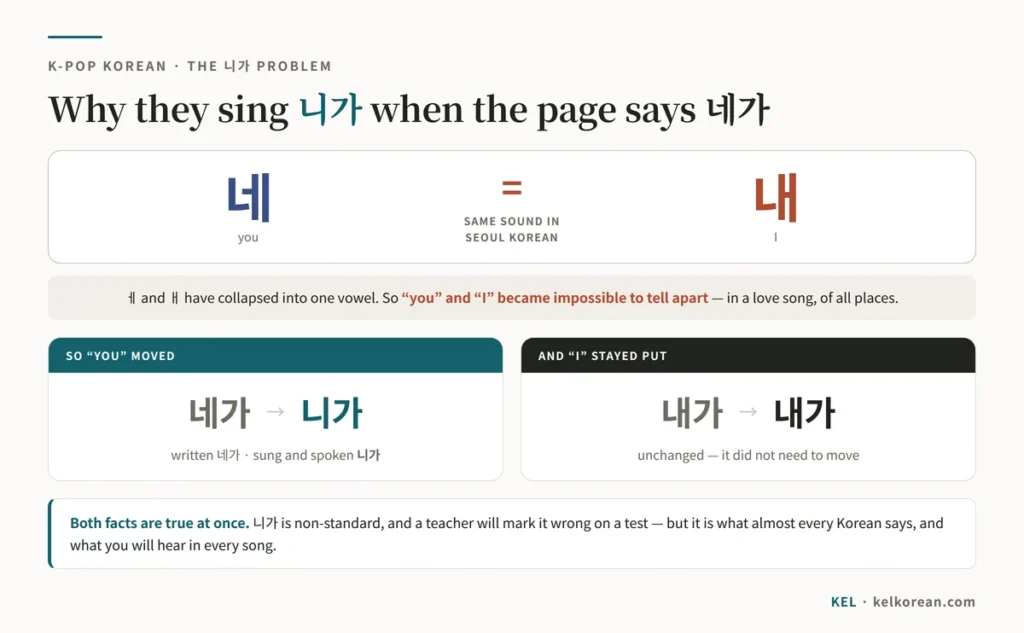
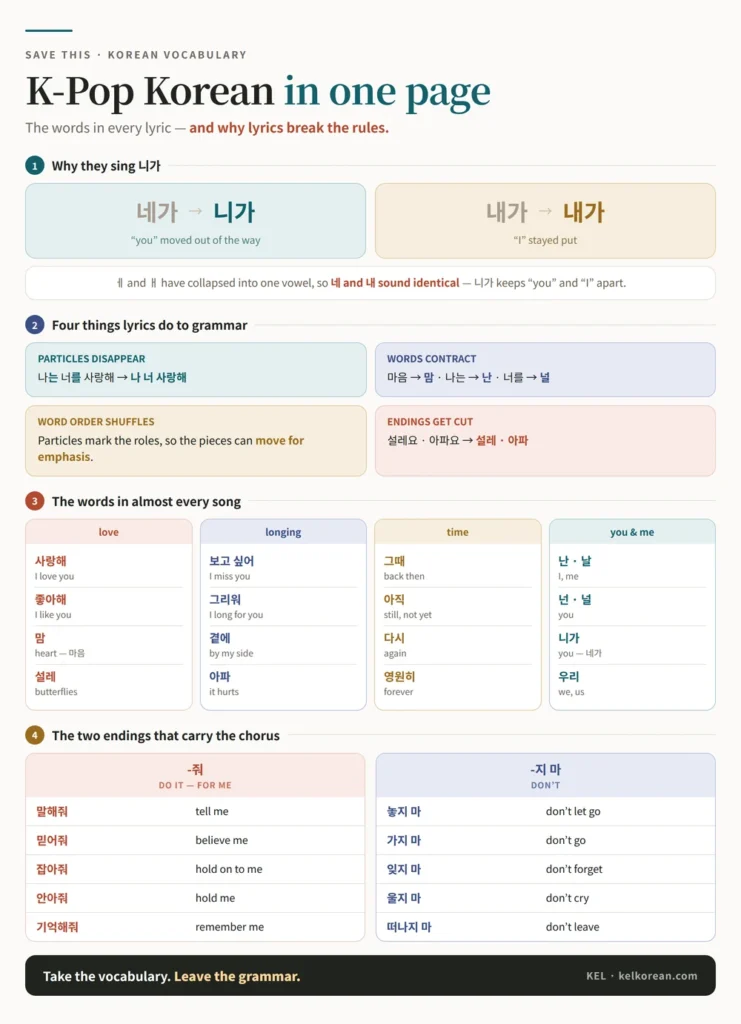
Why Lyrics Sing 니가 When the Page Says 네가
This is the single most confusing thing in K-pop Korean, and it has a clean explanation.
네가 means “you” as a subject. 내가 means “I.”
In modern Seoul Korean, the vowels ㅔ and ㅐ have collapsed into the same sound. That means 네 and 내 are now pronounced identically. In a sentence about two people, that is a disaster — the listener cannot tell who did what.
So speakers changed one of them. 네가 gets pronounced 니가 so that it no longer collides with 내가.
| Written | Sung and spoken | Means |
|---|---|---|
| 네가 | 니가 | you (subject) |
| 내가 | 내가 | I (subject) |
니가 is not standard written Korean — a Korean teacher will mark it wrong on a test. But it is what almost everyone says, and it is what you will hear in every song. Both facts are true at once.
Korean has several vowel pairs that learners struggle to separate; the one that matters most early on is covered in our guide to ㅓ vs ㅗ pronunciation.
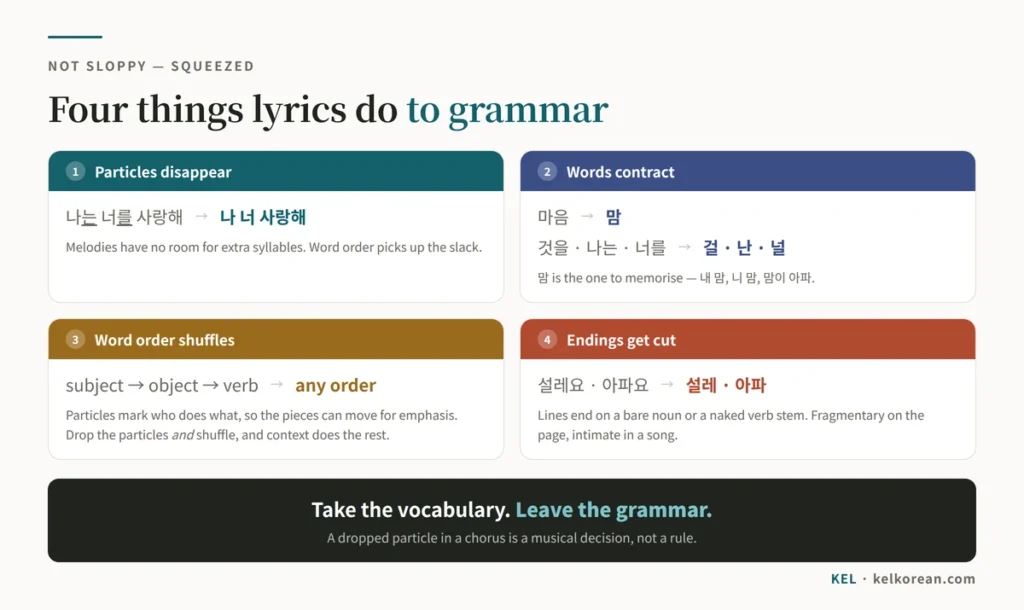
The Four Things Lyrics Do to Grammar
1. Particles disappear
Korean marks who does what with 은/는 and 을/를. Melodies do not have room for extra syllables, so lyrics drop them.
나는 너를 사랑해 → 나 너 사랑해
Nothing is lost to a Korean ear, because word order picks up the slack. The full system is in Korean particles explained.
2. Words contract
The same squeezing you hear in dramas, only harder.
| Full | In lyrics | Meaning |
|---|---|---|
| 마음 | 맘 | heart, feelings |
| 것을 | 걸 | the thing (object) |
| 것이 | 게 | the thing (subject) |
| 나는 | 난 | I |
| 나를 | 날 | me |
| 너를 | 널 | you |
| 그런데 | 근데 | but, by the way |
맘 is the one to memorise. It appears constantly — 내 맘, 니 맘, 맘이 아파 — and beginners often fail to recognise it as 마음.
3. Word order gets shuffled
Korean is subject-object-verb, but because particles mark the roles, the pieces can be moved around for emphasis without breaking the sentence. Lyrics use this freely — a line may put the object first, or leave the verb dangling at the start.
The catch is that this works because of particles. When lyrics drop the particles and shuffle the order, the sentence becomes genuinely ambiguous, and Korean listeners resolve it from context the same way you do. Our guide to Korean sentence structure explains the default order the shuffling departs from.
4. Sentences stop having endings
Textbook Korean ends in -요, -습니다 or -어. Lyrics often end on a bare noun, or a verb stem with nothing attached at all — 설레, 아파, 그리워. It reads as fragmentary on the page and lands as intimate in a song, which is exactly the intent.
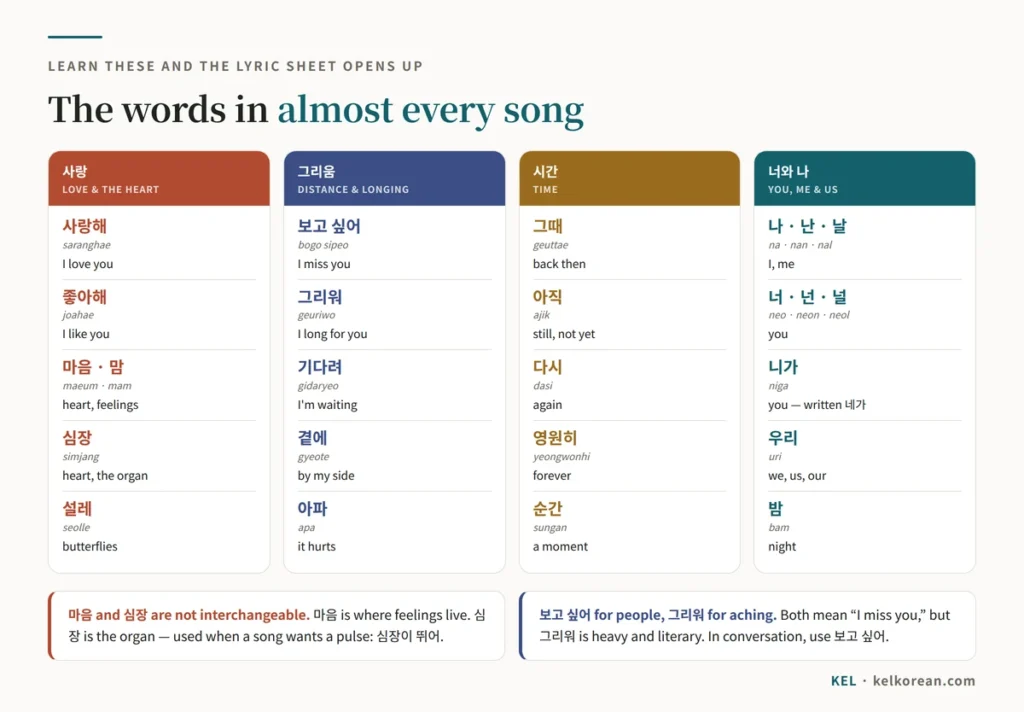
The Vocabulary That Recurs Everywhere
Learn these and a large share of any lyric sheet opens up.
Love and the heart
| Korean | Romanization | Meaning |
|---|---|---|
| 사랑 | sarang | love |
| 사랑해 | saranghae | I love you |
| 좋아해 | joahae | I like you |
| 마음 · 맘 | maeum · mam | heart, feelings |
| 심장 | simjang | heart, the organ — used for pounding |
| 설레 | seolle | to flutter, to feel butterflies |
마음 and 심장 are not interchangeable. 마음 is the emotional heart — where feelings live. 심장 is the physical one, used when a song wants a pulse: 심장이 뛰어, “my heart is pounding.”
Distance and longing
| Korean | Romanization | Meaning |
|---|---|---|
| 보고 싶어 | bogo sipeo | I miss you — literally I want to see you |
| 그리워 | geuriwo | I long for, I miss |
| 기다려 | gidaryeo | wait, I’m waiting |
| 곁에 | gyeote | by my side |
| 멀어 | meoreo | far, growing distant |
| 아파 | apa | it hurts |
보고 싶어 and 그리워 both translate as “I miss you.” 보고 싶어 is everyday and warm — it works for a friend, a parent, anyone. 그리워 is heavier and more literary, closer to I ache for. Songs use both; conversation uses 보고 싶어.
Time
| Korean | Romanization | Meaning |
|---|---|---|
| 그때 | geuttae | that time, back then |
| 아직 | ajik | still, not yet |
| 다시 | dasi | again |
| 영원히 | yeongwonhi | forever |
| 순간 | sungan | a moment |
| 밤 | bam | night |
You, me and us
| Korean | Romanization | Meaning |
|---|---|---|
| 나 · 난 · 날 | na · nan · nal | I, me |
| 너 · 넌 · 널 | neo · neon · neol | you |
| 니가 | niga | you (subject) — written 네가 |
| 우리 | uri | we, us, our |
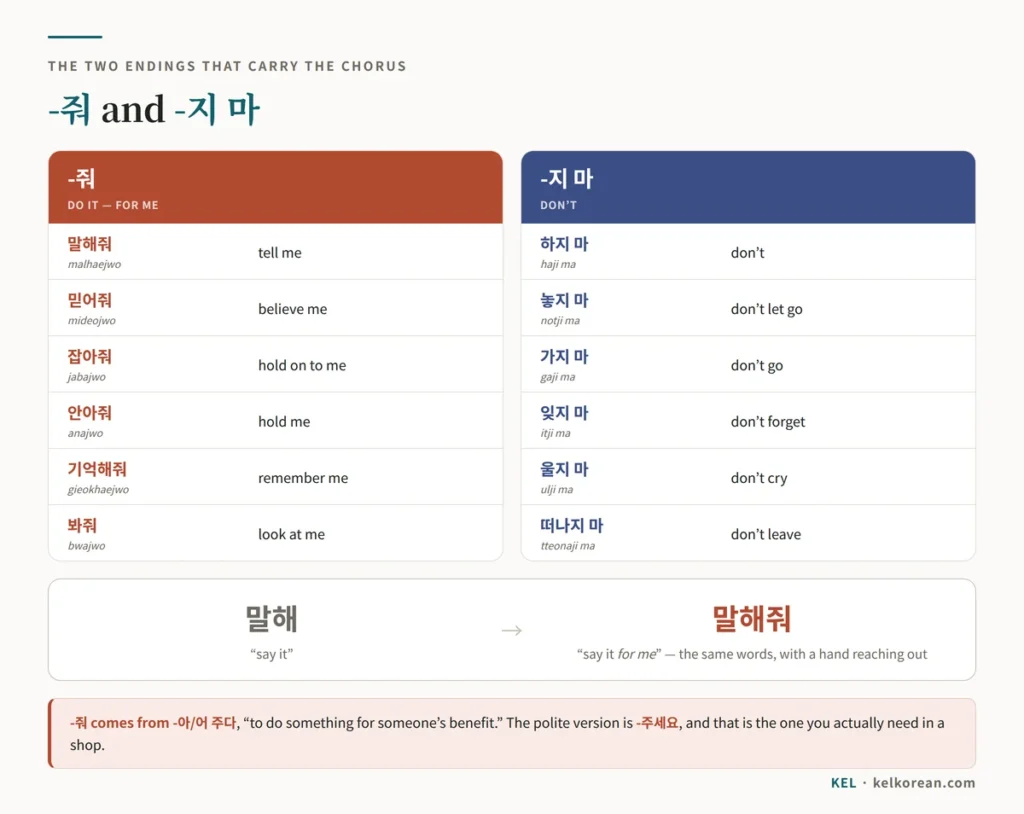
-줘: The Ending That Runs Half the Chorus
If one grammar pattern deserves your attention, it is this one.
-아/어 주다 means to do something for someone else’s benefit. In its casual command form it becomes -줘, and it turns a plain verb into a request with feeling attached.
| Korean | Romanization | Meaning |
|---|---|---|
| 말해줘 | malhaejwo | tell me |
| 믿어줘 | mideojwo | believe me |
| 잡아줘 | jabajwo | hold on to me |
| 안아줘 | anajwo | hold me |
| 기억해줘 | gieokhaejwo | remember me |
| 봐줘 | bwajwo | look at me |
The difference is real. 말해 is “say it.” 말해줘 is “say it for me” — the same words with a hand reaching out. That is why choruses are full of it.
The polite version is -주세요, which is the form you actually need in a shop or a restaurant. Our guide to Korean verb conjugation covers how the endings are built.
The Phrases You Will Hear in Song After Song
| Korean | Meaning |
|---|---|
| 괜찮아 | it’s okay |
| 하지 마 | don’t |
| 놓지 마 | don’t let go |
| 가지 마 | don’t go |
| 잊지 마 | don’t forget |
| 울지 마 | don’t cry |
| 알아 | I know |
| 몰라 | I don’t know |
Notice the pattern down the middle. -지 마 is the negative command, built from 말다, and K-pop leans on it heavily because it is short, urgent and fits any melody. If those look familiar, they are the same lines that fill drama dialogue — see K-drama Korean for the spoken versions.
Why Half a Line Is in English
Almost every K-pop song switches to English somewhere, and it is not an accident. English lines carry the hook, widen the international audience, and give the melody a different rhythmic texture — English packs more into fewer syllables than Korean does.
You will also meet Konglish in lyrics: English words that entered Korean and changed. 파이팅 is the obvious one — it means “you can do it,” not “fighting.” Several hundred Korean words are borrowed English, and they become free the moment you can read Hangul; Konglish covers the whole set, including the five that will trick you.
How to Actually Learn From Lyrics
Lyrics are a wonderful vocabulary source and a terrible grammar teacher. Use them accordingly.
Pick one song you already love. Familiarity does most of the work — you have heard the melody enough that the syllables are already in your head.
Get the Hangul, not the romanization. Romanization keeps you from ever reading, and the whole point is to attach sound to letters you can see.
Take five words. Ignore the rest. A single song has more vocabulary than you can absorb, and the poetic lines are the ones you should skip. Pull the five words that repeat.
Do not copy the grammar. A dropped particle in a chorus is a musical decision, not a rule. Learn the sentence patterns from a guide and the words from the song.
Say them out loud. The song has already trained your mouth on the rhythm. You are just attaching meaning to something you can already pronounce.
5 Mistakes Worth Avoiding
1. Writing 니가 in an exam. It is what everyone says and it is still non-standard. The written form is 네가.
2. Assuming 맘 is a different word from 마음. It is not — it is the same word, contracted.
3. Using 그리워 in casual conversation. It is heavy and literary. For a friend you have not seen in a while, 보고 싶어.
4. Learning grammar from a chorus. Choruses drop whatever does not fit the melody. Nothing there is a rule.
5. Reading lyrics in romanization. You lose the alphabet practice, and Korean romanization is inconsistent enough that you will learn the sounds wrong.
Quick Practice
What does each line mean?
- 니가 보고 싶어
- 내 맘 알아?
- 놓지 마
- 말해줘
- 다시 그때로
Answers
- “I miss you.” 니가 is 네가 — “you.”
- “Do you know how I feel?” 맘 is 마음.
- “Don’t let go.” 놓다 plus the -지 마 negative command.
- “Tell me” — with the -줘 that means for my sake.
- “Back to that time again.” No verb, and none needed.
Frequently Asked Questions
Can you learn Korean from K-pop?
For vocabulary and pronunciation, yes — and the repetition of a song you love is a genuinely efficient way to fix words in memory. For grammar, no. Lyrics drop particles, cut sentence endings and reorder freely, so a chorus teaches you patterns that are wrong outside the song.
Why do they sing 니가 instead of 네가?
Because ㅔ and ㅐ have merged in modern Seoul pronunciation, which makes 네가 (“you”) sound identical to 내가 (“I”). Saying 니가 keeps them apart. It is universal in speech and non-standard in writing.
What does 맘 mean?
It is 마음 — heart, mind, feelings — contracted to one syllable so it fits the melody. 내 맘 is “my heart.”
What is the difference between 보고 싶어 and 그리워?
Both mean “I miss you.” 보고 싶어 is everyday and works for anyone; 그리워 is heavier and more poetic. In conversation, use 보고 싶어.
What does -줘 mean at the end of a word?
It marks a request made for the speaker’s benefit. 말해 is “say it”; 말해줘 is “say it for me.” The polite form is -주세요.
Should I use romanization for lyrics?
No. Hangul takes about a week to learn and everything after that gets easier. Romanization is a permanent tax on your progress.
Final Thoughts
K-pop is a much better teacher than people expect, as long as you ask it the right question. It is superb at vocabulary, rhythm and pronunciation. It is unreliable at grammar, and it will happily teach you 니가 as though it were the written form.
Start with the words that repeat — 사랑, 맘, 보고 싶어, 괜찮아, 다시 — and with -줘, which carries half the choruses ever recorded. Take the grammar somewhere else.
And once the words are attaching, the same vocabulary shows up in dialogue with the endings put back on. That is what K-drama Korean covers.
Leave a Reply