Thank you in Korean looks like a single phrase in every phrasebook — 감사합니다, gamsahamnida — and then you arrive in Korea and hear four or five different versions in a single afternoon. That is not because Koreans are inconsistent. It is because thanking someone in Korean means choosing a level first.
One of my beginner students thanked me in Korean for the first time with 고마워 — the version you would use with a close friend or a younger sibling, not with a teacher. It was not rude, exactly. It was just the wrong setting on the dial. So instead of correcting the one word, I taught the whole dial: 고마워, 고마워요, 고맙습니다, 감사합니다, and how Koreans choose between them without thinking.
That dial is what this article is. By the end you will know which thank-you to use with whom, why 감사합니다 and 고맙습니다 are not a politeness ranking, how to say what you are thankful for, and what to say back when someone thanks you — which, it turns out, is not the phrase in the textbook.
The Short Answer
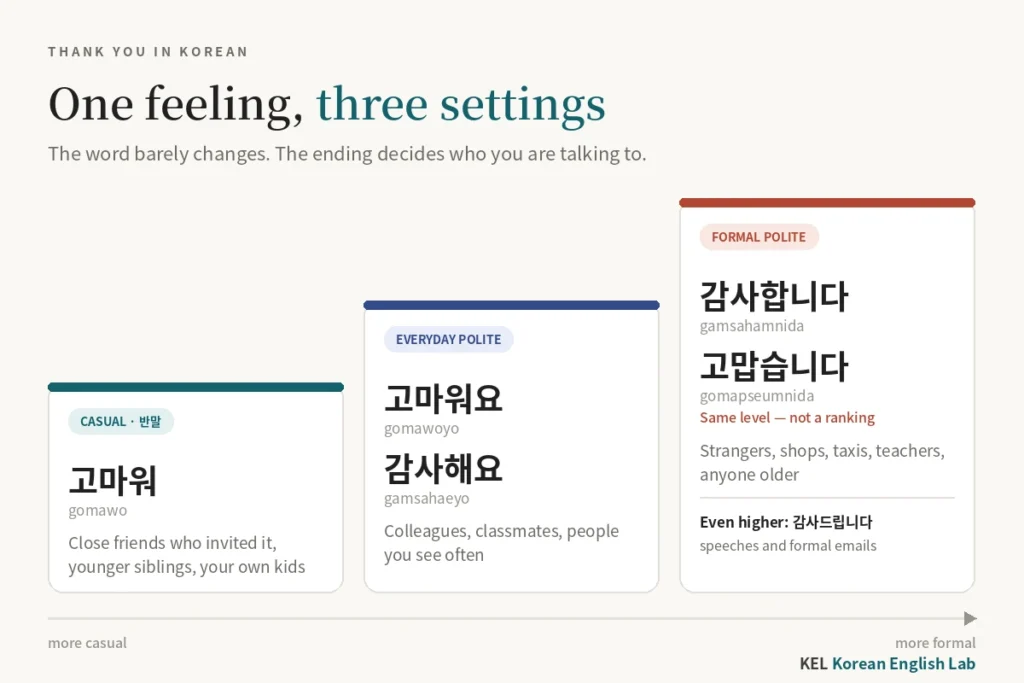
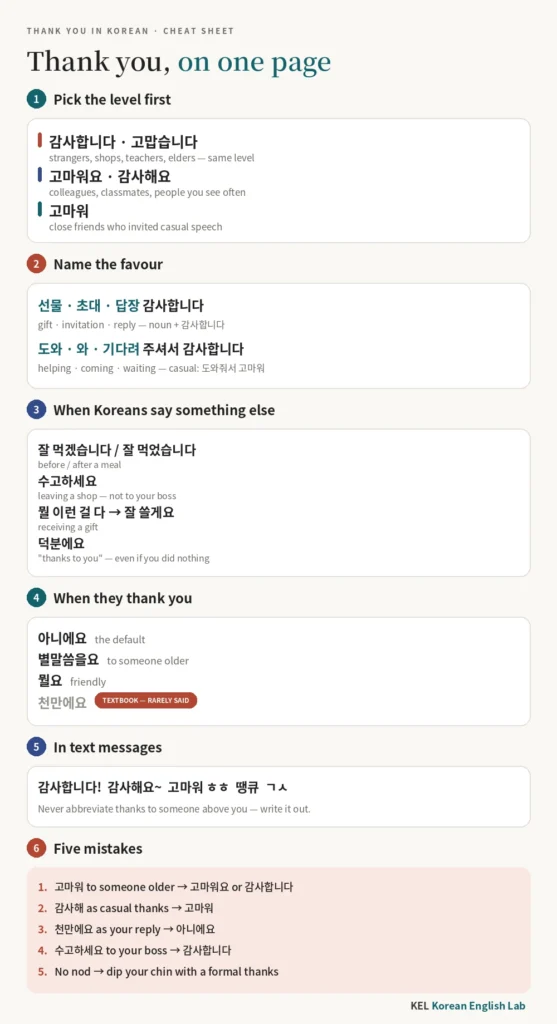
If you only remember one thing: say 감사합니다 to anyone you do not know well, and keep 고마워 for close friends your age or younger. Everything else in this article is refinement.
| Korean | Romanisation | Level | Use it with |
|---|---|---|---|
| 감사합니다 | gamsahamnida | Formal polite | Strangers, shop staff, taxi drivers, teachers, anyone older |
| 고맙습니다 | gomapseumnida | Formal polite | The same people — it is not a step down |
| 고마워요 / 감사해요 | gomawoyo / gamsahaeyo | Everyday polite | Colleagues, acquaintances, people you see often |
| 고마워 | gomawo | Casual (반말) | Close friends, younger siblings, your own children |
Notice that there is no row for “slightly more polite than 감사합니다 but less stiff.” That space does not really exist in thanks. When in doubt, go formal. No stranger in Korea has ever been offended by 감사합니다.
Why 고마워 Landed Wrong
Here is the idea behind the dial, because it is the part the phrasebooks skip.
고마워 is not a rude word. It is a casual word. For thanks, Korean does not switch to a different word to be polite; it keeps the same word and changes the ending. 고마워, 고마워요 and 고맙습니다 are one word at three settings, exactly as 먹어, 먹어요 and 먹습니다 are. The ending does not change the meaning. It changes who you are talking to.
So when a learner says 고마워 to a teacher, a Korean hears the right feeling at the wrong distance. It is roughly like an English speaker thanking their new boss with “cheers, mate” — warm, well-meant, and slightly startling. Most Koreans will smile and let it pass from a foreigner. But they notice, and it is an easy thing to get right.
The dial turns on two questions, asked in this order:
1. Are they older than you, or in a position above you? Teacher, boss, customer, shopkeeper, your friend’s parents. If yes, you are at 감사합니다 or 고맙습니다, and you stay there.
2. Have you agreed to drop the formality? Between equals, Koreans start polite and only switch to casual speech — 반말 — once someone explicitly offers, usually with 말 편하게 하세요 or 말 놓으세요, “speak comfortably.” Until that moment, 고마워요 is the ceiling. After it, 고마워 is correct, and 고마워요 starts to sound a little distant.
That second question is the one foreigners miss. Age alone does not unlock 고마워. A classmate your own age is still 고마워요 until one of you says the magic words. If the whole system of levels is new to you, our guide to Korean honorifics lays it out from the beginning, and Korean sentence endings shows how the same ending swap works on every verb.
감사합니다 vs 고맙습니다: Not a Politeness Ranking
This is the most common question learners ask about thanks, and most English-language answers get it wrong. They say 감사합니다 is more formal and 고맙습니다 is a softer step down. It is not. They sit on the same level.
The real difference is origin. 감사 is a Sino-Korean word, from the characters 感謝 — “feel” and “thank.” 고맙다 is native Korean, with no Chinese characters behind it. Korean is full of pairs like this, and in most of them the Sino-Korean word sounds a touch more official, which is where the myth comes from. Between these two, the effect is small enough that Koreans use them interchangeably in the same conversation.
Where the difference does show is at the two ends of the dial:
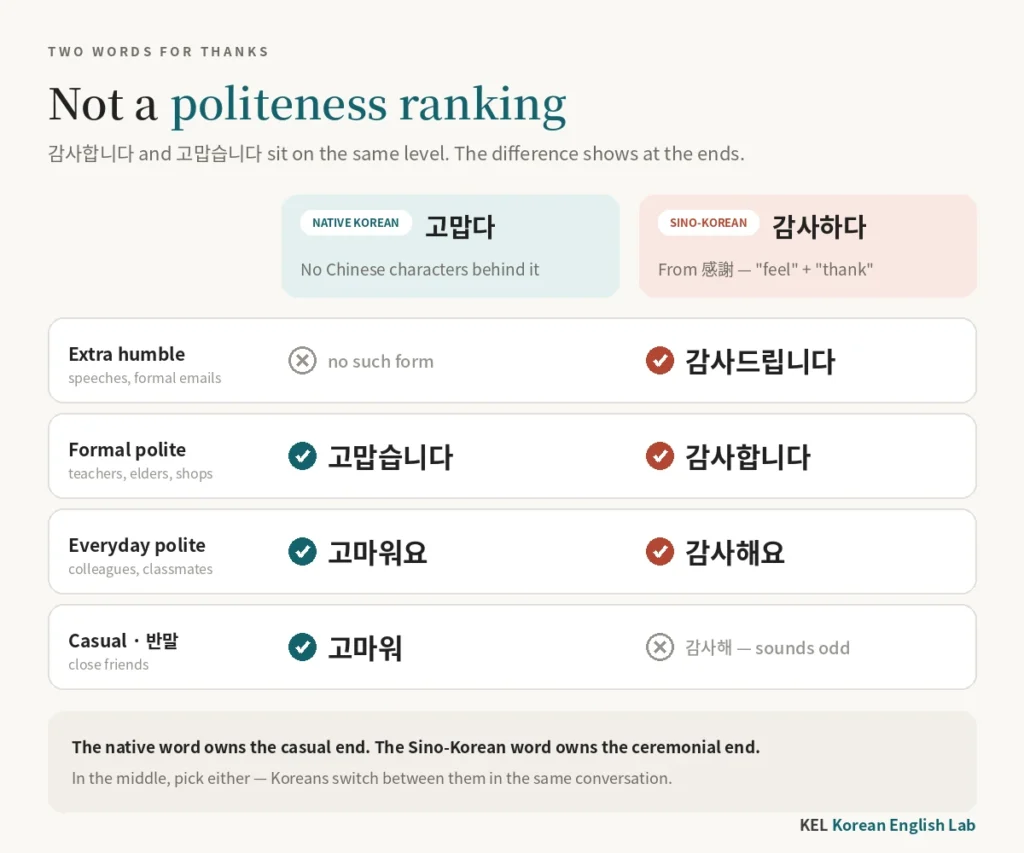
| Level | 고맙다 (native) | 감사하다 (Sino-Korean) |
|---|---|---|
| Extra humble | — no form | 감사드립니다 ✓ |
| Formal polite | 고맙습니다 ✓ | 감사합니다 ✓ |
| Everyday polite | 고마워요 ✓ | 감사해요 ✓ |
| Casual | 고마워 ✓ | 감사해 — sounds odd |
At the top, only 감사 can be raised further. 감사드립니다 — “I offer my thanks” — uses the humble verb 드리다, and it is what you hear in speeches, formal emails and announcements. There is no equivalent built on 고맙다.
At the bottom, only 고맙다 works. 고마워 is completely natural between friends. 감사해 is grammatical, but it sounds like someone trying to be casual and formal at the same time — a Korean ear hears the mismatch. So the native word owns the casual end, and the Sino-Korean word owns the ceremonial end. In the middle, pick either.
You may also run into the claim that 감사 is a Japanese import from the colonial period and that “real” Koreans should say 고맙습니다. It is a popular story, and it does not hold up — 感謝 was in Korean use long before the twentieth century, like thousands of other Sino-Korean words. Some Koreans prefer 고맙습니다 for its warmth, and that is a perfectly good reason. It is just not a rule.
Say What You Are Thanking Them For
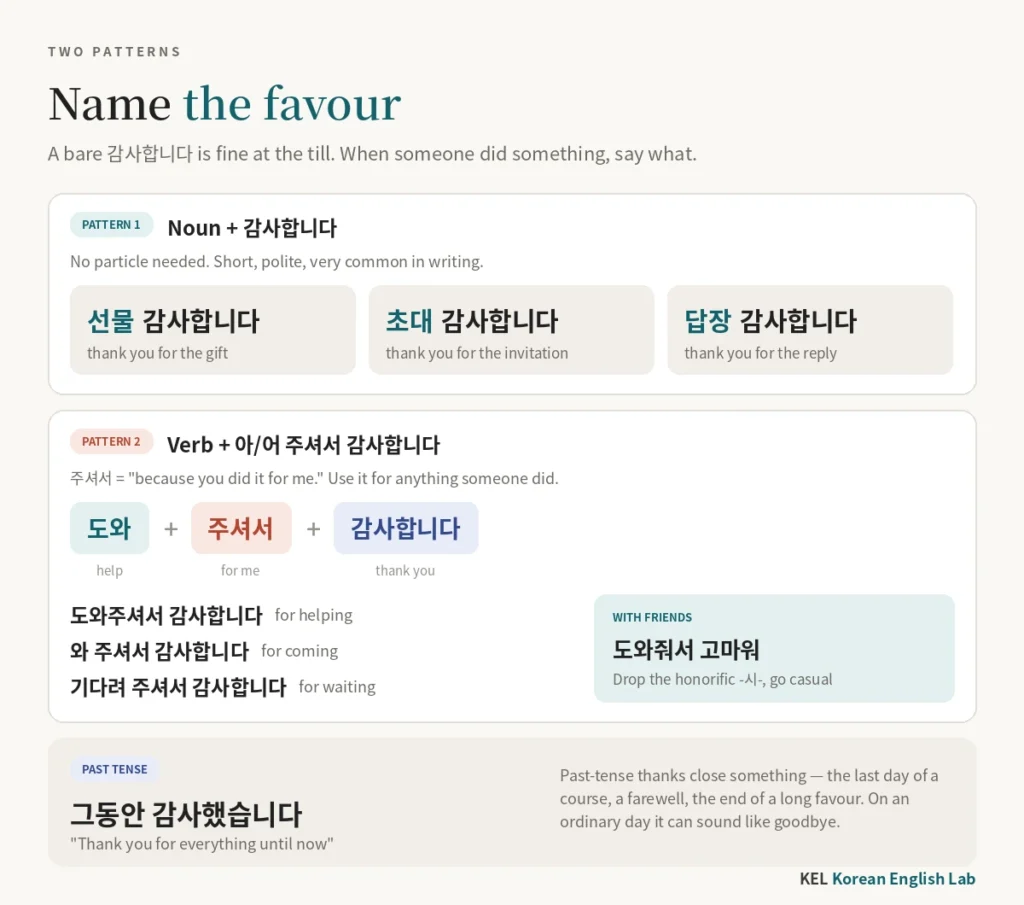
A bare 감사합니다 is fine at a till. When someone has actually done something for you, Koreans usually name it — and there are two patterns that cover almost every case.
Pattern one: a noun, then thanks
Put the thing in front: 선물 감사합니다 (thank you for the gift), 초대 감사합니다 (for the invitation), 답장 감사합니다 (for the reply). No particle needed. It is short, polite and very common in writing.
Pattern two: an action, with 주셔서
For something someone did, use the verb plus -아/어 주셔서, “because you did it for me”: 도와주셔서 감사합니다 (thank you for helping), 와 주셔서 감사합니다 (for coming), 기다려 주셔서 감사합니다 (for waiting). You will hear that last one in every Korean shop and on every delayed train.
With friends, drop the honorific -시- and go casual: 도와줘서 고마워, 와 줘서 고마워. Same structure, one notch down the dial.
The past tense has its own job
감사했습니다 and 고마웠어 are not just “I was thankful.” They close something. The last day of a course, a colleague’s farewell, the end of a long favour — that is when you hear 그동안 감사했습니다, “thank you for everything until now.” Said on an ordinary day it can sound like a goodbye, so save it for real endings.
When Koreans Say Something Else Instead
A lot of Korean gratitude never uses the word “thanks” at all. These are the ones worth recognising.
At meals. 잘 먹겠습니다 before eating and 잘 먹었습니다 after are the thank-you for food, said to whoever cooked or paid. Our guide to ordering food in Korean covers when to say them in a restaurant.
Leaving a shop or a taxi. Many Koreans say 수고하세요 — roughly “keep up the good work” — on the way out. It acknowledges someone’s labour, which is its own kind of thanks. One caution: etiquette guides advise against saying it to someone above you, because encouraging someone to keep toiling is something you say sideways or downward. To a shopkeeper it is fine. To your boss, say 감사합니다. Its past form, 수고하셨습니다, is covered in our guide to Korean greetings.
Receiving a gift. The first words are often a protest, not thanks: 뭘 이런 걸 다, “oh, you shouldn’t have.” Then comes a promise about the gift itself — 잘 쓸게요 (“I’ll use it well”) or 잘 먹을게요 (“I’ll enjoy eating it”). To a Korean, saying how you will use the gift is more grateful than the word 감사 alone.
Thanks to you. Ask a Korean how their exam or their new job is going and you may hear 덕분에요, “thanks to you” — even when you did nothing at all. It is a small, generous habit: crediting other people for your good luck.
And sometimes, sorry. When a favour feels too big, Koreans often apologise instead of thanking. That instinct has its own section in our guide to saying sorry in Korean.
Why Koreans Thank Their Families Less
Learners who stay with a Korean family often notice something that feels cold at first: people thank their parents and siblings much less than they would in English. A mother passes the rice, and nobody says anything.
It is not ingratitude. In a close Korean relationship, explicit thanks can create distance — it marks the favour as something that needed acknowledging, which is what you do with outsiders. Family is supposed to be inside the line. The feeling is carried by 정, the long-built attachment between people who look after each other, which we explain in our piece on 눈치, 정 and 한. Gratitude shows up as care returned — the fruit peeled for you, the call on a birthday — rather than as words.
This is changing, and many younger Koreans say 고마워 to their parents freely. But if you ever hear a Korean say 엄마, 고마워 and then look faintly embarrassed, now you know why. It is a big sentence at home.
One practical note for guests: none of this applies to you. As a visitor, thank your host family every time. You are not inside the line yet, and your 감사합니다 will be noticed and appreciated. The Korean family terms guide will help you address everyone correctly while you do it.
How to Answer a Thank You
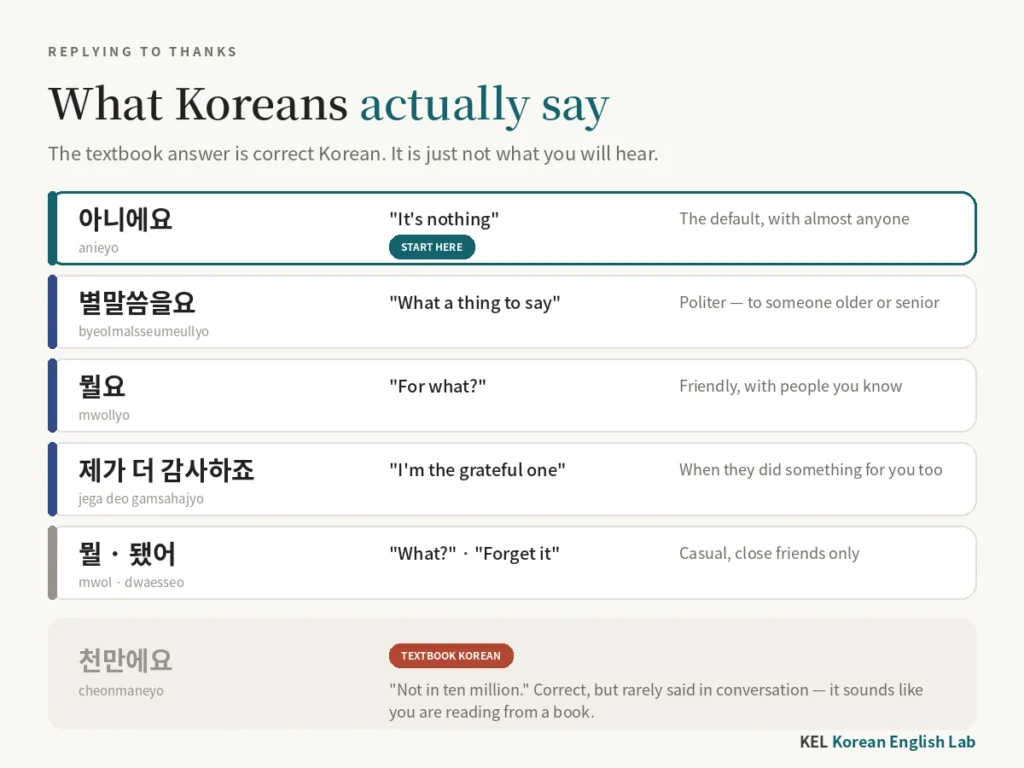
Every textbook teaches 천만에요 — “not in ten million” — as the reply to thanks. It is correct Korean. It is also almost never said in everyday conversation. Use it with a Korean friend and it will sound like you are reading from a textbook, because you are.
Here is what people actually say:
| Reply | Literally | When |
|---|---|---|
| 아니에요 | “It’s not (anything)” | The default. Works with almost anyone |
| 별말씀을요 | “What a thing to say” | Politer — to someone older or more senior |
| 뭘요 | “For what?” | Friendly, among people you know |
| 제가 더 감사하죠 | “I’m the one who’s grateful” | When they did something for you too |
| 뭘 / 됐어 | “What?” / “Forget it” | Casual, with close friends |
아니에요 is the one to learn first. It is the same modest “oh, not at all” that Koreans use to brush off a compliment, which we cover in our guide to yes and no in Korean. Say it with a small wave of the hand and you will sound completely natural.
Thank You in Text Messages
Texting moves the dial slightly. The same levels apply, but the endings get softened with extra characters.
감사합니다! or 감사해요~ is the safe choice with anyone you are not close to — the exclamation mark and the tilde add warmth that the formal ending lacks on screen. 고마워 ㅎㅎ is the friendly version. Among friends you will also see 땡큐, the English word in Hangul, and the consonant-only ㄱㅅ — short for 감사 — which our guide to Korean texting slang explains along with the rest of the shorthand.
The rule upward is simple: never abbreviate thanks to someone above you. A ㄱㅅ to your teacher reads the way “thx” reads in a formal email. Write it out.
Frequently Asked Questions
How do you say thank you in Korean?
The safe, polite form is 감사합니다 (gamsahamnida) or its equal, 고맙습니다 (gomapseumnida). With colleagues and acquaintances, 고마워요 is common. With close friends, 고마워.
Is 감사합니다 more polite than 고맙습니다?
No. They are on the same level. 감사합니다 comes from Chinese characters and 고맙습니다 is native Korean, and Koreans use both with teachers, customers and elders. The only real differences are at the extremes: 감사드립니다 exists but has no 고맙다 equivalent, and 고마워 is natural while 감사해 sounds odd.
What do you say back when someone says 감사합니다?
아니에요, “not at all,” is the everyday answer. To someone older, 별말씀을요. 천만에요 is correct but sounds like a textbook.
Do Koreans bow when they say thank you?
For formal thanks in person, yes — usually a small nod or a slight bend at the neck. Deep bows are for serious occasions. Between friends, no bow is needed — but with anyone you would say 감사합니다 to, a thank-you without the nod can feel half-finished. A dip of the chin is enough.
One Dial for Every Verb
My student’s 고마워 was not a mistake of feeling. It was a mistake of setting — and that is the easiest kind to fix, because the dial that turns 고마워 into 감사합니다 is the same one that turns every verb in the language. Learn it once for thank you in Korean and you have learned it for everything else.
If you are starting today, learn three things: 감사합니다 for everyone you do not know well, 고마워 for the friends who have invited it, and 아니에요 for when the thanks comes back to you. Then add 주셔서 감사합니다 so you can say what you are grateful for. Our list of the first 100 Korean words will give you plenty of favours to name.
Written by Minhyung Cha — 25 years teaching Korean, and 15+ years running an English academy in South Korea. I live and work in Busan, and every example on this site is checked as a native speaker. More about KEL.
Leave a Reply