
Geodae Gomtang is the restaurant in Haeundae with the queue outside. The name means “giant gomtang,” and the bowl is the reason people wait: Korean beef simmered until the broth turns milky, served with rice, kimchi and a heap of green onion. When my husband and I went on Hangul Day — 9 October, a public holiday that fell on a Friday this year — the screen at the door told us there were 139 teams ahead of us. We waited more than two hours. I would do it again, but I would do it differently, and that is what this guide is for.
I live just outside Busan and have taught Korean for over twenty-five years, so I read the menu the way a visitor cannot yet: as a set of very useful Korean words. Below is what gomtang actually is, how the waiting list works, how to read the three broths and seven bowls on the menu, what we ordered, how Koreans eat it, and the handful of phrases that make the visit easy. Every price comes from the menu on our table.
What Gomtang Is
곰탕 (gomtang) is beef soup made by simmering beef — meat, bones, or both — for many hours. The first syllable is usually traced to the verb 고다 (goda), “to boil something down slowly,” and 탕 (tang) is the word for a hearty soup you will see at the end of dozens of dish names, from 갈비탕 to 삼계탕. So 곰탕 is, more or less, “long-simmered soup.”
Koreans will tell you, sometimes at length, how gomtang differs from its cousin 설렁탕 (seolleongtang). The usual line is that gomtang leans on meat and gives a clearer broth, while seolleongtang leans on bones and comes out cloudy white. In practice the two overlap, and Geodae Gomtang makes the point for you: it serves gomtang in both a clear and a milky version, and lets you choose. What they share is the method. The broth arrives almost unseasoned, and you finish it yourself at the table.
Busan has its own soup that people come for, the pork-based 돼지국밥 (dwaeji gukbap). Gomtang is the beef side of the same idea — rice and broth as a whole meal — and our list of Korean food words covers the wider family of 국, 탕 and 국밥.
Name, Address and Hours
The sign on the wall is a lesson in itself. The big brushstroke characters are 巨大, Chinese characters read in Korean as 거대 (geodae), “huge” or “giant.” A large share of formal Korean vocabulary is built from Chinese characters like these, and 거대 is one you will meet again in words like 거대하다, “to be enormous.” The English spelling on the menu, Geodae Gomtang, follows the official romanisation, which is why it looks nothing like how an English speaker would guess the sound.
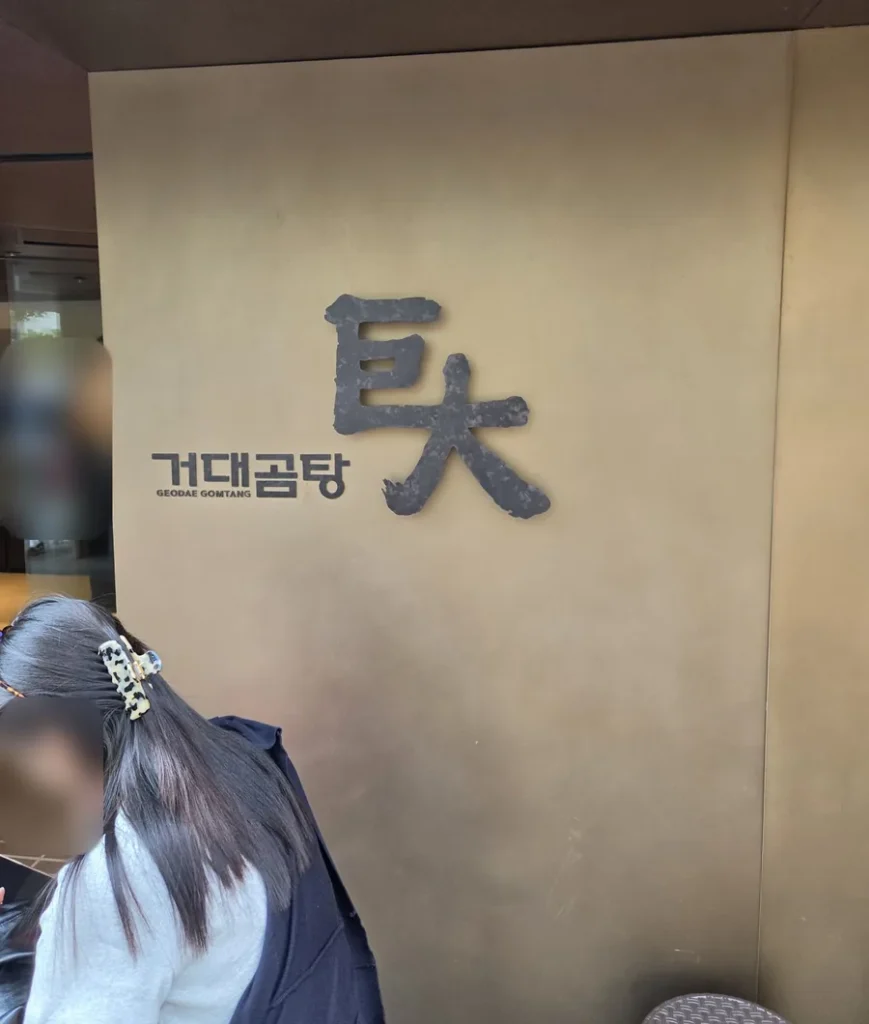
We went to the main branch, 거대곰탕 본점 (bonjeom, “main branch”). The Korean address is 부산 해운대구 해운대해변로 163, on the ground floor of a residential building’s shopping arcade. Do not try to find it from the English address. Search 거대곰탕 본점 in Naver Map, which our guide to Korea travel apps explains, and follow the walking route. If you are coming by taxi, show the driver the Korean name on your screen; our guide to taking a taxi in Korea covers the rest.
Recent reports give the hours as 7 a.m. to 9 p.m. every day, with last orders at 8:30 p.m. That early opening matters: gomtang is a breakfast food in Korea as much as a dinner one, and the quietest time to arrive is often the first hour of the morning. Hours change, so check the listing in Naver Map on the day.
The Wait: 139 Teams Ahead
There is no line of people on the pavement. Instead, a tablet by the door runs a waiting list through CatchTable (캐치테이블), one of the reservation and waitlist apps Korean restaurants use. You enter a mobile phone number, and the system sends you updates by KakaoTalk as your turn approaches. A small LANGUAGE button at the top of the screen switches it out of Korean. The screen on our visit showed 현재 웨이팅 139팀 — “currently waiting: 139 teams.” Note the counter: Korean counts restaurant parties in 팀 (tim), from the English team, not in people.
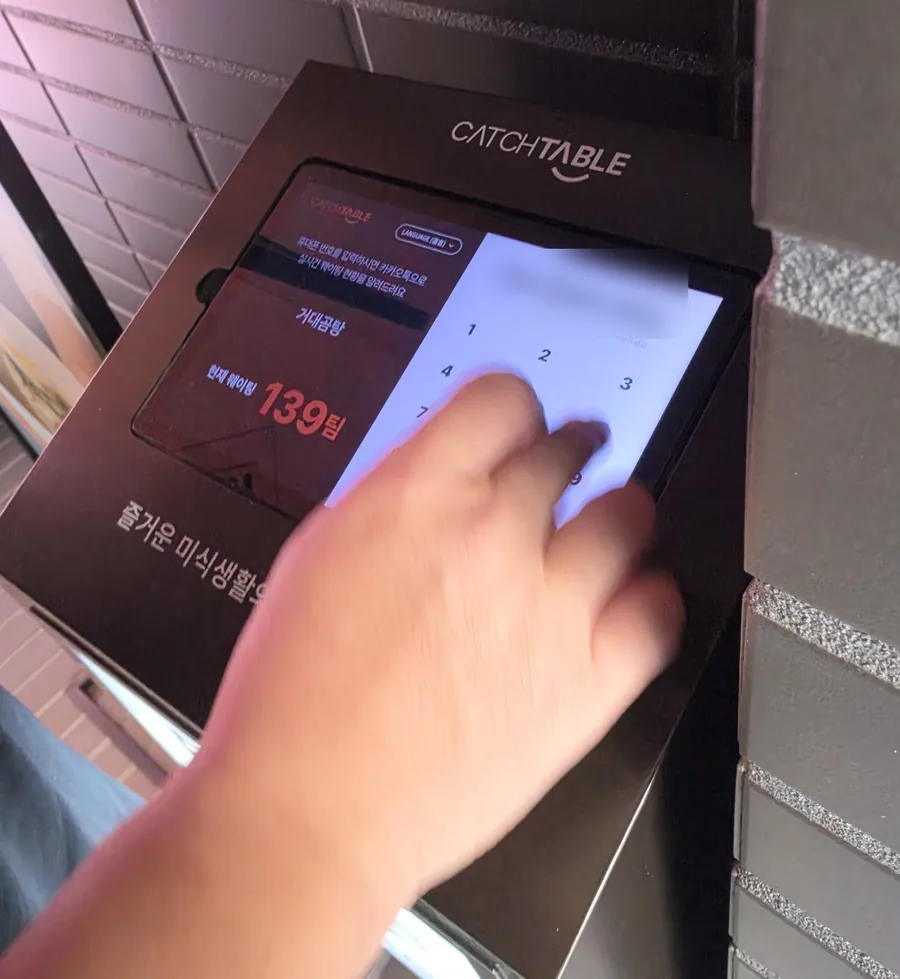
The kiosk is designed around a Korean mobile number, the kind that begins with 010. If you are travelling without one, ask a staff member before you join the list rather than after; they deal with overseas visitors every day. Once you are registered, you do not have to stand outside. We registered, walked along Haeundae Beach, and came back as the count dropped.
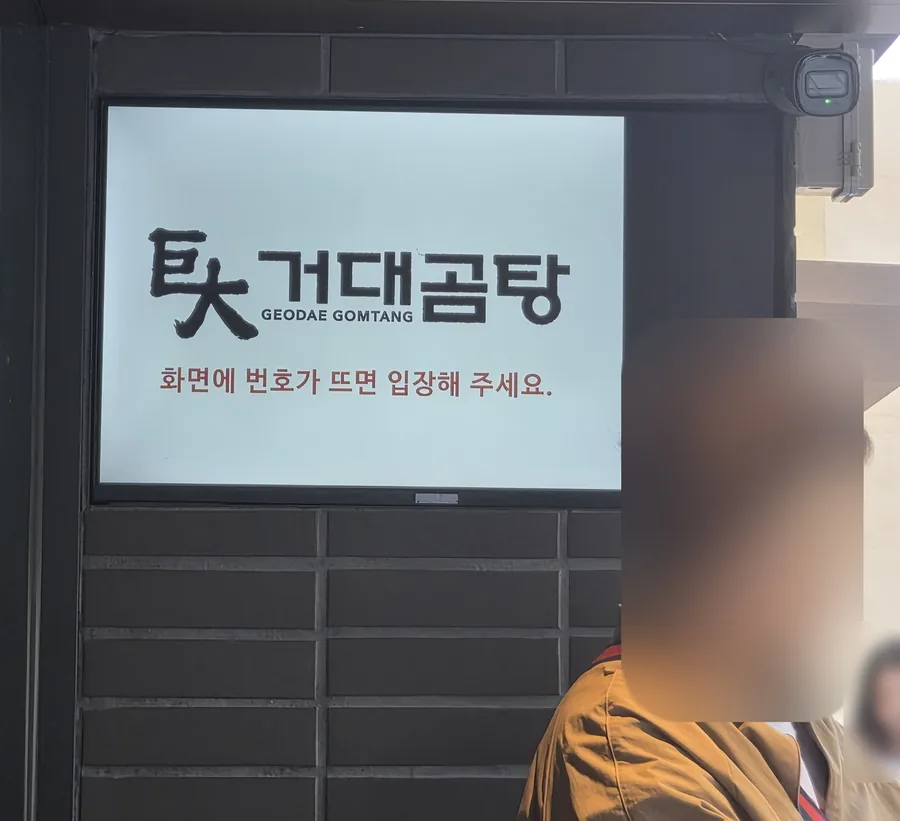
When your turn comes, a screen above the entrance displays your number, with one line of Korean underneath:
화면에 번호가 뜨면 입장해 주세요. — “When your number appears on the screen, please come in.”
It is a good sentence to take apart. 화면 is “screen,” 번호 is “number,” and 뜨다 means “to rise” or “to float” — the same verb used for the sun coming up, and in modern Korean for anything that pops up on a screen. -면 is “when” or “if,” and 입장해 주세요 is “please enter.” You will see 입장 on cinema, museum and concert signs too.
How to wait less than we did
- Avoid weekends, public holidays and meal times. We went on a holiday, which is the busiest possible kind of day. Others report waits of ten minutes on an ordinary evening, so the range is wide.
- Try breakfast or mid-afternoon. The early opening makes the first hour of the day, and the gaps between meals, your best chance.
- Register first, then explore. Haeundae Beach and the streets around it fill two hours without effort.
- Keep your phone charged and your notifications on. If your number comes up and you are not there, you may lose your turn.
Reading the Menu: Three Broths
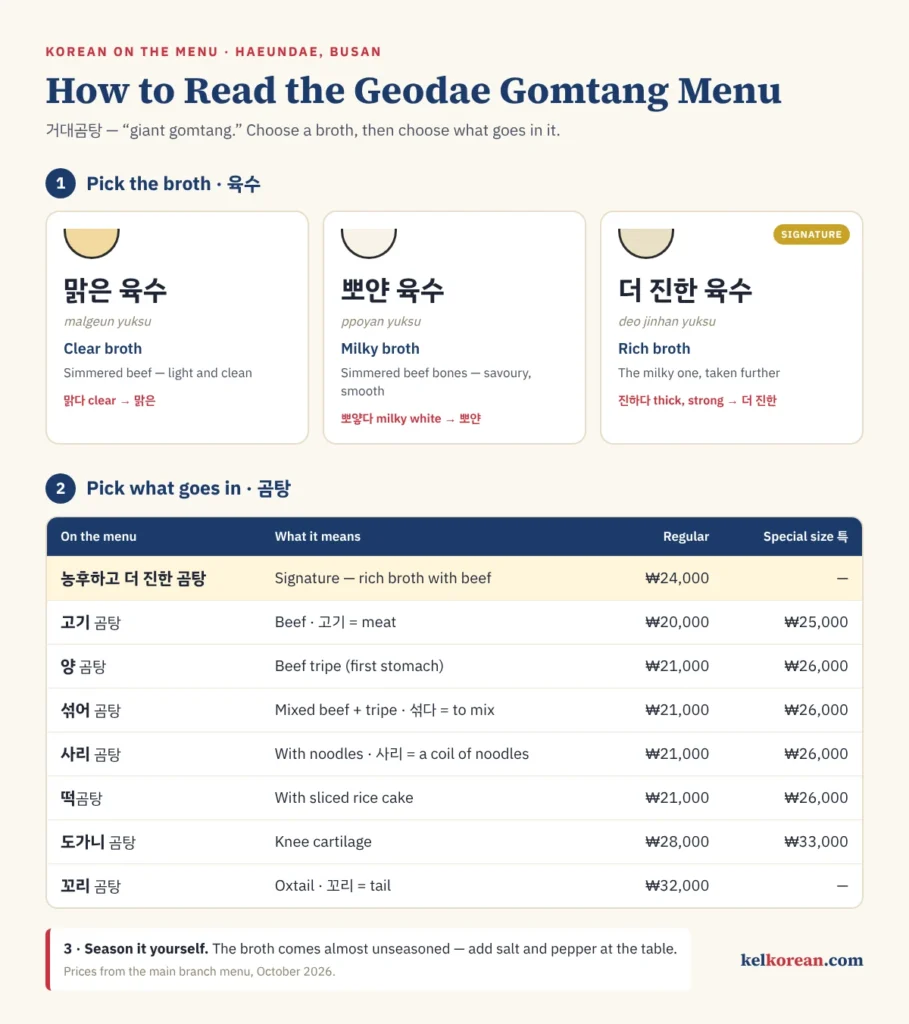
The menu is printed in Korean, English, Chinese and Japanese, which helps, but the English labels flatten a distinction that matters. Before you choose what goes in the bowl, you choose the broth, and there are three.
| Korean | Romanisation | What it is |
|---|---|---|
| 맑은 육수 | malgeun yuksu | Clear broth from simmered beef — light and clean |
| 뽀얀 육수 | ppoyan yuksu | Milky broth from simmered beef bones — savoury and smooth |
| 더 진한 육수 | deo jinhan yuksu | Rich broth — the milky one, taken further. Used in the signature bowl |
Here is where a teacher cannot resist. All three names follow the same pattern: an adjective with an ending that lets it sit in front of a noun. 맑다 (clear) becomes 맑은. 뽀얗다 (milky white) becomes 뽀얀. 진하다 (strong, thick) becomes 진한, and 더 in front means “more.” The signature dish goes one step further and stacks two: 농후하고 더 진한 곰탕, “rich and even deeper gomtang.” 농후하다 is a formal word you will mostly see on menus and in food writing. Learn this one ending and you can read half the descriptions on any Korean menu; our guide to essential Korean grammar patterns shows how it works with other words.
Along the top of the price grid are three columns: Beef consommé (the clear broth), Milky Soup, and Special Size, a bigger bowl. Most bowls cost the same whichever broth you pick, so choose by taste, not price.
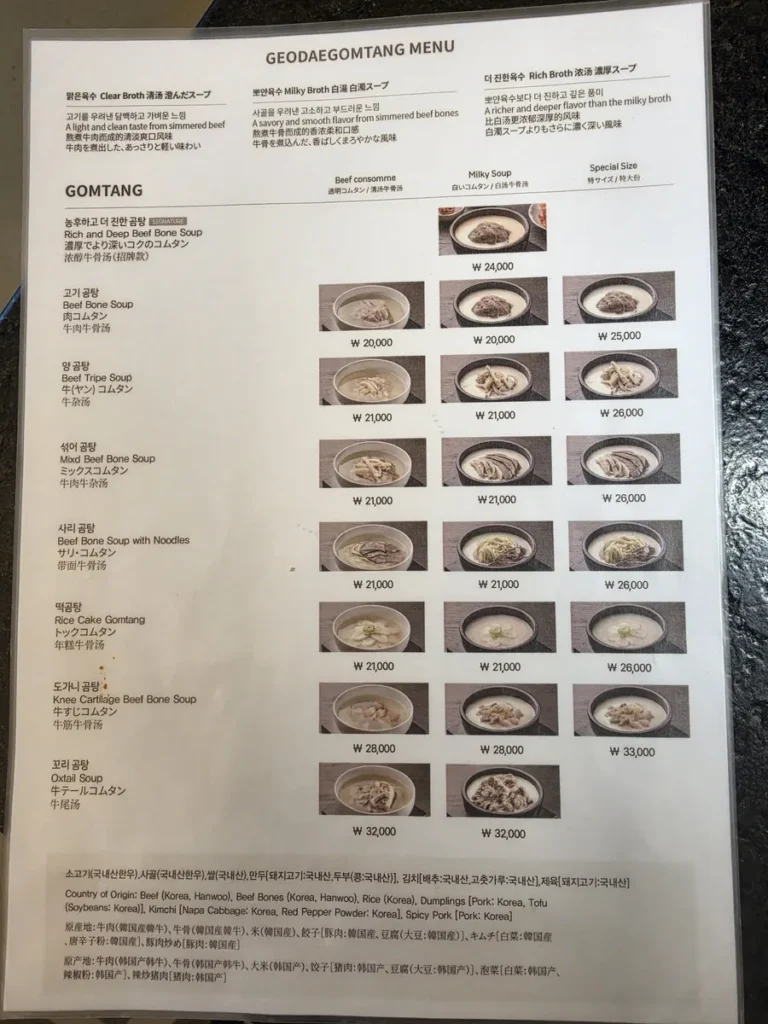
What goes in the bowl
The first word of each dish tells you what is added to the broth. These are the prices on our visit, in October 2026, for a regular bowl and the special size.
| On the menu | Meaning | Regular | Special size |
|---|---|---|---|
| 농후하고 더 진한 곰탕 | Signature: rich broth with beef | ₩24,000 | — |
| 고기 곰탕 | Beef — 고기 means meat | ₩20,000 | ₩25,000 |
| 양 곰탕 | Beef tripe — 양 is the first stomach | ₩21,000 | ₩26,000 |
| 섞어 곰탕 | Mixed beef and tripe — from 섞다, “to mix” | ₩21,000 | ₩26,000 |
| 사리 곰탕 | With noodles — 사리 is a coil of noodles | ₩21,000 | ₩26,000 |
| 떡곰탕 | With sliced rice cake — 떡 | ₩21,000 | ₩26,000 |
| 도가니 곰탕 | Knee cartilage — soft and gelatinous | ₩28,000 | ₩33,000 |
| 꼬리 곰탕 | Oxtail — 꼬리 means tail | ₩32,000 | — |
A few of these words travel well. 사리 is the same word you use to add a portion of noodles to a stew anywhere in Korea. 꼬리 also means the tail of a dog or a cat. And 양 is a trap for learners, because the same sound also means “sheep” and “amount.” On a beef menu, it is tripe. The first line of the origin notice at the bottom of the menu, 국내산 한우, means the beef and bones are Korean Hanwoo cattle.
Beyond the Soup
The second page is for sharing, and for groups it is where the evening gets expensive.
- 한우수육 (hanu suyuk) — sliced boiled Hanwoo beef, ₩68,000 for a medium plate and ₩88,000 for a large. 수육 means boiled, sliced meat, served with a dipping sauce.
- 소머리수육 — boiled beef head meat, ₩54,000. 소 is cow, 머리 is head.
- 한우 1++ 서울식 불고기 — Seoul-style bulgogi from top-grade Hanwoo, ₩45,000, with a minimum of two servings. 2인분 이상 on the menu means “two portions or more.”
- 제육 — spicy stir-fried pork, ₩28,000, and 양무침, spicy seasoned tripe, ₩18,000.
- 평양냉면 and 비빔냉면 — cold buckwheat noodles, in broth or with spicy sauce, ₩17,000.
- Dumplings — North Korean-style or kimchi, steamed or pan-fried, ₩8,000 for three and ₩15,000 for six.
The extras at the bottom are small but telling. An extra bowl of rice, 공기밥, is ₩2,000, and you can swap it for low-sugar farro rice for ₩1,000 more. 거대 파김치 is the house green-onion kimchi, ₩7,000, with a hotter version marked by two chillies. 명란 토핑 adds salted pollack roe for ₩3,000.
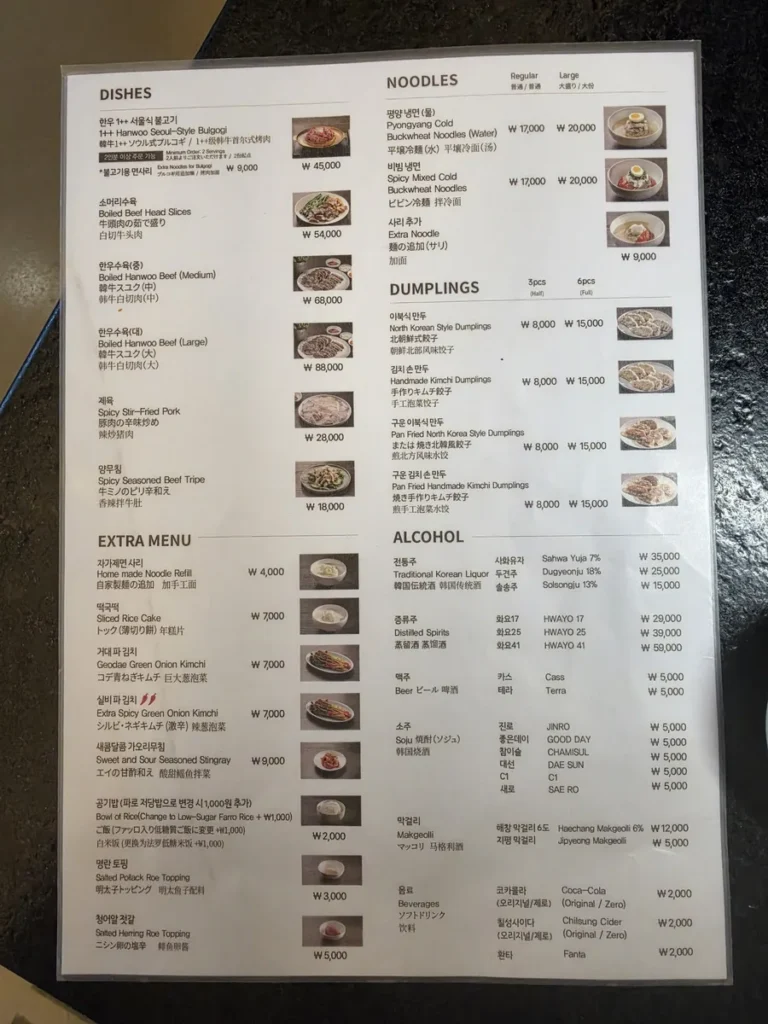
What We Ordered
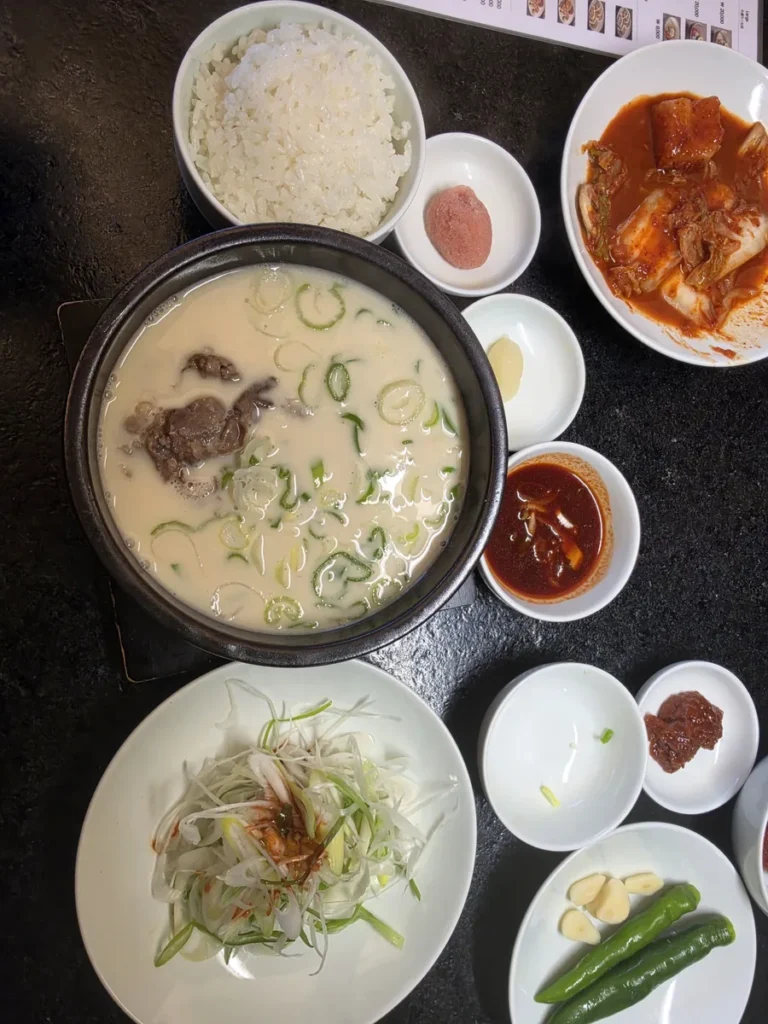
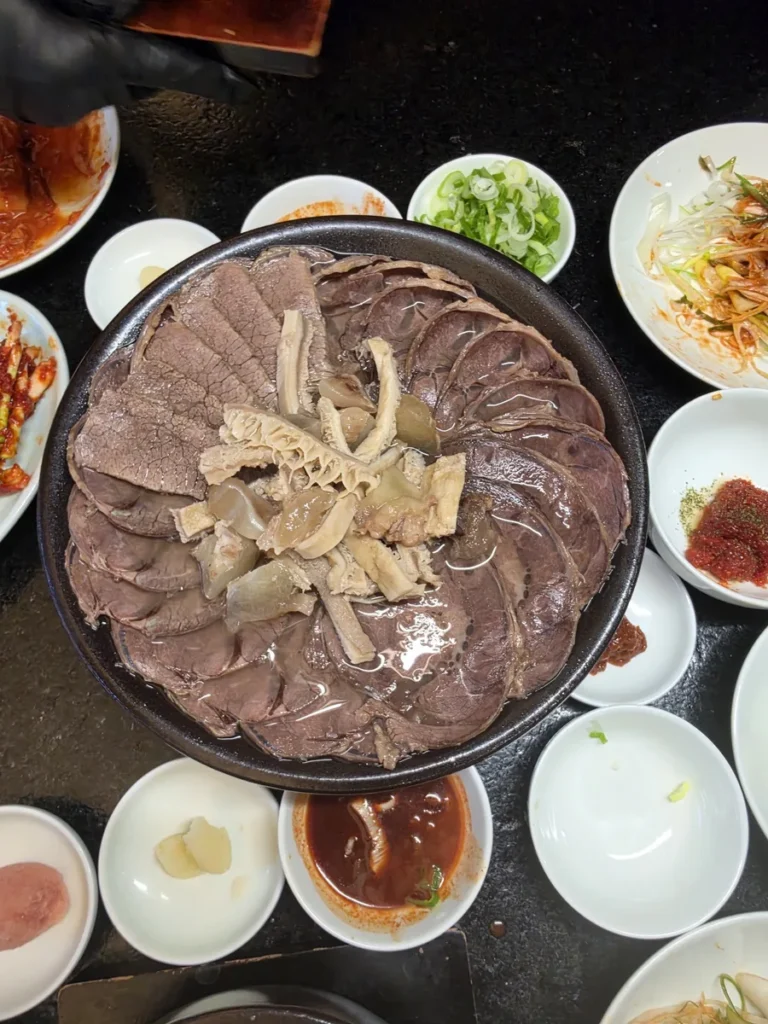
After two hours, we were not going to order the cheapest bowl. We had the signature, 농후하고 더 진한 곰탕, and a medium plate of 한우수육, ₩68,000, to share between the two of us.
The gomtang comes in a black earthenware pot, still bubbling at the edges, the broth thick and white with slices of beef and a scatter of green onion on top. Around it, the 반찬 (side dishes) arrive without being asked for: a bowl of kimchi in big pieces, a plate of shredded green onion dressed with chilli, raw garlic and green chillies, a dipping sauce with sliced onion for the meat, and a small spoonful of salted pollack roe, which comes as one of the free side dishes. Rice comes with the soup, in its own bowl.
The 수육 is a wide pot of thinly sliced beef laid out in a ring, with tripe piled in the centre and a circle of side dishes around it. It is a lot of meat, and it is meant for the table, not one person.
Was it worth the wait? For us, yes, and we would go back. But the honest version is this: the soup is excellent, and the two hours were the price of going on a public holiday. Go at a quieter time and you get the same bowl for a fraction of the wait.
How to Eat Gomtang
Nobody will correct you if you eat it your own way, but this is roughly what the people at the next table are doing.
- Taste the broth first. It will seem under-seasoned. That is on purpose.
- Season it yourself. Salt and pepper are on the table. Add a little, stir, taste, and repeat.
- Add the green onion. The shredded green onion can go straight into the pot; it softens in the heat.
- Decide about the rice. Many Koreans tip the rice into the soup, which is called 말아 먹다 (mara meokda), “to roll it in and eat.” Others keep the rice separate and take a spoonful at a time. Both are normal.
- Put kimchi on the spoon. A spoonful of rice and broth with a piece of kimchi on top is the bite the whole meal is built around.
- Dip the meat. Slices of beef, from the soup or the 수육, go into the sauce with the onion.
Side dishes are free, and asking for more is normal; our guide to ordering food in Korean covers that, along with getting a server’s attention and asking for the bill. Paying works as it does in most Korean restaurants, and our guide to how to pay in Korea explains what to expect with an overseas card.
The Korean You Need at a Gomtang Restaurant
The general restaurant phrases — how many people, calling the server, asking for the bill — are in our food-ordering guide. These are the ones specific to this kind of meal.
| Korean | Romanisation | Meaning |
|---|---|---|
| 웨이팅 등록했어요 | weiting deungnokhaesseoyo | I’ve put my name on the waiting list |
| 몇 팀 남았어요? | myeot tim namasseoyo? | How many groups are left before us? |
| 뽀얀 걸로 주세요 | ppoyan geollo juseyo | The milky broth, please |
| 맑은 걸로 주세요 | malgeun geollo juseyo | The clear broth, please |
| 특으로 주세요 | teugeuro juseyo | The special size, please |
| 수육 중으로 주세요 | suyuk jungeuro juseyo | The medium plate of boiled beef, please |
| 소금 어디 있어요? | sogeum eodi isseoyo? | Where is the salt? |
| 김치 좀 더 주세요 | gimchi jom deo juseyo | Could we have a bit more kimchi? |
| 공기밥 하나 추가요 | gonggibap hana chugayo | One more bowl of rice, please |
| 잘 먹었습니다 | jal meogeotseumnida | Thank you for the meal (said on leaving) |
The little word 걸로 in the middle rows is worth stealing. It is a spoken contraction of 것으로, “with the one that is…,” and you can put any adjective in front of it: 진한 걸로, 매운 걸로, 큰 걸로 — the rich one, the spicy one, the big one. And notice that 팀 counts like 명 does for people: 몇 팀 for “how many,” and native Korean numbers in front — 한 팀, 두 팀; our guide to Korean counters explains the system.
Register, Walk, Then Eat
If you keep one plan from this guide, make it this. Put your number into the kiosk the moment you arrive, then go and see Haeundae while the list moves. Come back when the count drops, order 뽀얀 or 더 진한 if you want the milky white broth everyone photographs, season it yourself, and put a piece of kimchi on every spoonful. And if you can, go early in the morning, when the giant gomtang comes without the giant queue.
If Busan is still at the planning stage, here is the best time to visit Busan, and our Korean phrases for travelers will cover the rest of the trip.
Written by Minhyung Cha — 25 years teaching Korean, and 15+ years running an English academy in South Korea. I live and work in Busan, and every example on this site is checked as a native speaker. More about KEL.
Leave a Reply