
Kimjang is the day, every late autumn, when a Korean family makes its kimchi for the whole winter in one go. The cabbages are salted, rinsed and drained, a bright red filling is mixed in a huge bowl, and several people sit on the floor around it, rubbing the filling into the cabbage leaves one by one until the pile of cabbage turns into tubs of kimchi. It is hard work, it takes a whole family, and it ends with one of the best meals of the year.
I grew up helping my mother with it every year. These days my husband’s family makes the kimjang, shares it with us, and the kimchi in my fridge right now is theirs. This guide explains what kimjang is, why it matters enough to be on UNESCO’s list, how it is changing, how you can try it in Korea, and the Korean words you will hear in every kitchen this November.
What Kimjang Is
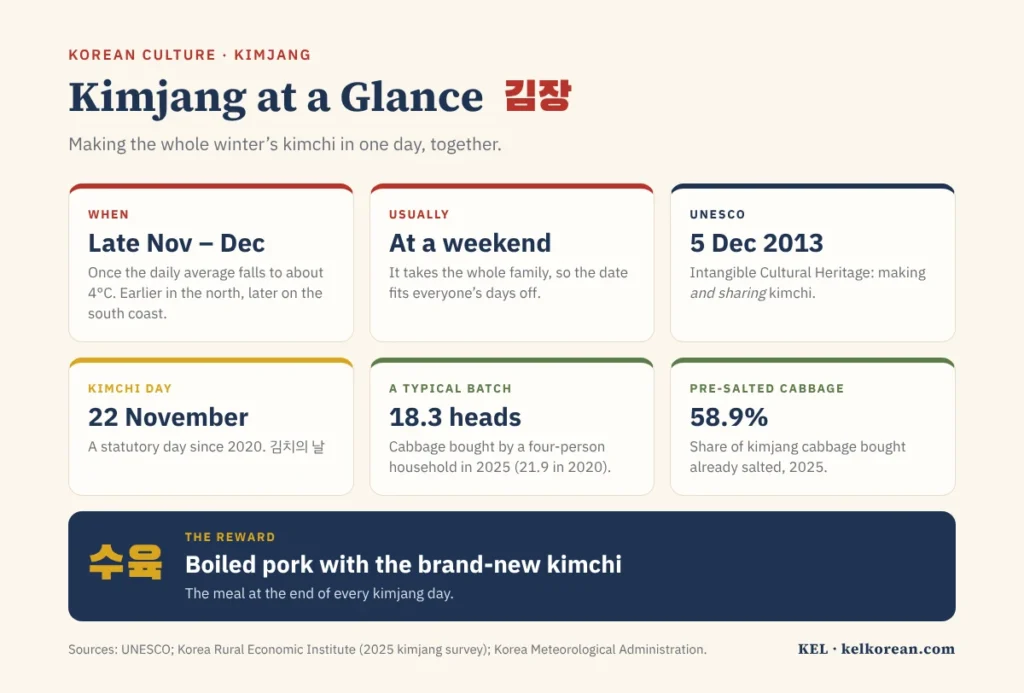
김장 (gimjang, usually written kimjang in English) means making a large batch of kimchi before winter. The verb is 김장하다, “to do the kimjang.” Before refrigerators and supermarkets, fresh vegetables were scarce from December to spring, and the kimchi made in November had to last until the new crops came. Old Korean writing calls it half of the winter’s food.
The custom is centuries old. A Goryeo-dynasty poet wrote about salting radishes for the winter, and Joseon-era almanacs list kimjang beside spring soy sauce making as one of the big jobs of a household’s year. The whole-cabbage kimchi most people picture today became common only in the late 1800s, after a new variety of napa cabbage with a tight head arrived. Kimjang was once important enough that some schools gave pupils a week off in November, a 김장 방학 (gimjang banghak), “kimjang holiday,” so they could help at home.
On UNESCO’s list
On 5 December 2013, UNESCO added Kimjang: Making and Sharing Kimchi in the Republic of Korea to its list of the Intangible Cultural Heritage of Humanity. Notice the wording. What was recognised is not kimchi the food but the practice: neighbours and relatives making it together and sharing it out. North Korea’s kimchi-making tradition was added separately in 2015. Korea also has a 김치의 날 (gimchi-ui nal), Kimchi Day, on 22 November, a statutory day since 2020. The date is a small pun: kimchi takes eleven or more ingredients, for the 11th month, and is said to have twenty-two benefits, for the 22nd.
When Kimjang Happens
Kimjang follows the cold. Kimchi made while it is still mild ripens and turns sour too quickly, so families wait until the weather has properly turned. The Korea Meteorological Administration’s rule of thumb is a daily average of 4°C or lower with nights around freezing. In a typical year that means late November to early December around Seoul and the centre of the country, and December further south. On the mild south coast, where I live, it comes last of all, a few weeks after the autumn colour has passed.
It almost always happens at a weekend. Kimjang needs many hands, and the hands belong to grown-up children, cousins and in-laws with jobs of their own, so families pick a Saturday that works for everyone and plan around it weeks in advance. My younger sister’s in-laws held theirs last year on Saturday 6 December 2025, and the two photos in this post are from that day. In November, the question 김장 언제 해요? (gimjang eonje haeyo?), “when are you doing your kimjang?”, is as common as talk about the weather.
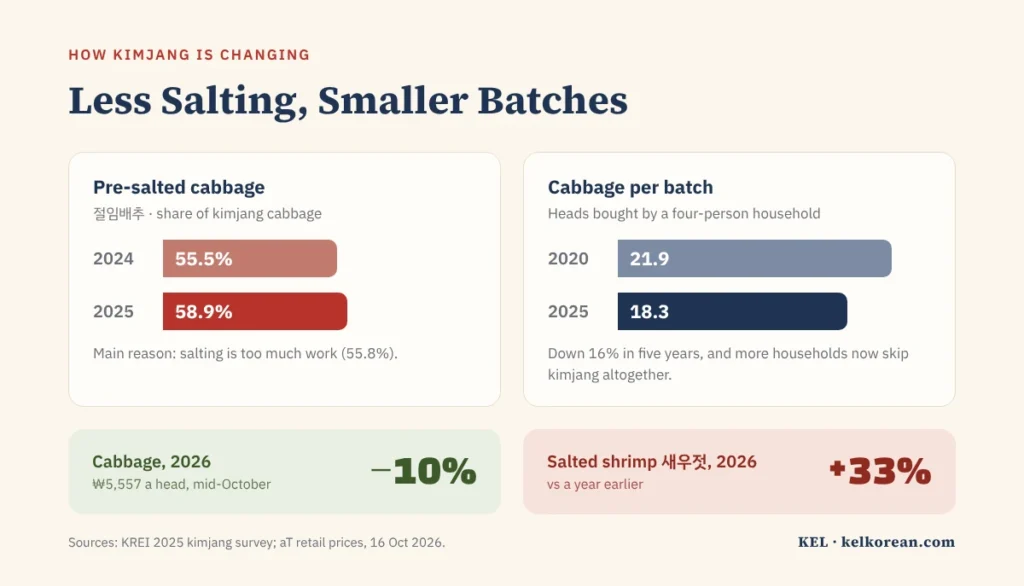
Prices are news, too. Every autumn the papers track the cost of cabbage, radish, chilli powder and salted shrimp. In 2026 the vegetables are cheaper than last year: in mid-October a head of cabbage was about ₩5,600 at retail, around 10% less than a year earlier. Salted shrimp, on the other hand, was up by about a third.
A Kimjang Day, Step by Step
Every family does it a little differently, but the shape of the day is the same everywhere. When I was a child, my jobs were the salting and the filling, which is to say most of it.
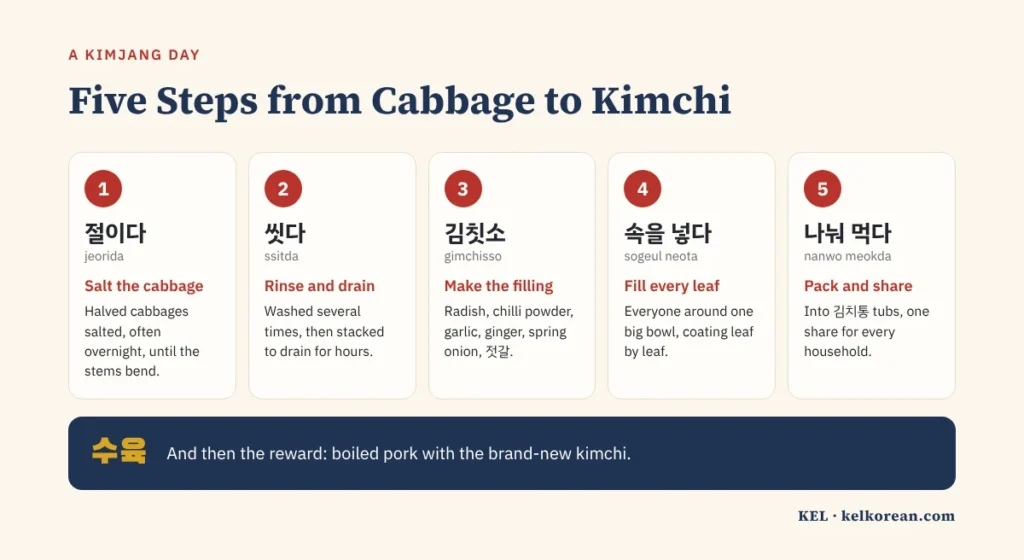
- Salt the cabbage: 절이다 (jeorida). The cabbages are split in halves or quarters and salted, usually the day before, until the thick white stems go soft and bend without snapping. This is the heaviest, slowest part of the job.
- Rinse and drain. The salted cabbage is washed several times to take off the extra salt, then stacked to drain for hours.
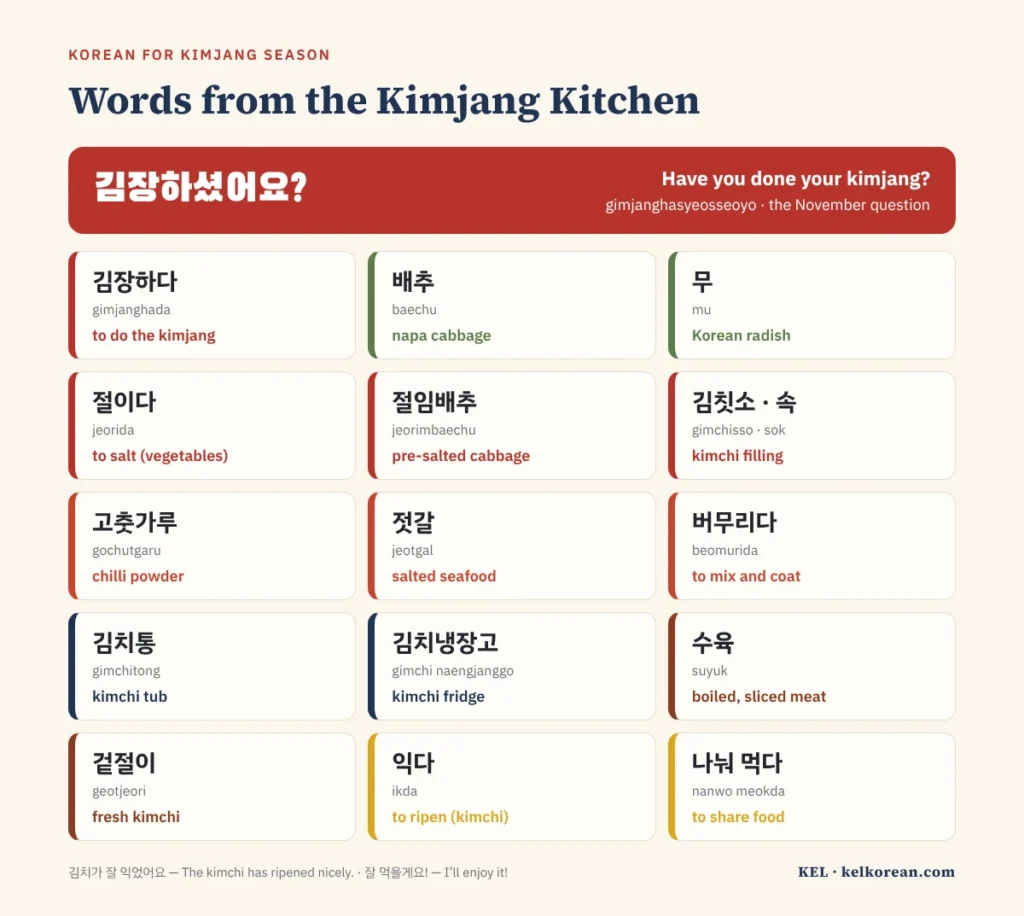
- Make the filling: 김칫소 (gimchisso), or simply 속 (sok), “the inside.” Shredded radish, chilli powder, garlic, ginger, spring onions and salted seafood such as 새우젓 (saeujeot), salted shrimp, are mixed together in one very large bowl.
- Fill the leaves: 속을 넣다 (sogeul neota). Everyone sits around the bowl with rubber gloves on and spreads the filling between every leaf, folding each piece into a neat bundle. 버무리다 (beomurida), to mix and coat, is the word for working the seasoning through.
- Pack and share. The bundles are pressed into 김치통 (gimchitong), kimchi tubs, and the tubs are divided up so that every household that helped goes home with its share.
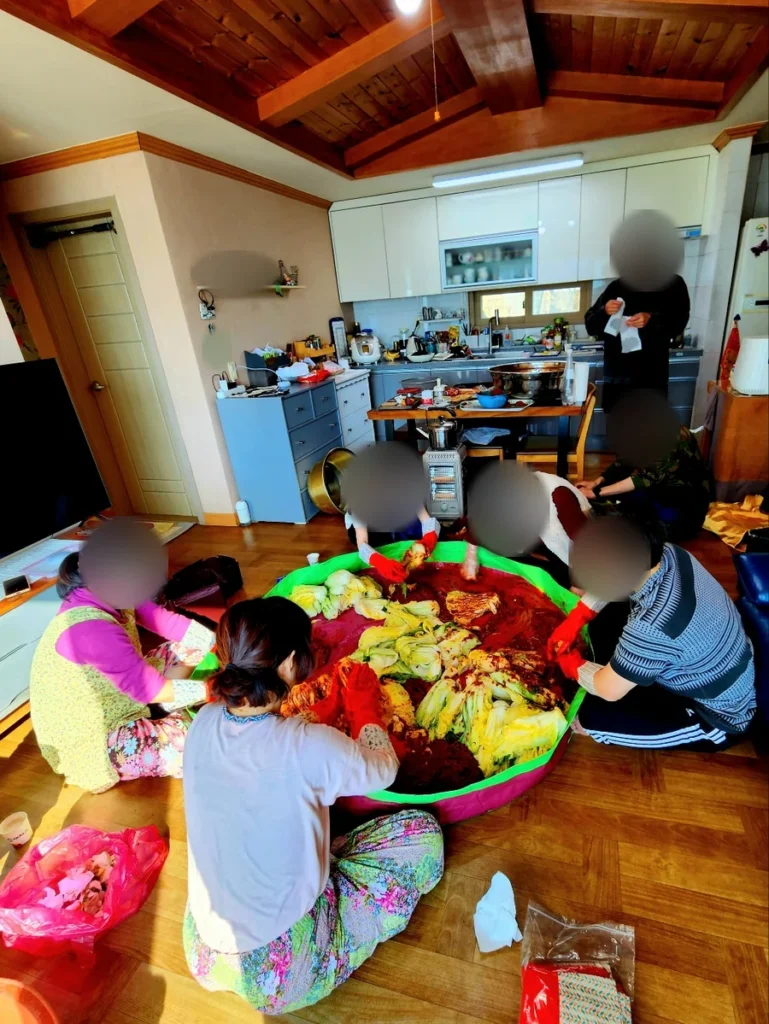
This is what step four looks like in a real living room. At my sister’s in-laws’ kimjang, the salted cabbage halves were piled on one side of a big round 김장 매트 (gimjang maeteu), a kimjang mat, with the red filling on the other. Everyone knelt or sat on the floor around it in red rubber gloves, working their way around the circle, while a big steel bowl waited on the kitchen table behind.
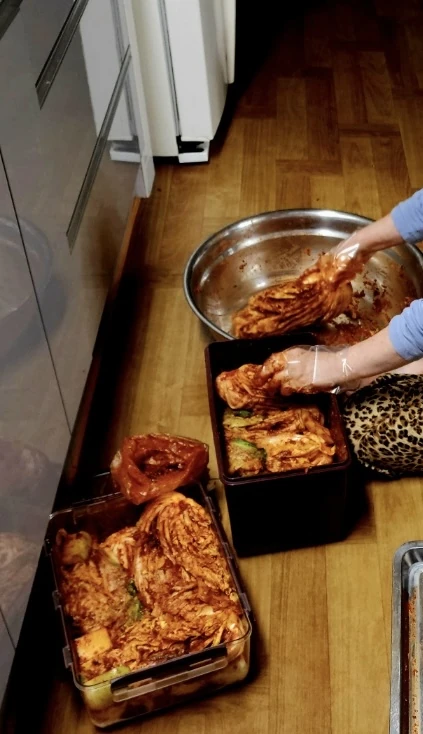
As each bundle is finished, it goes straight into a tub. Some families use plain plastic tubs and others use the square containers that fit their kimchi fridge.
The best meal of the year
And then comes the reward. In our house the kimjang meal was always the same: 수육 (suyuk), boiled pork, eaten with the brand-new kimchi straight from the bowl. The kimchi is not fermented yet at that point, so it is crisp, fresh and fiery, and with the soft pork it is honestly one of the most delicious things I know. Many families wrap the pork in a salted cabbage leaf with a spoonful of filling, the same combination restaurants sell as 보쌈 (bossam). Some add fresh oysters, which are in season at the same time.
How Kimjang Is Changing
Kimjang is still very much alive, but it looks different from the one I grew up with. Three changes are now completely normal:
- Pre-salted cabbage. Salting is the hardest part, so many families now skip it and buy 절임배추 (jeorimbaechu), cabbage that arrives already salted and drained, in a box. According to the Korea Rural Economic Institute, among households that still make their own kimchi, 58.9% of the cabbage bought for kimjang in 2025 was pre-salted, up from 55.5% the year before. More than half of those who chose it said salting was simply too much work.
- The kimchi fridge. The tubs used to be buried in earthenware jars in the yard to keep them cold. Today a 김치냉장고 (gimchi naengjanggo), a fridge designed only for kimchi, is a normal appliance in Korean homes, and it holds the kimchi at the right temperature through the winter and beyond.
- Smaller batches, or none. A four-person household bought 18.3 heads of cabbage for kimjang in 2025, compared with 21.9 in 2020. More and more households now skip kimjang altogether and buy their kimchi, or, like mine, eat the kimchi a parent made.
What has not changed is the sharing. Even families that no longer make kimjang often receive a tub or two from parents or in-laws, and every November charities and local governments hold huge public kimjang events and give the kimchi to neighbours in need. If you have read about the Chuseok holiday, you will recognise the pattern: the cooking falls on a few people, the eating is shared by everyone.
How to Experience Kimjang as a Visitor
Kimjang happens in private homes, so the easiest way in is an invitation. If a Korean friend or colleague mentions their family’s kimjang, it is fine to say you would love to see it. An extra pair of hands is always welcome. If not, there are other ways:
- A kimchi class in Seoul. Museum Kimchikan, a kimchi museum run by the food company Pulmuone, is on Insadong-gil, about five minutes’ walk from Exit 6 of Anguk Station on Line 3. Besides its exhibitions, it runs paid kimchi-making classes for foreign visitors. Book ahead on its website, and note that it is closed on Mondays. Museum Kimchikan has also offered free admission on Kimchi Day in past years.
- A public kimjang event. In November, city governments, food organisations and charities hold large kimjang festivals and sharing events, often with hands-on sessions. Check your city’s tourism website closer to the date.
- Volunteer. Kimchi-sharing drives for elderly neighbours need many hands and usually welcome volunteers. If you live in Korea, ask at your local community centre, church or university international office.
- Eat it. A 보쌈 restaurant serves boiled pork with fresh kimchi all year round, which is the closest thing to a kimjang meal you can order. Fresh, barely fermented kimchi is called 겉절이 (geotjeori).
If you are invited into a family’s kimjang, wear clothes you do not mind staining red, expect to sit on the floor for hours, and do not worry about doing it perfectly. Nobody will expect you to fold the leaves like a grandmother. Our guide to Korean family terms will help you work out who everyone in the room is.
Korean Words for Kimjang
| Korean | Romanisation | Meaning |
|---|---|---|
| 김장 / 김장하다 | gimjang / gimjanghada | Winter kimchi making / to do it |
| 배추 | baechu | Napa cabbage |
| 무 | mu | Korean radish |
| 절이다 | jeorida | To salt (vegetables) |
| 절임배추 | jeorimbaechu | Pre-salted cabbage |
| 김칫소 / 속 | gimchisso / sok | Kimchi filling |
| 고춧가루 | gochutgaru | Chilli powder |
| 젓갈 | jeotgal | Salted, fermented seafood |
| 버무리다 | beomurida | To mix and coat with seasoning |
| 김치통 | gimchitong | Kimchi tub |
| 김치냉장고 | gimchi naengjanggo | Kimchi fridge |
| 수육 | suyuk | Boiled, sliced meat |
| 겉절이 | geotjeori | Fresh, unfermented kimchi |
| 익다 | ikda | To ripen (kimchi) |
| 나눠 먹다 | nanwo meokda | To share food |
Two of these are worth a closer look. 익다 is the same verb used for ripe fruit and cooked food, and Koreans use it to describe how far along a kimchi is: 김치가 잘 익었어요 (gimchiga jal igeosseoyo), “the kimchi has ripened nicely,” is a compliment. 나눠 먹다 is built from 나누다, “to divide,” and 먹다, “to eat,” joined with the same 아/어 choice explained in our guide to Korean verb conjugation: 나누 + 어 shortens to 나눠. It is the word UNESCO’s title is really about.
Three sentences you will hear in November: 김장하셨어요? (gimjanghasyeosseoyo?), “have you done your kimjang?”, the polite question between neighbours; 김장 언제 해요?, “when are you doing it?”; and, when a tub arrives at your door, 잘 먹을게요! (jal meogeulgeyo), “I’ll enjoy it!”, the thank-you Koreans say for food.
A Tub of Kimchi at the Door
The kimjang of my childhood was a whole day helping my mother salt and fill the cabbage, with a plate of boiled pork at the end. The kimjang in my life now is a tub of kimchi from my husband’s family. Both are kimjang. The size of the batch has changed, the salting has moved to a factory, and the jars have moved into a fridge, but the point is the same as it was in 2013, when UNESCO wrote it down, and centuries before: you make it together, and you share it.
Written by Minhyung Cha — 25 years teaching Korean, and 15+ years running an English academy in South Korea. I live and work in Busan, and every example on this site is checked as a native speaker. More about KEL.
Leave a Reply