
Korean BBQ is the meal I eat more often than any other when we go out. My husband and I go to a 고깃집 (gogitjip), a Korean barbecue restaurant, about once a week, usually to one of a handful of places in Mulgeum, Yangsan, just north of Busan. Some nights it is pork belly, some nights marinated ribs, and on a good day it is 한우, Korean beef, over charcoal.
For a visitor, the first Korean BBQ dinner can be confusing. There is a fire in the middle of the table, a dozen small dishes arrive before the meat, and nobody explains what to do with the leaves. This guide walks through it the way I would at the table: the cuts, the grill, who does the grilling, how to wrap a 쌈 (ssam), what to order after the meat, and the Korean to use.
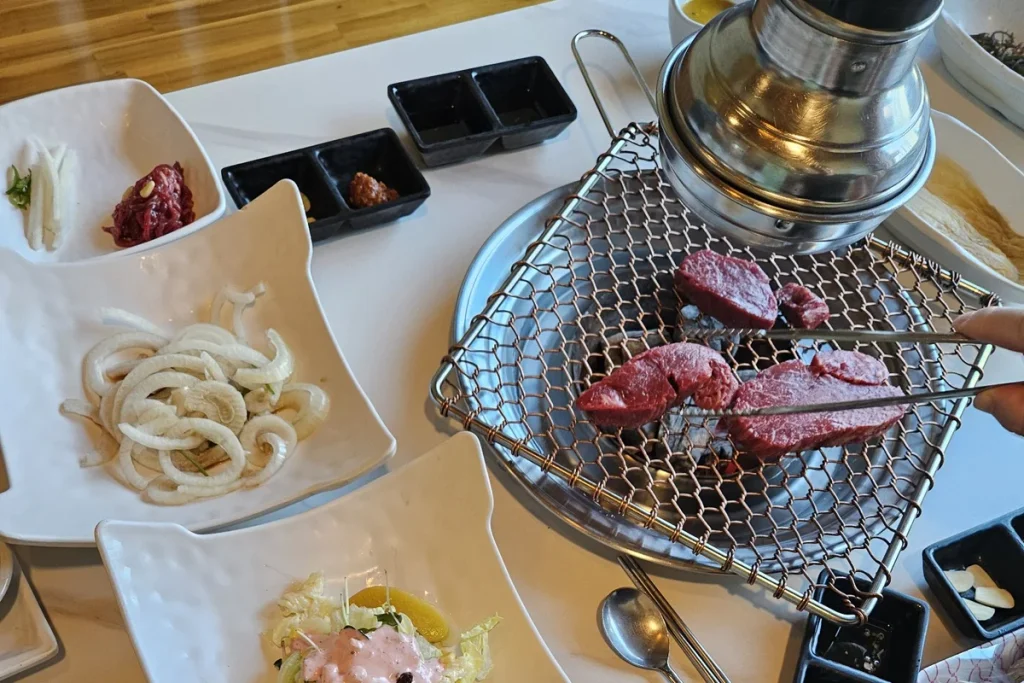
What a 고깃집 Is
고기 (gogi) means meat and 집 (jip) means house, so a 고깃집 is simply a “meat house.” The ㅅ in the middle is a spelling rule that appears when two words join, and it is why the word is said gogitjip, with a small catch before the j. Koreans rarely say “Korean BBQ.” They say 고기 먹으러 가자, “let’s go and eat meat,” and everyone knows what that means.
Every table has its own grill. The meat comes raw, and it is cooked in front of you, a few pieces at a time, while you eat. A meal can last two hours, and that is the point: it is the place Koreans go for birthdays, family dinners, team dinners and end-of-year parties.
Meat is ordered in 인분 (inbun), servings, and many places want at least two. Our guide to ordering food in Korean explains how that works, and why a solo diner is sometimes turned away from a grill restaurant.
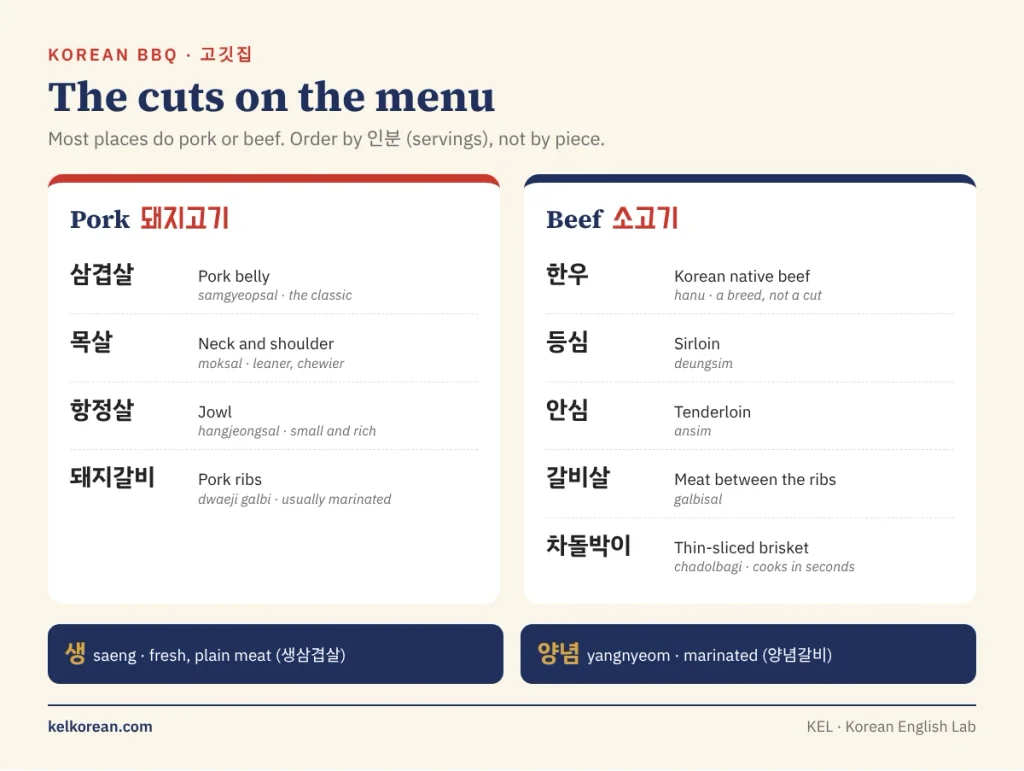
Pork or Beef: The Cuts on the Menu
Most 고깃집 specialise in either pork or beef, and the menu lists cuts rather than dishes. It depends on the restaurant, but at our table the order of popularity is pork belly first, then ribs, then 한우.
| Korean | Romanisation | Cut |
|---|---|---|
| 삼겹살 | samgyeopsal | Pork belly, the classic |
| 목살 | moksal | Pork neck and shoulder, leaner and chewier |
| 항정살 | hangjeongsal | Pork jowl, small and rich |
| 돼지갈비 | dwaeji galbi | Pork ribs, usually marinated |
| 한우 | hanu | Korean native beef (a breed, not a cut) |
| 등심 | deungsim | Beef sirloin |
| 안심 | ansim | Beef tenderloin |
| 갈비살 | galbisal | Meat cut from between the beef ribs |
| 차돌박이 | chadolbagi | Thinly sliced brisket that cooks in seconds |
Two words change the meaning of any cut. 생 (saeng), “fresh,” means the meat is plain, as in 생삼겹살. 양념 (yangnyeom), “seasoning,” means it has been marinated, usually in soy sauce, sugar, garlic and pear, as in 양념갈비. Marinated meat burns more easily, which is one reason many 갈비 places grill it for you.
한우 is the expensive one. It is graded by marbling, and 1++ is the top grade you will see on menus. It is worth trying once, but pork belly is what Koreans eat on an ordinary night.
Prices have climbed. In mid-2026 the Korea Consumer Agency’s price survey put a 200-gram serving of pork belly in Seoul at an average of 21,321 won. Restaurants do not all use the same weight for one 인분, so look for the number of grams on the menu. Our guide to Korean counters explains why it is 삼겹살 2인분 and not “two pork bellies.”
Charcoal or Gas: Choose the Fire
If I could give a visitor only one tip, it would be this: choose a place that grills over 숯불 (sutbul), charcoal. Look for the word on the sign, as in 숯불갈비 (sutbul galbi), “charcoal-grilled ribs.” The charcoal gives the meat a smoky taste that a gas plate cannot, and it is the taste most Koreans think of when they think of 고기.
Over charcoal the meat usually sits on a 석쇠 (seoksoe), a wire grill like the one in my photo. Other places use a 불판 (bulpan), a solid metal plate over gas, often tilted so the fat runs off. Both are fine, and pork belly on a hot plate is a classic too. Above the table there is usually a metal hood, and in a well-run place it draws the smoke straight up.
Who Grills the Meat?
It depends on the restaurant. At some places a member of staff comes to the table, puts the meat on, turns it and cuts it with scissors into bite-sized pieces. At others they bring the meat and leave the tongs with you.
At our table my husband does the grilling, and he is good at it. In many Korean groups there is one person like him, and everyone is happy to let them hold the tongs. For a visitor, though, my advice is to choose a restaurant where the staff grill for you, at least the first time. You will eat the meat at its best, and you can watch how it is done. If you are not sure, ask 구워 주시나요? (guwo jusinayo?), “do you grill it for us?”
A few things you will see either way. Pork belly is turned once or twice, not constantly, and cut with scissors when it is half done. Kimchi is often put on the edge of the grill to cook in the fat; well-aged kimchi from the winter kimjang is a favourite for this. Beef is cooked quickly and eaten while it is still pink in the middle. And when the plate gets black, you can ask for a new one.
How to Make a 쌈
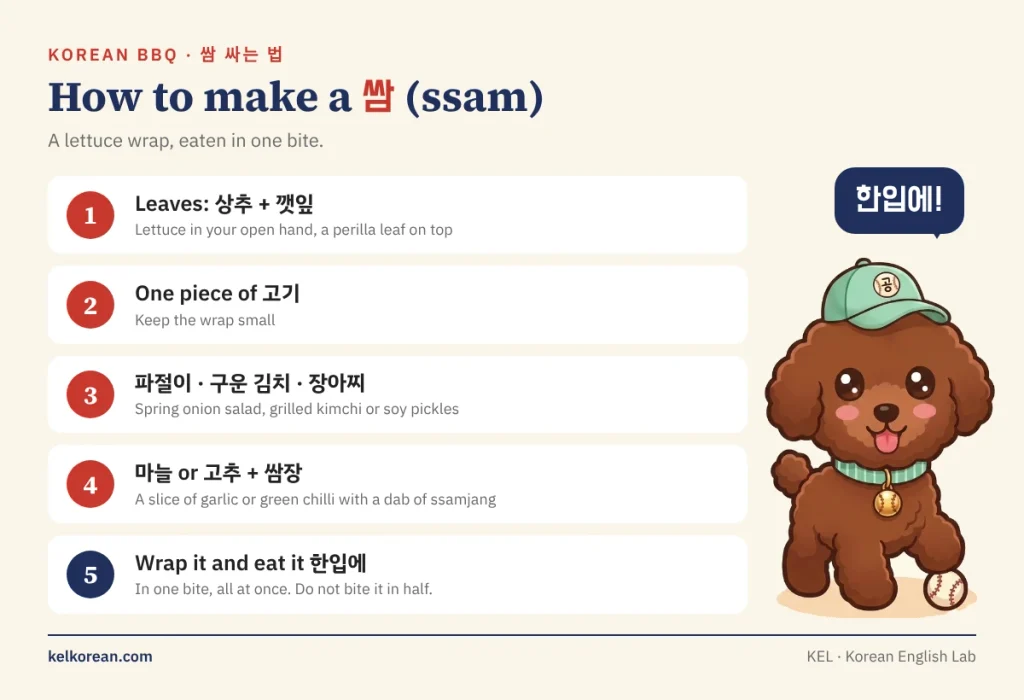
You can eat the meat on its own, dipped in a sauce. But the real way to eat Korean BBQ is in a 쌈 (ssam), a wrap made of leaves. The verb is 싸다 (ssada), “to wrap,” and a basket of leaves called 쌈채소 (ssamchaeso) comes to every table. This is how I make mine.
- Leaves. Hold a piece of 상추 (sangchu), lettuce, in your open hand and lay a 깻잎 (kkaennip), perilla leaf, on top. Perilla has a strong, minty taste that many visitors have never tried.
- Meat. Add one piece of meat. One is enough; the wrap should be small.
- Something sharp. Add a little 파절이 (pajeori), thin spring onion in a spicy dressing, a piece of the grilled kimchi, or some 장아찌 (jangajji), vegetables pickled in soy sauce.
- Garlic or pepper. Add a slice of garlic or a piece of green chilli pepper with a dab of 쌈장 (ssamjang), the thick dipping paste made from soybean and chilli paste.
- Wrap and eat it in one bite. Fold the leaves round everything and put the whole thing in your mouth at once.
That last step matters more than it sounds. A 쌈 is meant to go in whole. If you bite it in half, the filling falls out, the sauce drips, and you miss the point, which is to taste the meat, the leaf, the garlic and the 쌈장 together. Koreans happily fill their cheeks to do it. Make yours smaller rather than bite it.
Garlic can go on the grill too. Many people put the slices in a small foil dish or on the edge of the plate until they turn soft and sweet.
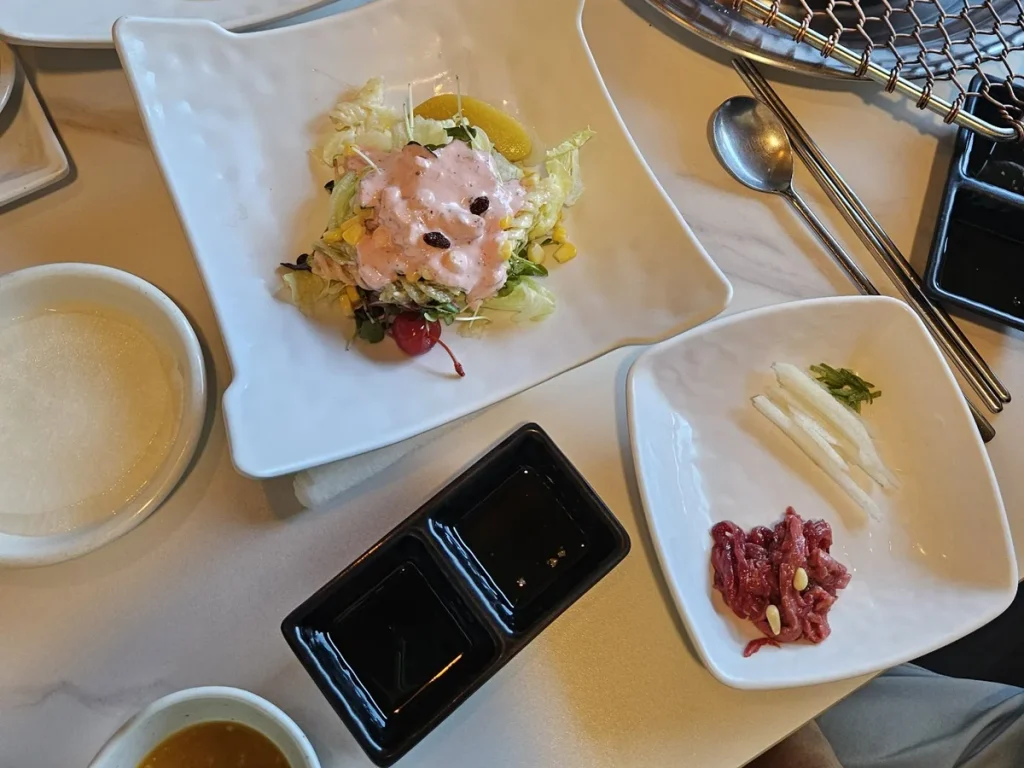
After the Meat: 식사
When the meat is nearly finished, the staff will often ask 식사는 뭘로 하시겠어요? 식사 (siksa) normally means “a meal,” but in a 고깃집 it means the rice or noodle course that ends the meal. Koreans almost always order one. Ours is usually one of these.
| Korean | Romanisation | What it is |
|---|---|---|
| 물냉면 | mul-naengmyeon | Cold buckwheat noodles in an icy broth, the classic after grilled meat |
| 된장찌개 | doenjang-jjigae | Soybean paste stew, eaten with rice |
| 누룽지 | nurungji | Toasted rice from the bottom of the pot, soft in hot water |
| 돌솥밥 | dolsotbap | Rice cooked and served in a hot stone pot |
With 돌솥밥 there is one more step. Scoop the rice into your bowl, then pour hot water or tea into the empty stone pot and put the lid back on. By the end of the meal the crust on the bottom has softened into 누룽지, and you eat it with a spoon. The icy 냉면, on the other hand, is there to cool your mouth after the fire.
If you are drinking with the meal, 소주 (soju) is the usual partner for pork belly. Our guide to Korean drinking etiquette explains how to pour and receive a glass.
What About the Smell?
Older guides warn that you will leave a 고깃집 smelling of smoke, and in some places that is still true. The places we go have dealt with most of it. The bench seats often open up as storage boxes, so your coat goes inside with the lid shut, and the hoods over the tables pull the smoke away. At our regular places I do not really worry about it any more. If you are going somewhere important afterwards, put your jacket in the seat box and you will be fine.
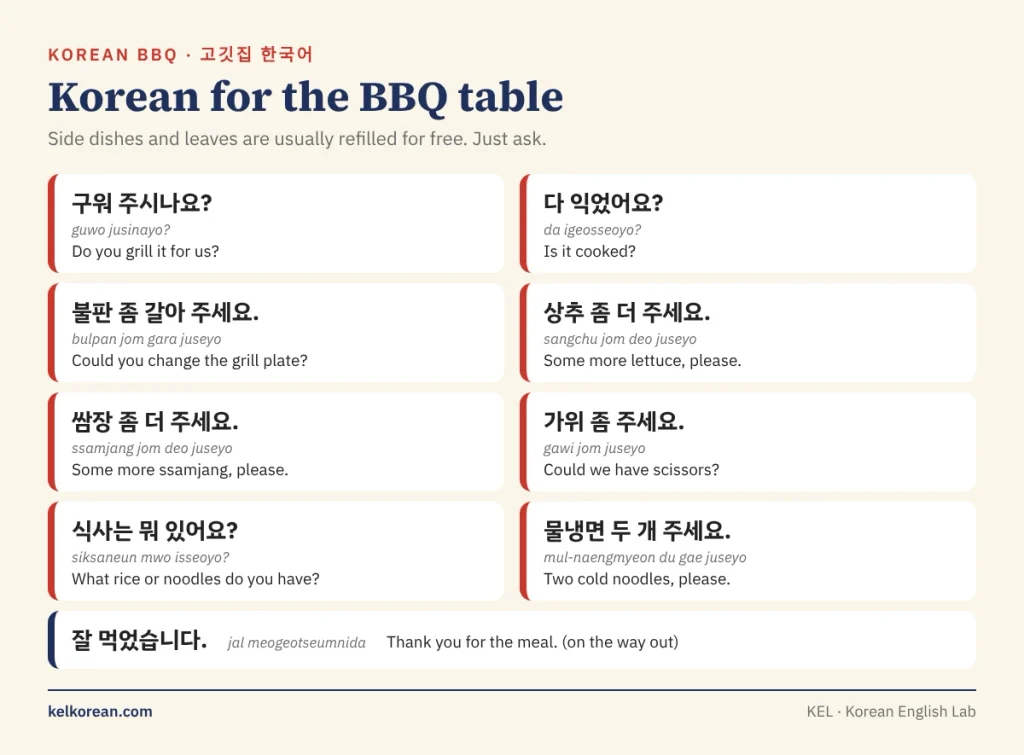
Korean for the BBQ Table
Side dishes and leaves are refilled for free in most places, so the sentences you will use most are requests. Here are the ones I hear at every table.
| Korean | Romanisation | Meaning |
|---|---|---|
| 구워 주시나요? | guwo jusinayo? | Do you grill it for us? |
| 다 익었어요? | da igeosseoyo? | Is it cooked? |
| 불판 좀 갈아 주세요. | bulpan jom gara juseyo | Could you change the grill plate? |
| 상추 좀 더 주세요. | sangchu jom deo juseyo | Some more lettuce, please. |
| 쌈장 좀 더 주세요. | ssamjang jom deo juseyo | Some more ssamjang, please. |
| 가위 좀 주세요. | gawi jom juseyo | Could we have scissors? |
| 식사는 뭐 있어요? | siksaneun mwo isseoyo? | What do you have for the rice or noodle course? |
| 물냉면 두 개 주세요. | mul-naengmyeon du gae juseyo | Two cold noodles, please. |
| 잘 먹었습니다. | jal meogeotseumnida | Thank you for the meal. |
좀 (jom) softens a request, a little like “please” or “could you.” 갈다 (galda) means “to change” or “to replace,” and you will hear it whenever the plate is swapped. Say 잘 먹었습니다 on your way out; it is the polite thing to say after any meal someone has served you. For the names of the dishes themselves, our guide to food in Korean has the full list.
Before You Go
- Finding one. Type 숯불갈비 (sutbul galbi), 삼겹살 or 한우 into a Korean map app. Every neighbourhood has several, and the ones full of local families are a good sign.
- Read the sign. 숯불 means charcoal, 생고기 means fresh meat, and 무한리필 (muhan ripil) means all-you-can-eat.
- Go with someone. Because of the two-serving minimum, Korean BBQ is easiest with at least two people.
- Let it cook. Pork should be cooked through. If you are not sure, ask 다 익었어요?
- Season it. End-of-year parties fill these restaurants in December. Our guide to Happy New Year in Korean explains the 송년회 (songnyeonhoe) tradition, and why so many of them happen at a 고깃집.
One Bite, All at Once
Korean BBQ is not difficult. Choose a place with a charcoal fire, let someone who knows what they are doing hold the tongs, and build your 쌈 small enough to eat in one go. Leave room for a bowl of cold 냉면 at the end. Then say 잘 먹었습니다 on the way out, and you have eaten the way we do every week.
Written by Minhyung Cha — 25 years teaching Korean, and 15+ years running an English academy in South Korea. I live and work in Busan, and every example on this site is checked as a native speaker. More about KEL.
Leave a Reply