
Korean winter street food appears on the pavements as soon as the first cold wind arrives. A small stall with a plastic awning sets up near a bus stop or a station exit, a row of cast-iron moulds starts to hiss, and suddenly the whole street smells of warm batter, sweet red beans and fish-cake broth. For a few months, from late autumn until the weather turns again, these stalls are one of the best and cheapest things about living in Korea.
I buy 붕어빵 and 어묵 from the stall in my neighbourhood all through the winter, and roasted sweet potatoes are a regular at home. This guide covers the five snacks you will see everywhere, what each one costs, how to order and pay in Korean, and the words that come with them.
When and Where to Find the Stalls
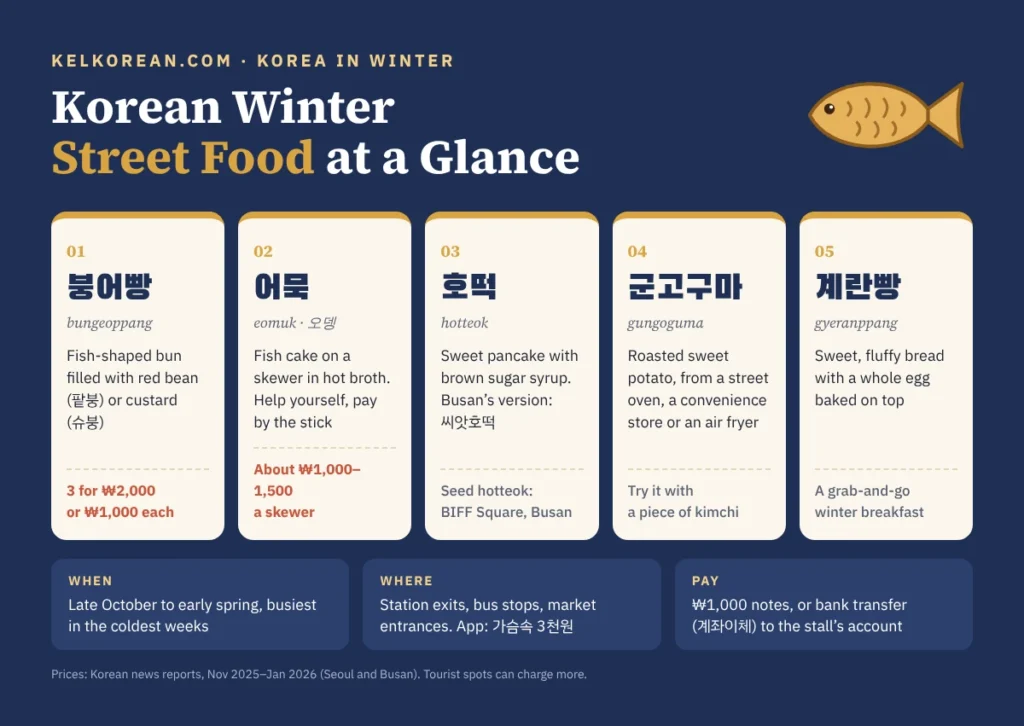
Winter snack stalls are seasonal. They start appearing in late October and November, are busiest in the coldest weeks, and quietly disappear in spring. Look near subway and bus stops, outside schools, at the entrance to traditional markets and on busy shopping streets. Many vendors come back to the same corner every year, so locals know exactly where “their” stall is.
Koreans even have a word for living near one: 붕세권 (bungsegwon), a joke built on 역세권, the estate-agent term for a flat within walking distance of a station. A 붕세권 is a home within walking distance of a 붕어빵 stall, and people say it with real envy. Because stalls move and close without notice, there is an app for finding them, 가슴속 3천원 (gaseumsok samcheonwon), whose name means “₩3,000 tucked inside your coat,” from the popular saying that in winter you should always carry ₩3,000 in case you pass a stall. Users pin stalls on a map and confirm that they are still there.
The stalls are fewer than they used to be. Korean newspapers have spent the last two winters reporting on vendors giving up as the cost of red beans, gas, paper bags and pitch fees rose, and app users have been marking more and more stalls as closed. So when you find a good one, go back.
The Five Winter Snacks
1. 붕어빵: the fish-shaped bun
붕어빵 (bungeoppang) means “crucian carp bread,” and that is what it looks like: a small fish of crisp, thin batter, baked in a hinged iron mould and filled with sweet red bean paste, 팥 (pat). It is the snack that defines Korean winter, and it is the one I buy most often.
The shape came from Japan. Japan’s tai-shaped taiyaki dates from the early 1900s, and in the 1930s similar iron moulds arrived in Korea, where thin flour batter was baked into cheap “paste breads.” After the Korean War, flour from relief supplies kept these cheap breads going. A close cousin, 잉어빵 (ingeoppang), “carp bread,” appeared in Daegu in 1998. Its batter has butter or oil in it, so it is softer and slightly chewy, and the filling goes all the way to the tail.
Most stalls now offer two fillings, and the choice has its own slang. 팥붕 (patbung) is red bean 붕어빵, 슈붕 (syubung) is custard cream 붕어빵, from 슈크림, “choux cream.” Asking a Korean friend which side they are on is a safe way to start an argument, and so is the other classic question: do you eat it head first or tail first?
Price: for years it was a few for ₩1,000. Today, three for ₩2,000 or ₩1,000 each are the usual prices, and some places charge ₩1,500. The reason is mostly the beans: in November 2025 the wholesale price of Korean red beans was more than 20% higher than a year earlier and almost double the price two years before.
2. 어묵: fish cake in hot broth
어묵 (eomuk) is fish cake, sheets of it folded onto long wooden skewers and left to simmer in a big tray of clear broth flavoured with radish and kelp. You will also hear it called 오뎅 (odeng), a word borrowed from Japanese. 어묵 is the standard Korean word, but plenty of people, and plenty of stall signs, still say 오뎅. Many stalls also offer a spicy version in red sauce.
Fish cake is Busan’s food in a way. The technique came into the port city during the Japanese colonial period, it fed the crowds of refugees who poured into Busan during the Korean War, and by the 1960s Busan factories were exporting it. Today “Busan eomuk” is a brand of its own, and fish-cake shops near Nampo-dong and Jagalchi Market draw queues.
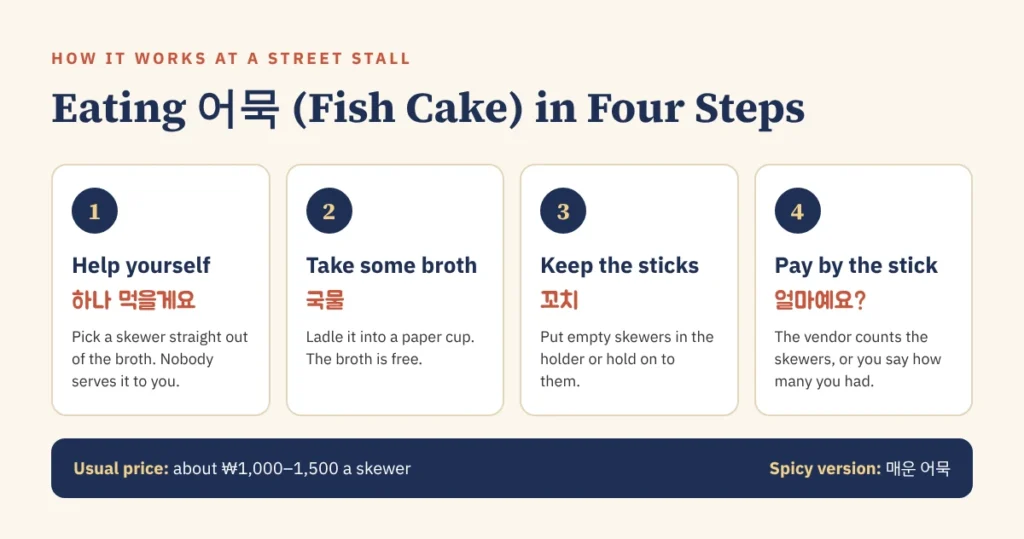
Eating 어묵 at a stall has its own rhythm, and it surprises first-time visitors:
- Help yourself. Stand at the counter and pick a skewer straight out of the broth. Nobody serves it to you.
- Take some broth. There is a ladle and a stack of paper cups. The broth, 국물 (gungmul), is free, and on a cold evening it is half the point.
- Keep your skewers. Put the empty sticks in the holder or hold on to them.
- Pay by the stick. When you are done, the vendor counts the skewers, or you tell them how many you had, and you pay.
It works on trust, and it works well. Along with 붕어빵, 어묵 is the snack I buy most often, and the two are a natural pair: something sweet to take home and something hot to eat on the spot.
Price: roughly ₩1,000 to ₩1,500 a skewer at an ordinary stall. Tourist spots can charge far more. In the summer of 2025, a stall near a famous temple on the edge of Busan made national news for charging ₩3,000 a skewer, while stalls in Haeundae’s market were charging ₩1,200 to ₩1,400.
3. 호떡: the sweet pancake, and Busan’s seed version
호떡 (hotteok) is a disc of yeasted dough filled with brown sugar, cinnamon and chopped nuts, pressed flat on a griddle until the sugar melts into a syrup. It came from China: Chinese merchants who settled in Korea in the late 19th century sold it cheaply, and it spread from there.
Busan has its own version, 씨앗호떡 (ssiat hotteok), “seed hotteok,” and its home is BIFF Square in Nampo-dong, about five minutes’ walk from Exit 7 of Jagalchi Station on Line 1. The hotteok is fried, cut open along one side, and stuffed with a spoonful of sunflower seeds, pumpkin seeds, pine nuts and peanuts, so you get crunch as well as syrup. I have eaten it there myself, and if you are in Busan in winter, it belongs on your list. If you are planning a winter visit to Busan, our Busan season-by-season guide has more ideas.
One warning that every Korean will give you: the sugar inside is very hot. Take a small bite at the edge first, and hold it upright in its paper cup so the syrup does not run down your hand.
4. 군고구마: roasted sweet potato
군고구마 (gungoguma) means “roasted sweet potato,” from 굽다, to roast, and 고구마, sweet potato. It used to be sold from black drum-shaped ovens on street corners, wrapped in newspaper. Those ovens are much rarer now, but the snack has simply moved: convenience stores sell roasted sweet potatoes at the counter all winter, and many homes make their own.
Mine are almost always homemade. An air fryer makes a roasted sweet potato with almost no effort, and that is how I eat them most of the time. If you are staying somewhere with an air fryer, buy a bag of sweet potatoes at a supermarket and try it. You will meet two main varieties: 밤고구마 (bamgoguma), “chestnut sweet potato,” which is dry and fluffy, and 호박고구마 (hobakgoguma), “pumpkin sweet potato,” which is soft, orange and very sweet.
Koreans love to eat them with a piece of kimchi on top, especially in November, when the new kimjang kimchi arrives. It sounds strange and tastes wonderful.
5. 계란빵: egg bread
계란빵 (gyeranppang) is a small oval loaf of sweet, slightly fluffy batter with a whole egg baked on top. It is filling enough to count as breakfast, which makes it a popular grab-and-go snack on a cold morning.
How to Order and Pay in Korean
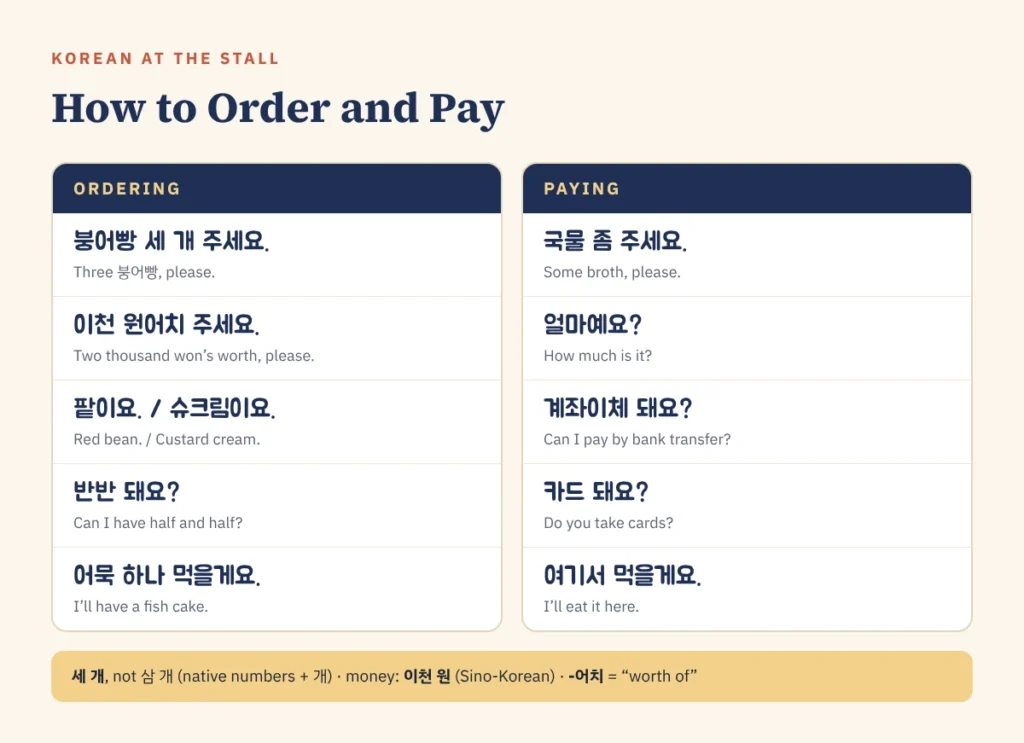
Street stalls are one of the easiest places to practise Korean, because the conversation is short and always the same. You need a number, a 주세요, and maybe one choice. If 주세요 and 얼마예요 are new to you, start with our guide to shopping in Korean.
| Korean | Romanisation | Meaning |
|---|---|---|
| 붕어빵 세 개 주세요. | bungeoppang se gae juseyo | Three 붕어빵, please. |
| 이천 원어치 주세요. | icheon woneochi juseyo | Two thousand won’s worth, please. |
| 팥이요. / 슈크림이요. | pachiyo / syukeurimiyo | Red bean, please. / Custard cream, please. |
| 반반 돼요? | banban dwaeyo? | Can I have half and half? |
| 어묵 하나 먹을게요. | eomuk hana meogeulgeyo | I’ll have a fish cake. |
| 국물 좀 주세요. | gungmul jom juseyo | Some broth, please. |
| 얼마예요? | eolmayeyo? | How much is it? |
| 계좌이체 돼요? | gyejwaiche dwaeyo? | Can I pay by bank transfer? |
| 카드 돼요? | kadeu dwaeyo? | Do you take cards? |
| 여기서 먹을게요. | yeogiseo meogeulgeyo | I’ll eat it here. |
Notice that 붕어빵 is counted with 개, the general counter, and Sino-Korean numbers are not used for it: it is 세 개, never 삼 개. Our guide to Korean counters explains why. Money, on the other hand, uses the Sino-Korean numbers: 이천 원. The ending 어치 (eochi) means “worth of,” so 이천 원어치 is “₩2,000’s worth,” a handy way to order when you do not know how many that buys.
Paying is where street stalls have changed most. Cash in small notes is still the safest choice for visitors, and a ₩50,000 note for a ₩2,000 snack will not be popular. But many stalls now have a little sign with a bank name and an account number, and Koreans simply pay by bank transfer on their phones. I find it the easiest way to pay, and it saves counting coins with cold fingers. If you do not have a Korean bank account, our guide to paying in Korea explains your options.
Korean Words for Winter Street Food
| Korean | Romanisation | Meaning |
|---|---|---|
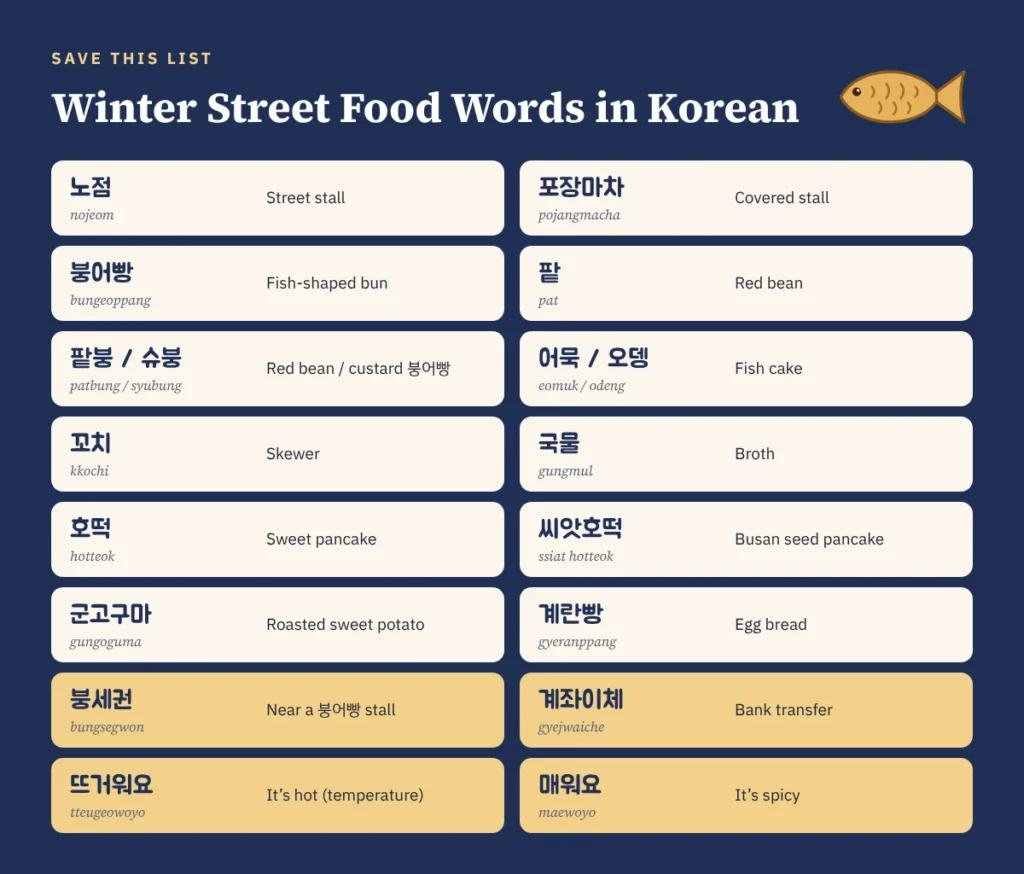
| 노점 / 포장마차 | nojeom / pojangmacha | Street stall / covered stall |
| 붕어빵 | bungeoppang | Fish-shaped bun |
| 팥 | pat | Red bean |
| 팥붕 / 슈붕 | patbung / syubung | Red bean 붕어빵 / custard 붕어빵 |
| 어묵 / 오뎅 | eomuk / odeng | Fish cake |
| 꼬치 | kkochi | Skewer |
| 국물 | gungmul | Broth |
| 호떡 / 씨앗호떡 | hotteok / ssiat hotteok | Sweet pancake / seed pancake |
| 군고구마 | gungoguma | Roasted sweet potato |
| 계란빵 | gyeranppang | Egg bread |
| 붕세권 | bungsegwon | Within walking distance of a 붕어빵 stall |
| 계좌이체 | gyejwaiche | Bank transfer |
| 뜨거워요 | tteugeowoyo | It’s hot (temperature) |
One last word worth knowing is 뜨거워요, from 뜨겁다. It means hot to the touch, and it is what a vendor will say as they hand you a 호떡. Spicy hot is a different word, 매워요 (maewoyo), which you will need for the red 어묵. Mixing them up is a very common beginner slip at a food stall, and our list of Korean food words has more of the vocabulary you will need at the table.
A Few Tips Before You Go
- Carry ₩1,000 notes. Even with bank transfers everywhere, a few small notes make every stall easy.
- Expect to wait. 붕어빵 and 호떡 are cooked a few at a time. If the tray is empty, the vendor will tell you how long, and a fresh one is worth the wait.
- Eat standing up. Most stalls have no seats. Eating on the spot, then dropping your paper cup and skewers in the stall’s bin, is completely normal.
- Check the price first at tourist spots. Neighbourhood stalls are cheap. Stalls at famous sights are not always, so ask 얼마예요? before you start eating.
- Look again tomorrow. Stalls open when the vendor decides, and close when the batter runs out. If one is missing today, it may well be back tomorrow.
A Warm Paper Bag on the Way Home
Korean winters are cold, and these snacks are how Koreans make the cold bearable: a skewer of 어묵 and a cup of broth while you wait, a paper bag of 붕어빵 warming your hands on the way home, a sweet potato out of the air fryer in the evening. None of them costs more than a couple of thousand won, and all of them come with a small, friendly conversation in Korean. Find your 붕세권, learn your three sentences, and pick a side: 팥붕 or 슈붕.
Written by Minhyung Cha — 25 years teaching Korean, and 15+ years running an English academy in South Korea. I live and work in Busan, and every example on this site is checked as a native speaker. More about KEL.
Leave a Reply