You know the alphabet. You have a few hundred words. You even know which particle goes where.
And then you try to say “I eat rice,” and you stall — because 먹다 (meokda) is sitting there in your notebook in a form that no Korean person has ever said out loud in casual conversation.
That gap is verb conjugation, and it is the single biggest bottleneck between “I know Korean words” and “I can make a Korean sentence.” The good news is that Korean conjugation is far more regular than most learners expect. There are no I go / he goes / they went agreements to memorize. One verb form works for every subject in the sentence.
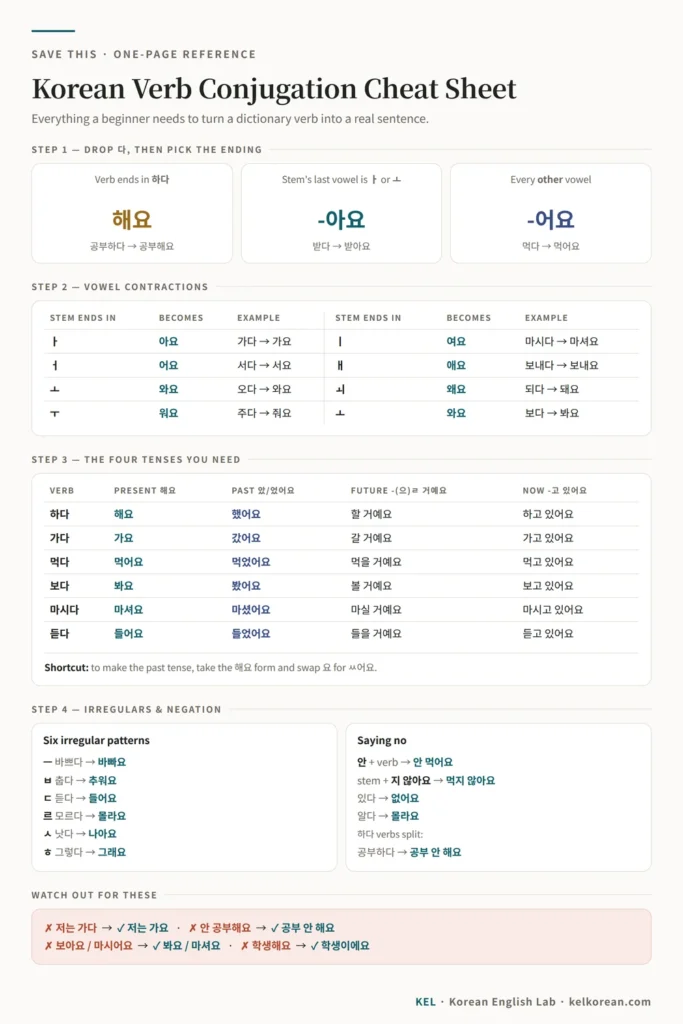
This guide walks you through the polite present tense (the form you will use 80% of the time), then past, future, progressive, negation, and the irregular verbs that break the pattern. By the end you will be able to take any Korean verb from a dictionary and turn it into a sentence you can actually say.
The Good News: What Korean Conjugation Does Not Do
Before the rules, here is what you can stop worrying about.
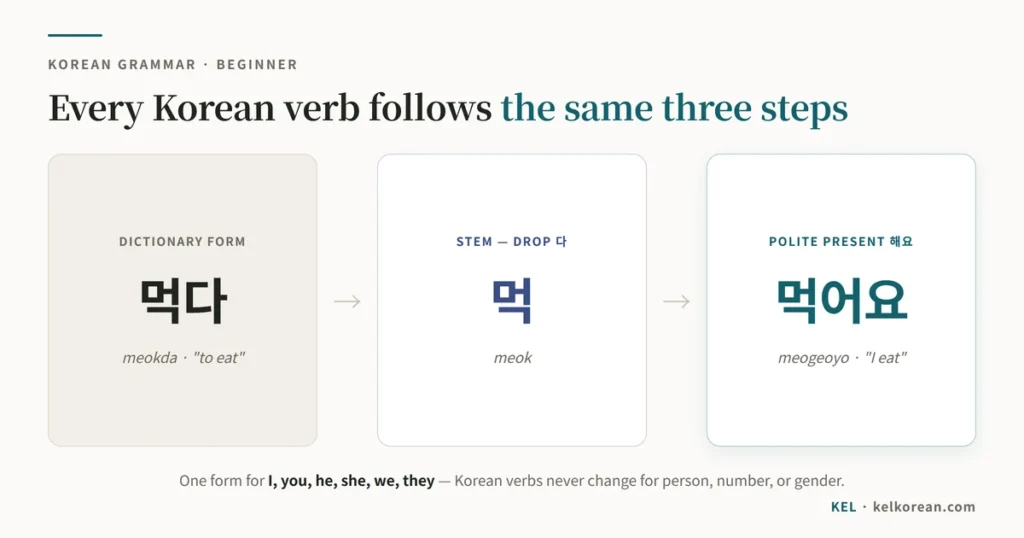
Korean verbs do not change for person or number. In English, go becomes goes for he/she/it. In Spanish it changes five ways. In Korean, 가요 (gayo) means I go, you go, he goes, she goes, we go, and they all go. Same form, every time.
| English | Korean |
|---|---|
| I go | 저는 가요 (jeoneun gayo) |
| You go | 민수 씨는 가요 (Minsu ssineun gayo) |
| He goes | 그는 가요 (geuneun gayo) |
| We go | 우리는 가요 (urineun gayo) |
| They go | 그들은 가요 (geudeureun gayo) |
Korean verbs also do not change for gender. There is no masculine or feminine agreement anywhere in the system.
So what does change a Korean verb? Two things: tense (when it happened) and speech level (how polite you are being). That is the whole system. Everything below is a variation on those two axes.
Korean adjectives conjugate like verbs. This surprises almost everyone. 바쁘다 (bappeuda, to be busy) is not “busy” plus a linking verb — it is a verb, and it conjugates exactly like one: 바빠요 (bappayo), “I am busy.” Korean grammar calls these 형용사, descriptive verbs. Once you learn the conjugation rules for verbs, you get adjectives for free.
Step 1: Find the Verb Stem
Every Korean verb in the dictionary ends in -다 (-da). That -다 is not part of the meaning — it is a marker that says “this is the unconjugated form.”
To conjugate anything, you first strip it off. What remains is the stem.
| Dictionary form | Meaning | Stem |
|---|---|---|
| 가다 (gada) | to go | 가 |
| 먹다 (meokda) | to eat | 먹 |
| 보다 (boda) | to see, to watch | 보 |
| 마시다 (masida) | to drink | 마시 |
| 읽다 (ikda) | to read | 읽 |
| 하다 (hada) | to do | 하 |
| 배우다 (baeuda) | to learn | 배우 |
| 바쁘다 (bappeuda) | to be busy | 바쁘 |
That is the entire step. Drop 다, keep the rest.
One thing to notice already: some stems end in a consonant (먹, 읽), and some end in a vowel (가, 보, 마시). That distinction matters constantly in Korean grammar — it is the same 받침 (batchim, final consonant) logic that decides which Korean particle you attach to a noun.
Step 2: The 아요/어요 Rule
Now we build the 해요체 (haeyoche) — the polite present tense. This is the everyday-polite form Koreans use with colleagues, shopkeepers, classmates, and most adults they are not close to. If you only learn one conjugation, learn this one.
The rule has three branches:
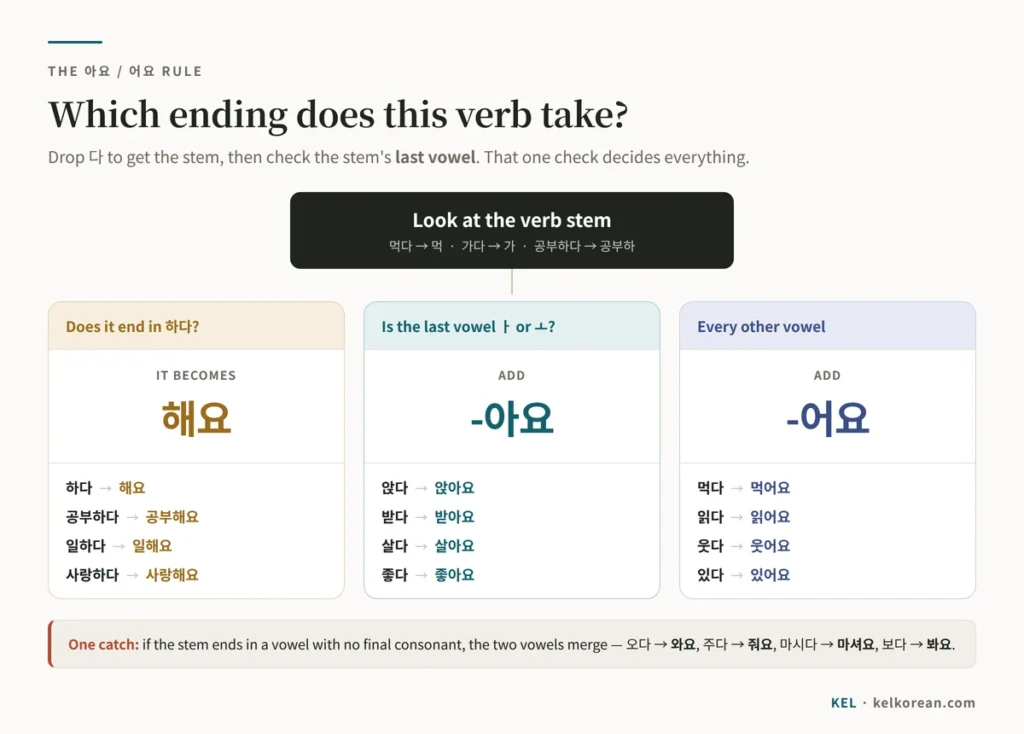
1. If the stem’s last vowel is ㅏ or ㅗ → add -아요
2. For every other vowel → add -어요
3. If the verb ends in 하다 → it becomes 해요
That is it. Look at the last vowel in the stem, pick 아요 or 어요, done.
Branch 1: ㅏ or ㅗ → 아요
| Verb | Stem | Last vowel | Result |
|---|---|---|---|
| 앉다 (antda, to sit) | 앉 | ㅏ | 앉아요 (anjayo) |
| 받다 (batda, to receive) | 받 | ㅏ | 받아요 (badayo) |
| 살다 (salda, to live) | 살 | ㅏ | 살아요 (sarayo) |
| 좋다 (jota, to be good) | 좋 | ㅗ | 좋아요 (joayo) |
Branch 2: Everything else → 어요
| Verb | Stem | Last vowel | Result |
|---|---|---|---|
| 먹다 (meokda, to eat) | 먹 | ㅓ | 먹어요 (meogeoyo) |
| 읽다 (ikda, to read) | 읽 | ㅣ | 읽어요 (ilgeoyo) |
| 웃다 (utda, to laugh) | 웃 | ㅜ | 웃어요 (useoyo) |
| 있다 (itda, to exist/have) | 있 | ㅣ | 있어요 (isseoyo) |
Branch 3: 하다 → 해요
This one is a memorized exception, and it is the most valuable exception in the language. Thousands of Korean verbs are built as noun + 하다, and every single one of them conjugates the same way.
| Verb | Result |
|---|---|
| 하다 (to do) | 해요 (haeyo) |
| 공부하다 (to study) | 공부해요 (gongbuhaeyo) |
| 일하다 (to work) | 일해요 (ilhaeyo) |
| 말하다 (to speak) | 말해요 (malhaeyo) |
| 사랑하다 (to love) | 사랑해요 (saranghaeyo) |
| 좋아하다 (to like) | 좋아해요 (joahaeyo) |
| 운동하다 (to exercise) | 운동해요 (undonghaeyo) |
Learn one pattern, unlock a thousand verbs. This is why 하다 verbs are the best return on investment in early Korean study.
Step 3: When the Vowels Collide
Here is the part that trips people up. When the stem ends in a vowel with no final consonant, the 아 or 어 you are adding crashes into it — and Korean merges them rather than letting you say both.
You do not need to memorize these as separate rules. Say them out loud and you will hear why they happen.
| Stem ends in | + 아요/어요 | Becomes | Example |
|---|---|---|---|
| ㅏ | 아요 | 아요 (merges) | 가다 → 가요 (gayo) |
| ㅓ | 어요 | 어요 (merges) | 서다 → 서요 (seoyo) |
| ㅗ | 아요 | 와요 | 오다 → 와요 (wayo) |
| ㅜ | 어요 | 워요 | 주다 → 줘요 (jwoyo) |
| ㅣ | 어요 | 여요 | 마시다 → 마셔요 (masyeoyo) |
| ㅐ | 어요 | 애요 (merges) | 보내다 → 보내요 (bonaeyo) |
| ㅚ | 어요 | 왜요 | 되다 → 돼요 (dwaeyo) |
Worked examples:
- 보다 (to watch) → 보 + 아요 → 봐요 (bwayo) — 영화를 봐요. (yeonghwareul bwayo, “I watch a movie.”)
- 배우다 (to learn) → 배우 + 어요 → 배워요 (baewoyo) — 저는 한국어를 배워요. (jeoneun hangugeoreul baewoyo, “I’m learning Korean.”)
- 기다리다 (to wait) → 기다리 + 어요 → 기다려요 (gidaryeoyo)
- 만나다 (to meet) → 만나 + 아요 → 만나요 (mannayo) — 친구를 만나요. (chingureul mannayo, “I’m meeting a friend.”)
If the ㅗ/ㅜ contractions feel unstable in your mouth, it is worth going back to the vowel sounds themselves — the difference between 어 and 오 is exactly the distinction doing the work here.
Step 4: Past Tense — Add 았/었어요
Once you can produce the 해요 form, past tense costs you almost nothing. The vowel choice follows the exact same rule — ㅏ/ㅗ takes 았, everything else takes 었 — and then you add 어요.
Shortcut: take the 해요 form, replace the final 요 with ㅆ어요.
| Present | Past | Example |
|---|---|---|
| 가요 | 갔어요 (gasseoyo) | 학교에 갔어요. (hakgyoe gasseoyo, “I went to school.”) |
| 먹어요 | 먹었어요 (meogeosseoyo) | 밥을 먹었어요. (babeul meogeosseoyo, “I ate.”) |
| 해요 | 했어요 (haesseoyo) | 숙제를 했어요. (sukjereul haesseoyo, “I did my homework.”) |
| 봐요 | 봤어요 (bwasseoyo) | 영화를 봤어요. (yeonghwareul bwasseoyo, “I watched a movie.”) |
| 마셔요 | 마셨어요 (masyeosseoyo) | 커피를 마셨어요. (keopireul masyeosseoyo, “I drank coffee.”) |
| 배워요 | 배웠어요 (baewosseoyo) | 한국어를 배웠어요. (hangugeoreul baewosseoyo, “I learned Korean.”) |
That shortcut works because the past tense marker is built on the same 아/어 base. Get the present tense right and the past tense is free.
Step 5: Future and Intention — -(으)ㄹ 거예요
Korean’s most common future form is -(으)ㄹ 거예요 (-(eu)l geoyeyo). It carries both “will” and “I’m planning to.”
The choice depends on 받침 again:
- Stem ends in a vowel → add -ㄹ 거예요
- Stem ends in a consonant → add -을 거예요
- Stem ends in ㄹ → just add 거예요
| Verb | Future | Example |
|---|---|---|
| 가다 | 갈 거예요 (gal geoyeyo) | 내일 갈 거예요. (naeil gal geoyeyo, “I’ll go tomorrow.”) |
| 먹다 | 먹을 거예요 (meogeul geoyeyo) | 저녁을 먹을 거예요. (jeonyeogeul meogeul geoyeyo, “I’m going to eat dinner.”) |
| 하다 | 할 거예요 (hal geoyeyo) | 나중에 할 거예요. (najunge hal geoyeyo, “I’ll do it later.”) |
| 살다 | 살 거예요 (sal geoyeyo) | 서울에서 살 거예요. (seoureseo sal geoyeyo, “I’ll live in Seoul.”) |
Note the spelling: it is 거예요, not 거에요. This is one of the most common spelling errors even native speakers make online.
Step 6: Right Now — -고 있어요
For “I am currently doing X,” attach -고 있어요 (-go isseoyo) directly to the stem. No vowel harmony, no 받침 check — it is the same for every verb.
- 먹다 → 먹고 있어요 (meokgo isseoyo) — 지금 먹고 있어요. (“I’m eating right now.”)
- 공부하다 → 공부하고 있어요 (gongbuhago isseoyo)
- 가다 → 가고 있어요 (gago isseoyo)
- 기다리다 → 기다리고 있어요 (gidarigo isseoyo)
Worth knowing: Korean does not require the progressive as strictly as English does. 지금 먹어요 is perfectly natural for “I’m eating right now.” Use -고 있어요 when you want to emphasize that the action is ongoing.
Step 7: Saying No — Two Ways to Negate
The short way: 안 + verb
Put 안 (an) directly in front of the conjugated verb.
- 안 가요 (an gayo) — I don’t go / I’m not going
- 안 먹어요 (an meogeoyo) — I don’t eat
- 안 바빠요 (an bappayo) — I’m not busy
The long way: -지 않아요
Attach -지 않아요 (-ji anayo) to the stem. Slightly more formal, more common in writing.
- 가지 않아요 (gaji anayo)
- 먹지 않아요 (meokji anayo) — 고기를 먹지 않아요. (“I don’t eat meat.”)
The trap: 하다 verbs split
This is the single most common negation mistake learners make. With noun + 하다 verbs, 안 goes between the noun and 하다 — not in front of the whole thing.
| ✗ Wrong | ✓ Correct |
|---|---|
| 안 공부해요 | 공부 안 해요 (gongbu an haeyo) |
| 안 일해요 | 일 안 해요 (il an haeyo) |
| 안 운동해요 | 운동 안 해요 (undong an haeyo) |
Plain 하다 verbs that are not noun-based (like 좋아하다) do keep 안 in front: 안 좋아해요.
Two verbs with their own negatives
- 있다 (to exist / to have) → negative is 없어요 (eopseoyo), not 안 있어요
- 알다 (to know) → negative is 몰라요 (mollayo), not 안 알아요
Step 8: The Irregular Verbs
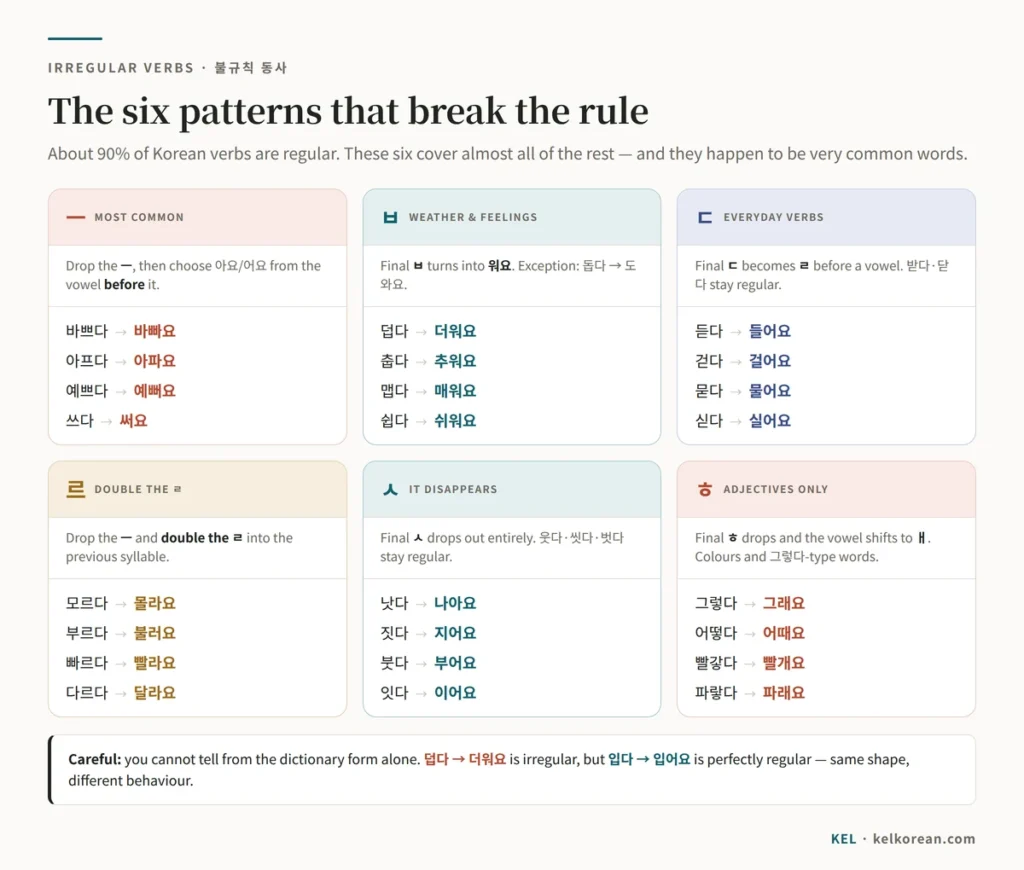
About 90% of Korean verbs follow the rules above exactly. The remaining ones fall into a handful of predictable patterns. You do not need to memorize these on day one — but you will meet them fast, because the irregular verbs happen to be extremely common words.
ㅡ irregular — the most important one
If the stem ends in ㅡ, drop it, then look at the vowel in the syllable before it to choose 아요 or 어요. If there is no earlier syllable, use 어요.
| Verb | Result |
|---|---|
| 바쁘다 (to be busy) | 바빠요 (bappayo) |
| 아프다 (to hurt, be sick) | 아파요 (apayo) |
| 예쁘다 (to be pretty) | 예뻐요 (yeppeoyo) |
| 쓰다 (to write, to use) | 써요 (sseoyo) |
| 크다 (to be big) | 커요 (keoyo) |
ㅂ irregular
Stem-final ㅂ turns into 워요.
| Verb | Result |
|---|---|
| 덥다 (to be hot) | 더워요 (deowoyo) |
| 춥다 (to be cold) | 추워요 (chuwoyo) |
| 어렵다 (to be difficult) | 어려워요 (eoryeowoyo) |
| 쉽다 (to be easy) | 쉬워요 (swiwoyo) |
| 맵다 (to be spicy) | 매워요 (maewoyo) |
Two exceptions go to 와요 instead: 돕다 → 도와요 (to help), 곱다 → 고와요.
Not every ㅂ is irregular. 입다 (to wear) → 입어요, 잡다 (to catch) → 잡아요.
ㄷ irregular
Stem-final ㄷ becomes ㄹ before a vowel.
| Verb | Result |
|---|---|
| 듣다 (to listen) | 들어요 (deureoyo) |
| 걷다 (to walk) | 걸어요 (georeoyo) |
| 묻다 (to ask) | 물어요 (mureoyo) |
Regular ㄷ verbs: 받다 → 받아요, 닫다 → 닫아요, 믿다 → 믿어요.
르 irregular
Drop the ㅡ and double the ㄹ.
| Verb | Result |
|---|---|
| 모르다 (to not know) | 몰라요 (mollayo) |
| 부르다 (to call, to sing) | 불러요 (bulleoyo) |
| 빠르다 (to be fast) | 빨라요 (ppallayo) |
| 다르다 (to be different) | 달라요 (dallayo) |
ㅅ irregular
Stem-final ㅅ disappears.
| Verb | Result |
|---|---|
| 낫다 (to get better) | 나아요 (naayo) |
| 짓다 (to build) | 지어요 (jieoyo) |
| 붓다 (to pour, to swell) | 부어요 (bueoyo) |
Regular ㅅ verbs: 웃다 → 웃어요, 씻다 → 씻어요, 벗다 → 벗어요.
ㅎ irregular (adjectives)
| Verb | Result |
|---|---|
| 그렇다 (to be so) | 그래요 (geuraeyo) |
| 어떻다 (to be how) | 어때요 (eottaeyo) |
| 빨갛다 (to be red) | 빨개요 (ppalgaeyo) |
Where 해요 Sits Among the Speech Levels
해요체 is one of several politeness levels. Here is the quick map so you know what you are choosing:
| Level | Form of 가다 | When to use |
|---|---|---|
| 하십시오체 (formal polite) | 갑니다 (gamnida) | News, presentations, military, customer service |
| 해요체 (polite) | 가요 (gayo) | Default for almost everything — this guide’s focus |
| 해체 / 반말 (casual) | 가 (ga) | Close friends, younger people, family |
If you are unsure which to use, use 해요체. It is polite enough for nearly every situation a learner will encounter and never sounds rude. For the full picture of when to shift up or down, see our guide to Korean honorifics.
The 20 Verbs to Conjugate First
If you drill nothing else, drill these.
| Dictionary | Meaning | 해요 (present) | Past |
|---|---|---|---|
| 하다 | to do | 해요 | 했어요 |
| 가다 | to go | 가요 | 갔어요 |
| 오다 | to come | 와요 | 왔어요 |
| 먹다 | to eat | 먹어요 | 먹었어요 |
| 마시다 | to drink | 마셔요 | 마셨어요 |
| 보다 | to see, watch | 봐요 | 봤어요 |
| 듣다 | to listen | 들어요 | 들었어요 |
| 읽다 | to read | 읽어요 | 읽었어요 |
| 쓰다 | to write, use | 써요 | 썼어요 |
| 말하다 | to speak | 말해요 | 말했어요 |
| 배우다 | to learn | 배워요 | 배웠어요 |
| 가르치다 | to teach | 가르쳐요 | 가르쳤어요 |
| 사다 | to buy | 사요 | 샀어요 |
| 팔다 | to sell | 팔아요 | 팔았어요 |
| 만나다 | to meet | 만나요 | 만났어요 |
| 살다 | to live | 살아요 | 살았어요 |
| 주다 | to give | 줘요 | 줬어요 |
| 자다 | to sleep | 자요 | 잤어요 |
| 있다 | to exist, have | 있어요 | 있었어요 |
| 알다 | to know | 알아요 | 알았어요 |
Pair these with the vocabulary in our 100 Korean words to learn first and you can build hundreds of real sentences.
5 Common Conjugation Mistakes
1. Using the dictionary form in speech. ✗ 저는 가다. ✓ 저는 가요. The -다 form belongs in dictionaries and vocabulary lists, not conversations.
2. Putting 안 in the wrong place with 하다 verbs. ✗ 안 공부해요. ✓ 공부 안 해요.
3. Treating adjectives like English adjectives. ✗ 저는 바쁘다 예요. ✓ 저는 바빠요. Korean adjectives conjugate on their own — they do not take a separate “to be.”
4. Conjugating 이에요/예요 as if it were a verb. For “I am a student,” you attach 이에요 to the noun: 학생이에요 (haksaengieyo). It is not 학생해요. 이다 is its own copula with its own pattern.
5. Skipping the contraction. ✗ 보아요, 마시어요. ✓ 봐요, 마셔요. Both are technically derivable, but only the contracted forms sound natural in speech.
Quick Practice: Conjugate These
Convert each dictionary form to the 해요 (polite present) form. Answers below.
- 읽다 (to read) → ?
- 오다 (to come) → ?
- 운동하다 (to exercise) → ?
- 바쁘다 (to be busy) → ?
- 듣다 (to listen) → ?
- 기다리다 (to wait) → ?
- 춥다 (to be cold) → ?
- 모르다 (to not know) → ?
Answers:
- 읽어요 — stem 읽, vowel ㅣ → 어요
- 와요 — stem 오, vowel ㅗ → 아요, then ㅗ + ㅏ contracts to ㅘ
- 운동해요 — 하다 verb
- 바빠요 — ㅡ irregular; drop ㅡ, preceding vowel is ㅏ → 아요
- 들어요 — ㄷ irregular; ㄷ becomes ㄹ
- 기다려요 — stem ends in ㅣ, contracts with 어 to 여
- 추워요 — ㅂ irregular
- 몰라요 — 르 irregular; drop ㅡ, double the ㄹ
Now try the same eight in the past tense. (Hint: swap 요 for ㅆ어요.)
Frequently Asked Questions
Do I have to learn 합니다 form too?
Not immediately. 해요체 will carry you through daily conversation, travel, classes, and most workplaces. Learn to recognize 합니다 form early — you will hear it constantly in announcements and on TV — but you can delay producing it until you are comfortable with 해요.
Why do some textbooks say 아/어/여요 with three parts?
The 여 branch exists only for 하다, which always contracts to 해요 anyway. Some textbooks list it for completeness. Treating 하다 → 해요 as a memorized exception is faster and gets you the same result.
How do I know if a verb is irregular?
You will not, from the dictionary form alone — 입다 and 덥다 look identical in structure but conjugate differently. Good dictionaries mark irregulars, and Naver Dictionary shows conjugated forms directly. In practice, most learners absorb them through exposure rather than lists.
Is 반말 rude?
Not inherently — it is what close friends and family use with each other. It is rude only when used with someone who has not invited it, or with someone older or senior. As a learner, wait until a Korean speaker says 말 놓으세요 (“speak casually with me”) before switching.
Do I conjugate differently when talking about myself vs. someone else?
The tense forms are identical. What can change is the honorific marker -시-, which you add when the sentence’s subject deserves respect — never for yourself. 할머니가 가세요 (“Grandmother goes”) vs. 저는 가요 (“I go”). Our honorifics guide covers this in detail.
Where does conjugation sit in a Korean sentence?
At the very end, always. Korean is subject-object-verb, and the conjugated verb closes the sentence — which is why Korean speakers can flip a sentence’s meaning entirely with the last syllable. See our guide to Korean sentence structure.
Final Thoughts
Verb conjugation feels like the hardest wall in beginner Korean, and then it stops being one — usually faster than learners expect. The reason is that you are not memorizing hundreds of forms. You are learning one decision (ㅏ/ㅗ or not), one exception worth a thousand verbs (하다 → 해요), and a short list of irregulars that show up so often you will learn them by hearing them.
Pick five verbs from the table above. Conjugate each one into present, past, future, and negative. That is twenty forms, and it takes about ten minutes. Do that for four days and you will have covered the twenty verbs that account for most of what beginners actually need to say.
If you have not yet locked down Hangul, particles, or numbers, those pair naturally with this one — particles tell you what role each word plays, conjugation tells you when it happened, and together they turn a vocabulary list into a language.
Keep learning with Korean English Lab. Our bilingual Korean–English worksheets and printable workbooks are designed for self-study learners who want structured practice, not just theory.
Leave a Reply