
Sorry in Korean is not one word. It is a small family of words, and choosing between them tells the listener how you see the two of you — which is why a correct apology can still land badly.
Most phrase lists give you 미안해요 and 죄송합니다, call one casual and the other polite, and stop there. That is enough to get through a crowded subway. It is not enough to know why saying 죄송합니다 to your partner sounds cold, why you should never say it to someone who has just lost a parent, or why a Korean friend will say 미안해 while handing you a present.
English uses one word, sorry, for at least eight different jobs: apologising, getting attention, squeezing past, interrupting, softening a personal question, not hearing, sympathising and offering condolences. Korean gives each job its own phrase. Only one of those eight is an apology — and that is the one where the Korean word for sorry belongs.
This guide covers all of them: the five levels of apology, the difference between 죄송 and 미안 that nobody explains, the English sorries that must not be translated, and how to answer when someone apologises to you.
The Five Levels of Sorry
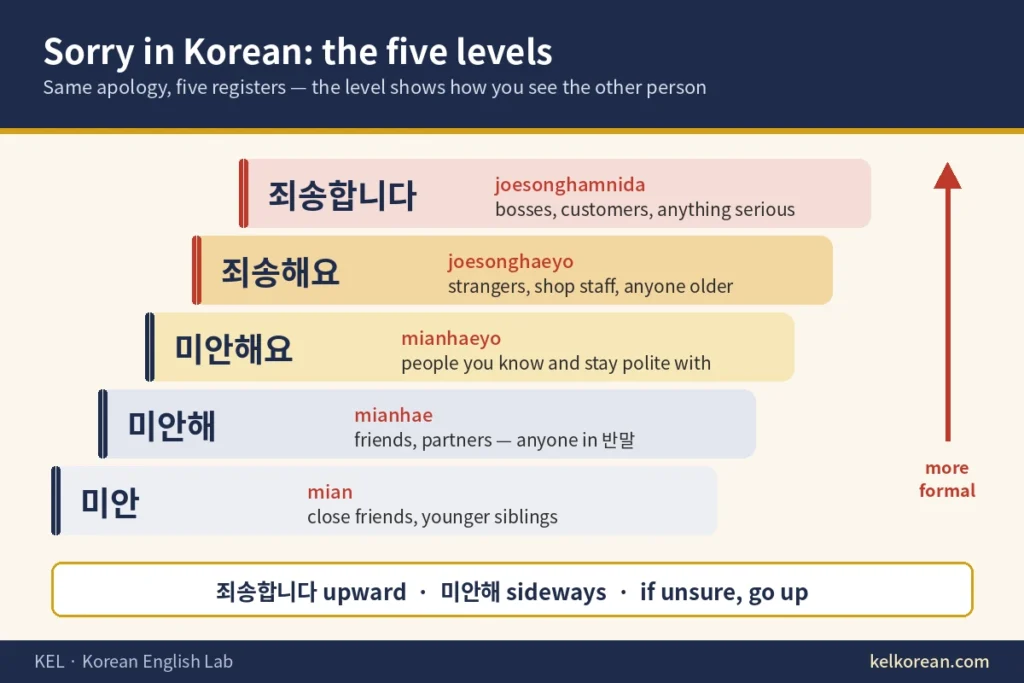
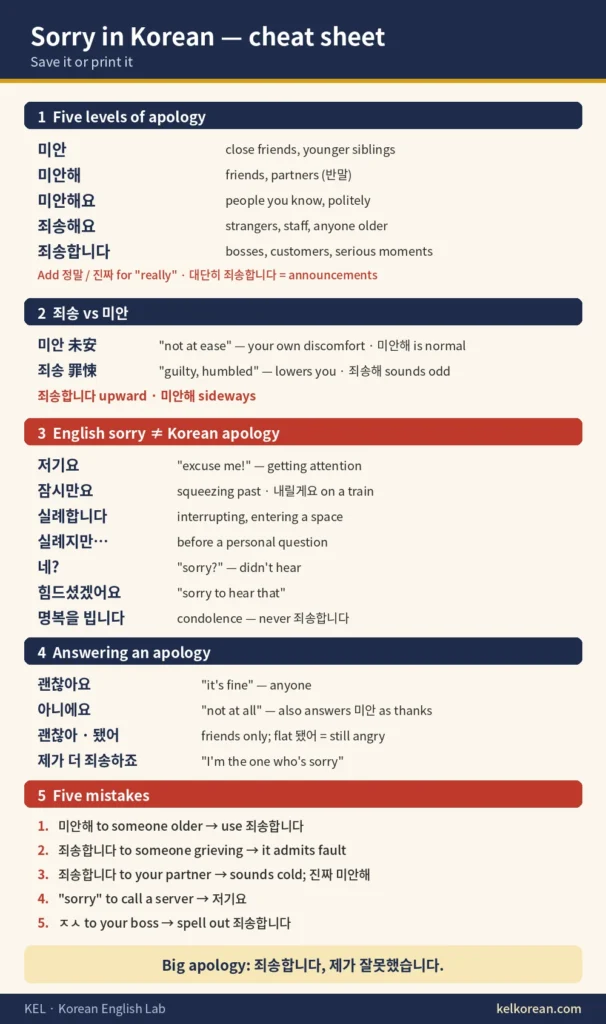
Korean apologies are built from two stems, 미안하다 and 죄송하다, conjugated for how formal the situation is. Here is the whole ladder, from the most relaxed to the most deferential.
| Korean | Romanisation | Who it is for |
|---|---|---|
| 미안 | mian | Close friends and younger siblings. Clipped, quick, almost a shrug |
| 미안해 | mianhae | Friends, partners, anyone you speak 반말 with |
| 미안해요 | mianhaeyo | People you know but are polite with — a coworker your age, a neighbour |
| 죄송해요 | joesonghaeyo | Strangers, shop staff, anyone older — the everyday safe choice |
| 죄송합니다 | joesonghamnida | Bosses, teachers, customers, anything public or serious |
Two intensifiers stack on top. 정말 and 진짜 both mean “really” — 정말 죄송합니다, 진짜 미안해 — and 진짜 is the more casual of the two. 대단히 죄송합니다, “greatly sorry,” is what you mostly hear in airline announcements and company statements rather than in conversation.
In text messages between friends you will also see ㅈㅅ, the consonants of 죄송 — our guide to Korean texting slang covers it and its cousins. To anyone senior, spell the whole thing out.
If you only learn one, learn 죄송합니다. Too polite is a small social cost; too casual can be a real one. Our guide to Korean honorifics explains the levels in general, and banmal covers who you are allowed to drop them with.
죄송 and 미안 Are Not the Same Word, Politer
Nearly every English guide treats 죄송합니다 as a more formal 미안합니다. That is half right, and the missing half is the useful part.
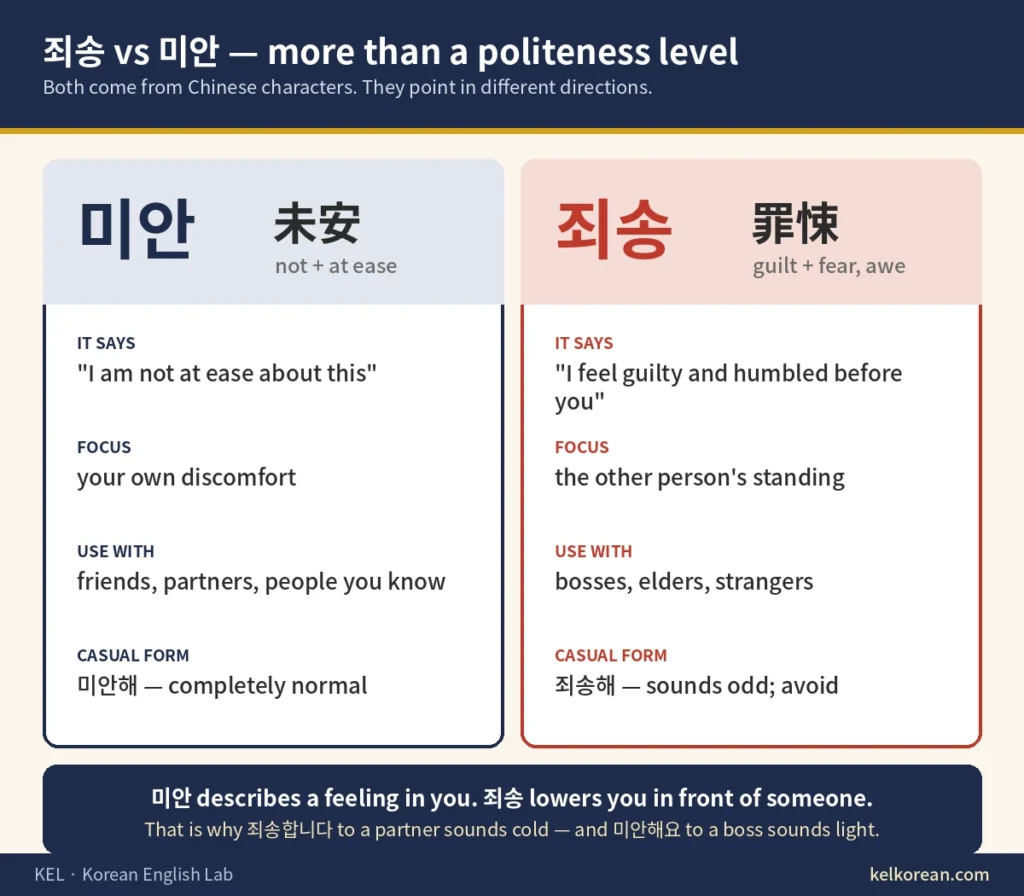
Both words come from Chinese characters — a surprise to anyone who has read that 미안 is the “native Korean” one. They say different things:
| 미안 (未安) | 죄송 (罪悚) | |
|---|---|---|
| Characters | 未 not + 安 at ease | 罪 guilt + 悚 fear, awe |
| What it says | “I am not at ease about this” | “I feel guilty and humbled before you” |
| Centre of gravity | Your own discomfort | The other person’s standing |
| 반말 form | 미안해 — completely normal | 죄송해 — almost never said |
미안 describes a feeling in you. 죄송 lowers you in front of someone. That is why 죄송 has no natural casual form: you cannot humble yourself before someone while speaking to them as an equal, so 죄송해 sounds like a joke — which is how it gets used, if at all.
It is also why 죄송합니다 to a partner or a close friend sounds cold. It is not too polite in a flattering way. It puts a formal distance between you, and in the middle of an argument it can read as “fine, I will say the words.” Between people who speak 반말, a real apology is 미안해, often with 진짜 in front of it.
And the reverse: 미안해요 to your boss is not rude, but it is light. For a missed deadline it sounds as if you are sorry about your inconvenience rather than theirs. Use 죄송합니다 upward, every time.
How to Pronounce 죄송합니다
Two things happen between the spelling and the sound.
합니다 is said 함니다. When ㅂ meets ㄴ it turns into ㅁ, so 죄송합니다 is pronounced joesong-ham-ni-da and 미안합니다 is mian-ham-ni-da. It is one of the most regular sound changes in Korean, and it applies to every -ㅂ니다 ending you will ever say. Our guide to Korean pronunciation rules covers it with the rest of the set.
죄 is usually said like 줴. Standard pronunciation treats ㅚ as a single rounded vowel but also allows it as we, and that is what most Koreans actually say. Jwe-song-ham-ni-da will sound more natural than a careful joe.
Half the Time, Sorry Is Not an Apology
This is where learners go wrong most often, because English trains you to reach for sorry in situations Korean handles with a completely different phrase.
| When English says | You mean | Korean says |
|---|---|---|
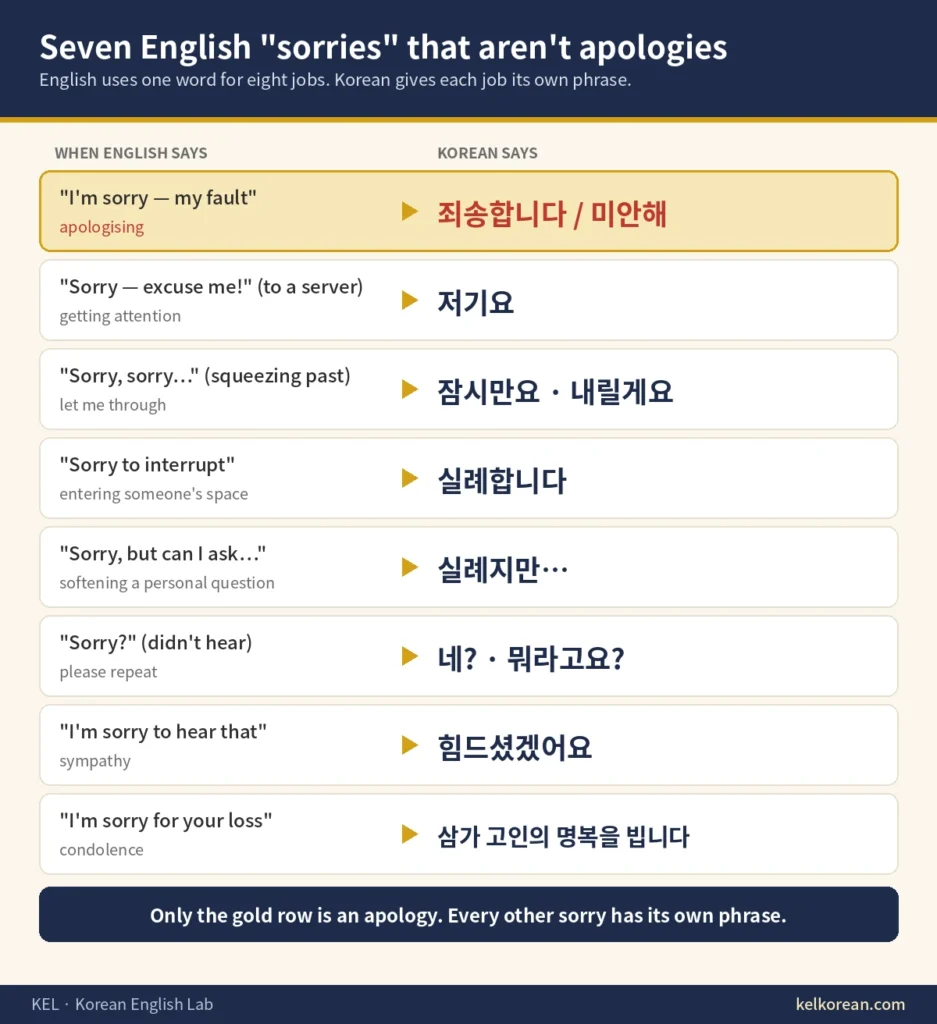
| “Sorry — excuse me!” (to a server) | Getting attention | 저기요 (or 여기요 in a restaurant) |
| “Sorry, sorry” (squeezing past) | Let me through | 잠시만요, or 내릴게요 on a train |
| “Sorry to interrupt” | I am entering your space | 실례합니다 |
| “Sorry, but can I ask…” | Softening a personal question | 실례지만… |
| “Sorry?” (didn’t hear) | Please repeat | 네? or 뭐라고요? |
| “I’m sorry to hear that” | Sympathy | 힘드셨겠어요, 속상하셨겠어요 |
| “I’m sorry for your loss” | Condolence | 삼가 고인의 명복을 빕니다 |
저기요 comes from 저기, “over there,” and is how you call anyone — a server, a stranger who dropped something. In a restaurant you will hear 여기요 (“over here”) just as often. Say 죄송합니다 to get a waiter’s attention and you sound oddly apologetic for simply needing something. Our guide to ordering food in Korean shows it in action.
잠시만요 (“just a moment”) is what you say pushing through a crowd, and on a packed train Koreans say 내릴게요 — “I’m getting off” — which tells people what you need rather than apologising for needing it. Both are in our Korean subway guide.
실례합니다 means “I am committing a discourtesy” — knocking on an office door, stepping between two people talking. Its cousin 실례지만 opens a question you know is personal, and it is exactly how a polite Korean asks how old you are.
And “sorry?” when you did not catch something is just 네? with a rising tone. Nothing was your fault. Nothing needs apologising for.
Never Say 죄송합니다 to Someone Who Is Grieving
This deserves its own section, because the mistake is easy, well meant, and painful to hear.
“I’m sorry for your loss” contains the word sorry, so learners translate it as 죄송합니다. But 죄송합니다 admits fault. To a grieving Korean it sounds as though you are apologising for the death — as though you had something to do with it. It is well meant, but it is not what Koreans say, and it can leave the other person unsure how to respond.
What Koreans actually say:
| Situation | What to say | Meaning |
|---|---|---|
| Writing a message, or formally | 삼가 고인의 명복을 빕니다 | “I respectfully pray for the deceased’s happiness in the next life” |
| At a funeral hall, in person | 뭐라 드릴 말씀이 없습니다 | “I have no words to offer you” |
| To a friend, gently | 많이 힘들지… | “This must be so hard…” |
The second one surprises people, and it is the most Korean of the three. At a funeral hall, saying very little is correct — a bow, a few words, your presence. “I have no words” is not a failure of vocabulary. It is the right words.
The same logic applies to smaller bad news. A friend failed an exam or got dumped: 속상하겠다, “that must be upsetting,” or 힘들었겠다, “that must have been hard.” You are describing their feeling, not apologising for it.
죄송한데요: Sorry as a Door-Opener
Korean does use sorry for one job English does too — softening a request. It just builds it into the sentence.
죄송한데요 and 죄송하지만 both mean “I’m sorry, but…” and open almost any request to a stranger. 죄송한데요, 사진 좀 찍어 주실 수 있어요? — “Sorry, could you take a photo for us?” 죄송하지만 오늘은 안 될 것 같아요 — “I’m sorry, but today won’t work.” The first is the everyday one; the second is a notch more formal and very common before a refusal.
You will also see the fixed phrase 불편을 드려 죄송합니다 — “sorry for the inconvenience” — on every construction barrier, closed escalator and delayed train announcement in the country. Once you can read it, you will notice it daily.
When 미안 Means Thank You
Here is the part that is invisible from outside Korea.
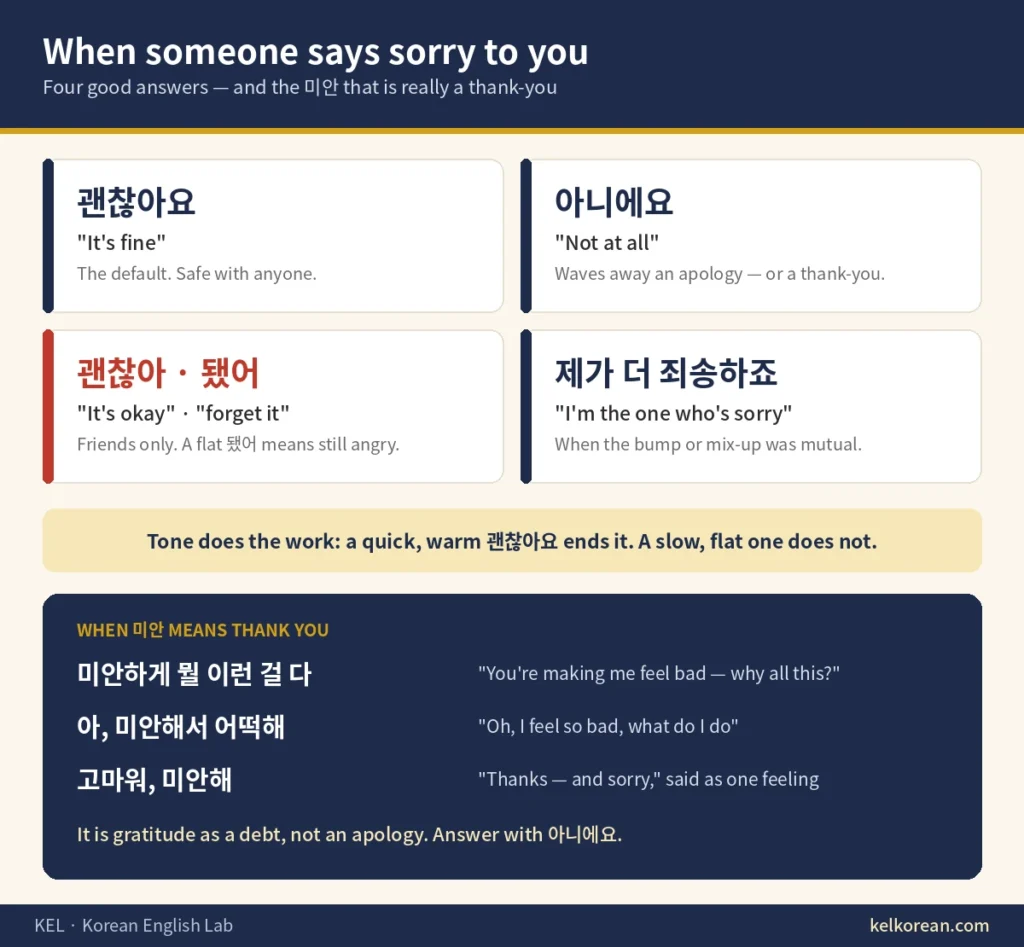
A friend picks up the bill, drives you to the airport, brings you soup when you are ill. An English speaker says thank you. A Korean very often says 미안 first — 미안하게 뭘 이런 걸 다, “you’re making me feel bad, why would you do all this,” or 아, 미안해서 어떡해, “oh, I feel so bad, what do I do.”
It is not an apology. It is gratitude expressed as a debt. Receiving too much kindness leaves you “not at ease” — the literal meaning of 미안 — until you can return it. This is the same instinct behind 정, and it is why you will often hear the pair together: 고마워, 미안해, “thanks, and sorry,” both said as one feeling.
You do not need to produce this yourself as a beginner. But when a Korean apologises for a gift you just gave them, you will know nothing went wrong. The right reply is below.
How to Answer an Apology
Someone apologises to you. You have four good options, and all of them are some version of “it’s nothing.” Our guide to yes and no in Korean explains why 아니에요 is so flexible.
| Say | Meaning | Use it |
|---|---|---|
| 괜찮아요 | “It’s fine” | The default. Safe with anyone |
| 아니에요 | “Not at all” | Waving away an apology or a thank-you — also the answer to 미안하게 뭘 이런 걸 |
| 괜찮아 / 됐어 | “It’s okay” / “forget it” | Friends only — and 됐어 in a flat voice means you are still angry |
| 제가 더 죄송하죠 | “I’m the one who should be sorry” | When a bump or a mix-up was mutual |
Tone matters more here than the word. A warm, quick 괜찮아요 ends the matter. A slow, flat one tells the other person it is not fine at all — which Korean speakers read instantly, and English speakers often miss.
Bigger Apologies: 잘못했어요 and 사과드립니다
죄송합니다 says you feel bad. For a real apology, Korean has a stronger move: naming the fault.
잘못했어요 means “I did wrong.” It is what a child says to a parent, what a partner says after a genuine mistake, what an employee says after a real error. 제 잘못이에요, “it’s my fault,” does the same job. Pairing the two — 죄송합니다, 제가 잘못했습니다 — is the complete form, and it carries far more weight than repeating 죄송합니다 louder.
사과드립니다, “I offer an apology,” is the formal written version you will see in emails, notices and statements. It sounds careful and official; nobody says it to a friend.
Public apologies in Korea follow a script almost word for word. 심려를 끼쳐 드려 죄송합니다 — “I am sorry to have caused you concern” — opens nearly every one, followed by a deep bow held for several seconds. Once you have heard it, you will spot it in news clips and K-dramas alike.
And one pun, because Korean internet users cannot resist it: the word for apology, 사과, sounds exactly like the word for apple. They are two unrelated words that happen to share a sound, and a 🍎 in a half-joking apology message is the result.
Frequently Asked Questions
How do you say sorry in Korean?
죄송합니다 (joesonghamnida) is the safe, polite form for strangers, anyone older and anything serious. 미안해요 (mianhaeyo) is gentler and used with people you know, and 미안해 (mianhae) is for close friends and partners.
What is the difference between 죄송합니다 and 미안합니다?
미안 means you are not at ease about something; 죄송 means you feel guilty and humbled before the other person. Both are polite, but 죄송합니다 lowers you further and is the right choice with bosses, teachers, customers and elders.
How do I say “excuse me” in Korean?
It depends on what you are doing. 저기요 (or 여기요 in a restaurant) to get someone’s attention, 잠시만요 to get past, 실례합니다 when you are interrupting or entering someone’s space.
How do you respond when someone says sorry in Korean?
괜찮아요 (“it’s fine”) works with anyone. 아니에요 (“not at all”) waves the apology away, and with friends 괜찮아 is enough.
First Ask: Is This an Apology?
The words themselves take five minutes to learn. The judgement takes longer, and it comes down to one question: is this actually an apology? If it is, pick your level — 죄송합니다 upward, 미안해 sideways. If it is attention, passage, interruption or sympathy, Korean has a better phrase waiting, and using it will make you sound far more fluent than any amount of polite apologising.
If you are starting out, pair this with our guide to Korean greetings and the first 100 Korean words — between them, they cover most of what a beginner says in a day. And the next time a Korean friend says 미안해 while accepting your gift, answer 아니에요 and smile. You have understood something most phrasebooks miss.
Written by Minhyung Cha — 25 years teaching Korean, and 15+ years running an English academy in South Korea. I live and work in Busan, and every example on this site is checked as a native speaker. More about KEL.
Leave a Reply