Pepero Day falls on 11 November, and for about two weeks before it, Korea’s convenience stores turn red. Towers of chocolate-stick boxes go up by the door, gift baskets wrapped in cellophane appear by the till, and the word 빼빼로 is on sign after sign.
Then, on the day itself, everyone gives them away. Schoolchildren hand them to classmates, office workers leave a box on the next desk, and couples try to outdo each other. Nobody is required to take part, and almost everybody does.
From the outside it looks like a holiday a snack company invented. It is not, quite. It started with teenage girls in Busan — the city I live in — and only later did the company catch up. This guide explains where the day came from, who gives Pepero to whom, what a Korean couple actually does on 11 November, the other holiday that shares the date, and the Korean you need to join in.
Four Ones, Four Sticks
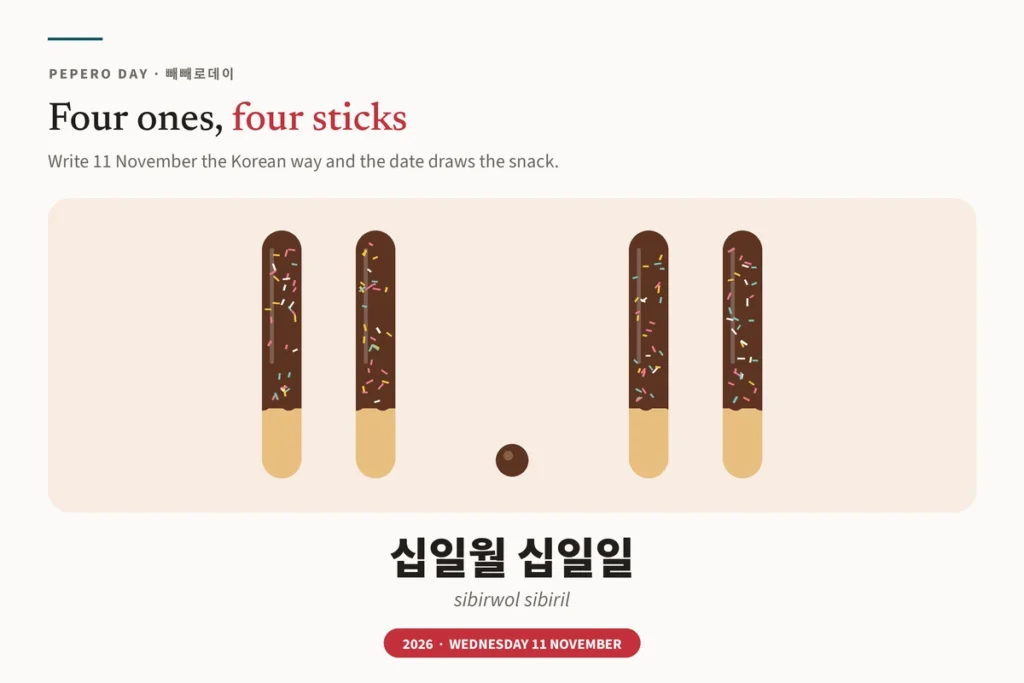
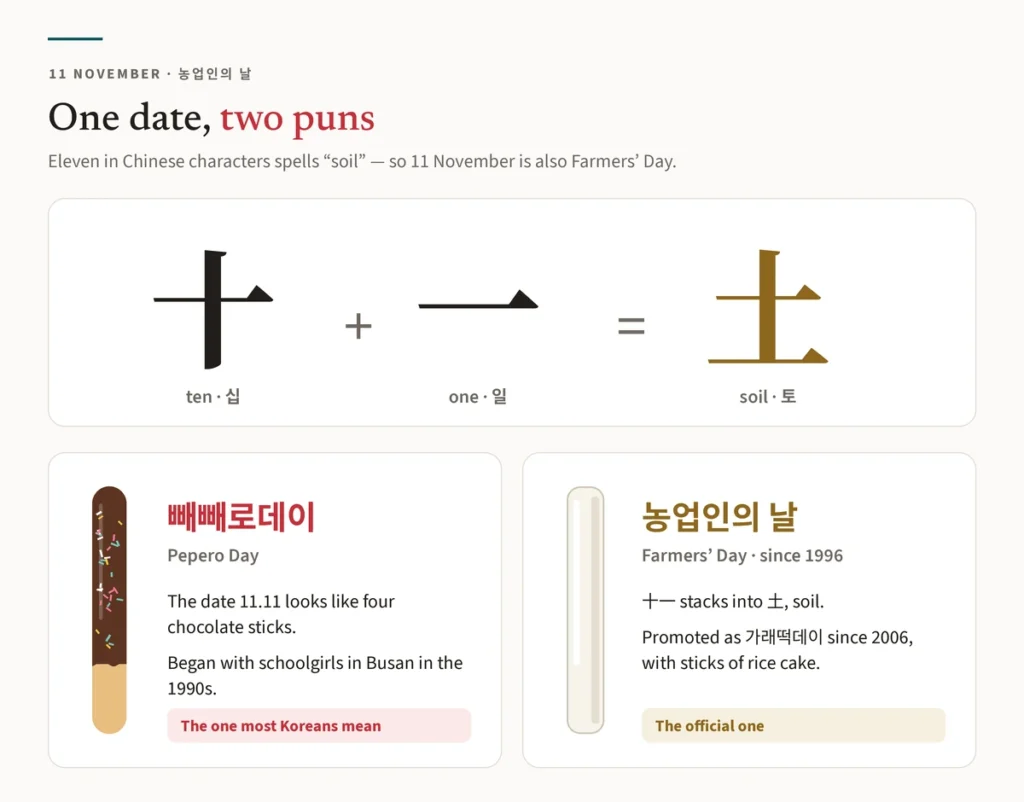
Pepero is a thin biscuit stick dipped in chocolate, made by Lotte since 1983. Write 11 November the way Koreans do — 11.11 — and you get four thin upright lines in a row. That is the whole reason for the date. The holiday is a visual pun.
The name is a small Korean lesson of its own. 빼빼 is a mimetic word for being very thin, as in 빼빼 마르다 (ppaeppae mareuda), “to be skinny as a rake.” Lotte has said the name comes from the snack’s long, thin shape, and any Korean hears 빼빼 in it straight away.
Out loud, the date is 십일월 십일일 (sibirwol sibiril), and the holiday is 빼빼로데이 (ppaeppaero dei). Months and days both use Sino-Korean numbers; our guides to Korean numbers and dates in Korean cover why. In 2026, Pepero Day is a Wednesday. In 2027 it is a Thursday. It is not a public holiday, so the exchanging happens at school and at work.
It Started With Schoolgirls in Busan
The most widely told origin story places Pepero Day in Busan and the surrounding Yeongnam region in the early-to-mid 1990s. Girls at school there began giving each other Pepero on 11 November, with a joking wish: may you end up as slim as this stick. Accounts disagree on the details — some say middle-school girls, some say high-school girls, some say 1993 and some 1994 — and Lotte’s own history says only that it is “known to have started” this way.
What is on the record is that the custom was big enough by 1996 for the Yonhap news agency to report on it, describing 11 November as a day for wishing each other slimness. Lotte has said publicly that the company did not create the day and that it began as schoolgirls’ culture. The company’s marketing came afterwards, and it worked: Lotte reports that roughly half of a year’s Pepero sales in Korea now come in the autumn run-up to 11 November.
Nobody means the “get thin” part any more. The wish dropped away and the exchanging stayed, which is how a joke between classmates became something closer to a second Valentine’s Day — one that includes your friends.
One piece of trivia you may still see repeated: in 2011, 11/11/11 was promoted as a “once-in-a-millennium” Pepero Day. It was not. A date with six 1s in it comes round once a century.
Who Gives Pepero to Whom
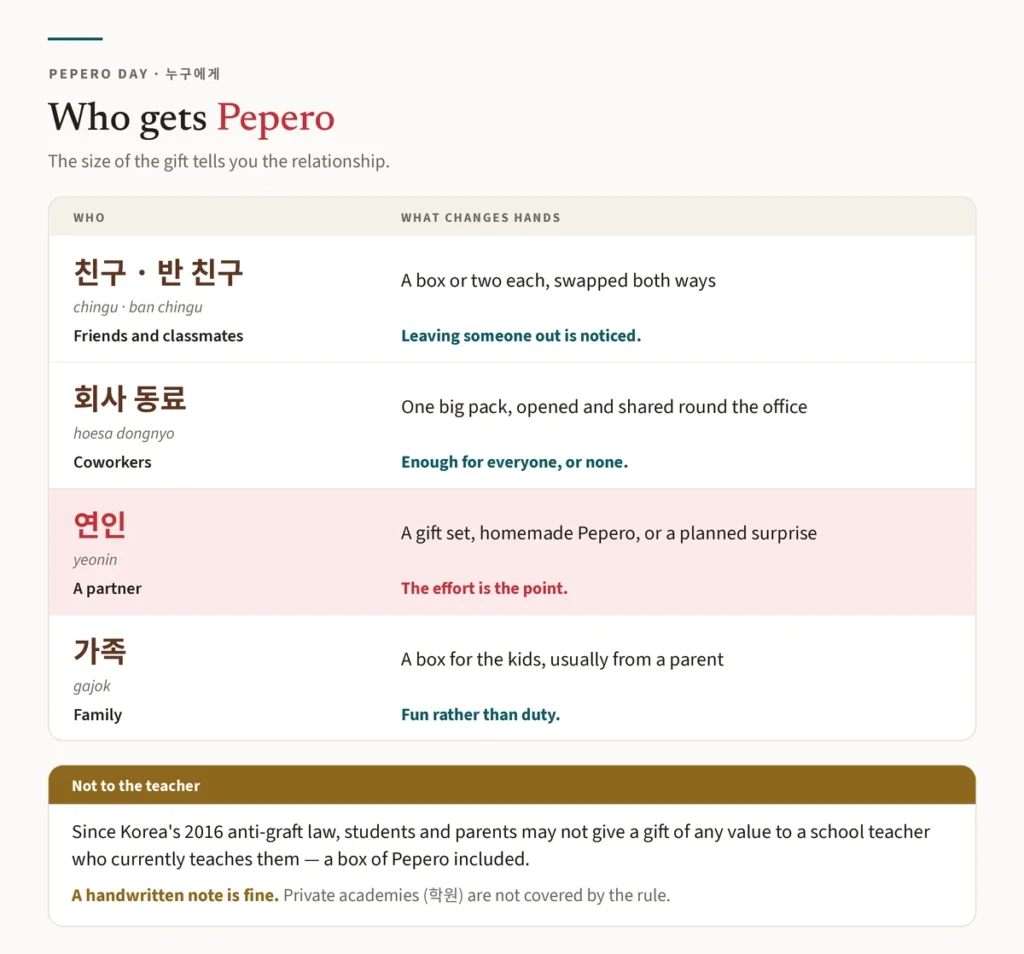
This is the part that makes Pepero Day different from the Western idea of Valentine’s Day. It is not mainly a romantic holiday. It is a sharing one, and the size of the gift tells you the relationship.
I can speak for this one personally. At school, my friends and I swapped Pepero every year without fail. Years later, at the English academy I ran, it was students and teachers alike: everyone brought boxes for everyone, and I came home with so many that for days afterwards I ate almost nothing but Pepero. (Private academies — 학원 — are not covered by the school gift rule further down, which is why the exchange there could include the teachers.)
| Who | What usually changes hands | What it means |
|---|---|---|
| Friends and classmates | A box or two each, swapped both ways | “We’re friends.” Leaving someone out is noticed. |
| Coworkers | A big multi-pack, opened and shared round the office | Goodwill. One person brings them for the whole team. |
| A partner | Something bigger: a gift set, homemade Pepero, or an arrangement with a small present | The effort is the point. |
| Family | A box for the kids, often from a parent | Fun rather than duty. |
Two things are worth knowing if you are in Korea for the day.
At an office, bring enough for everyone or bring none. A pile of boxes on one corner of the desk, free for anyone, is the usual approach. Handing Pepero to three colleagues out of ten creates the very awkwardness the day is meant to avoid. Our guide to Korean job titles covers who you will be sharing an office with.
Students give to each other, not to their teacher. Since Korea’s anti-graft law came into force in 2016, students and parents may not give gifts of any value to a school teacher who currently teaches them — and a box of Pepero counts. A handwritten note is fine. Former teachers are a different matter, but on Pepero Day the classroom exchange is between classmates.
What a Korean Couple Actually Does
For couples, Pepero Day is a chance to make a small fuss, and the snack is more of a prop than the present. If you need the words for the card, our guide to I love you in Korean covers the four forms of 사랑해 and when Korean couples start using it.
The simplest version is a large gift box or one of the cellophane baskets sold at convenience stores in the run-up to the day. A step up is 수제 빼빼로 (suje ppaeppaero), homemade Pepero: plain biscuit sticks dipped in melted chocolate and rolled in nuts or sprinkles. Shops sell kits for exactly this in early November, and making them is a common thing to do for a boyfriend or girlfriend.
Then there are the people who turn it into an event — 이벤트 (ibenteu), which in Korean dating talk means a planned surprise for your partner rather than a public occasion. When my husband and I were dating, he secretly laid out an enormous heart of Pepero on the floor at home and left it there for me to find. It is exactly the kind of gesture the day exists for: cheap materials, a lot of effort, and the unmistakable message that you planned ahead.
Couples also play the 빼빼로 게임 (ppaeppaero geim), where two people bite in from either end of one stick and see who stops first. It has been a party-game staple on Korean variety shows for years. It is very much a couples-and-close-friends game, not an office one.
Pepero Day and Korea’s Other Gift Days
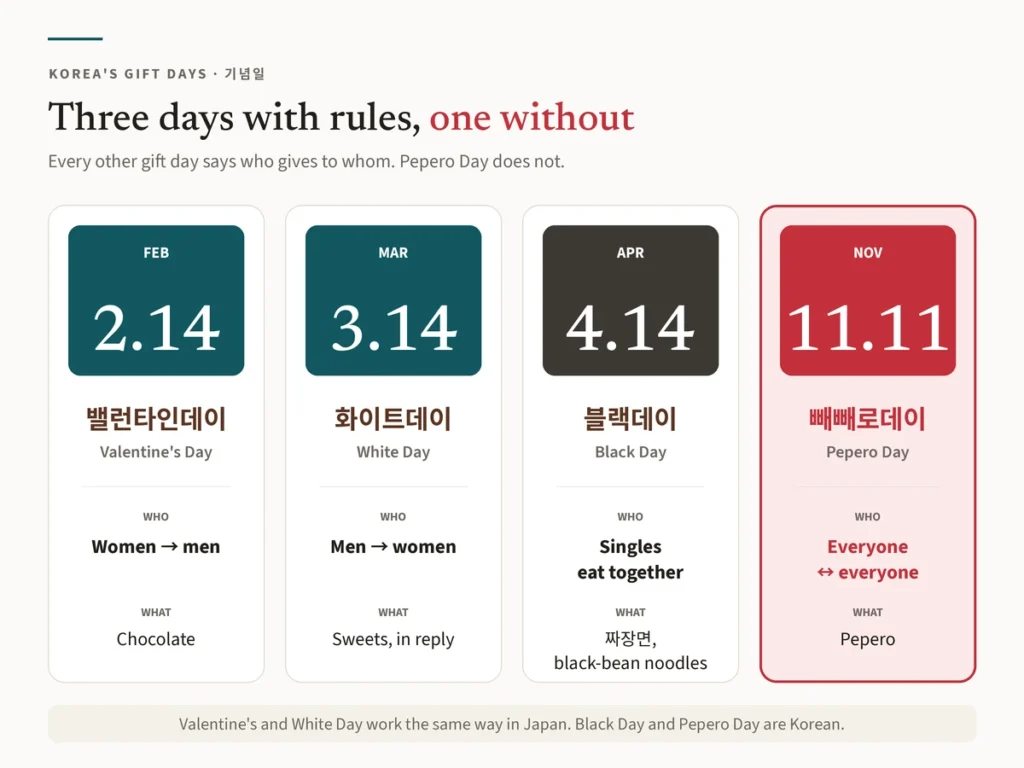
Pepero Day makes more sense once you see the calendar it sits in. Korea runs a sequence of gift days, and each one has a rule about who gives what.
| Date | Day | Who gives what |
|---|---|---|
| 14 February | 밸런타인데이 (Valentine’s Day) | Traditionally, women give men chocolate |
| 14 March | 화이트데이 (White Day) | Men answer with sweets |
| 14 April | 블랙데이 (Black Day) | Singles who received nothing eat 짜장면, black-bean noodles |
| 11 November | 빼빼로데이 (Pepero Day) | Everyone gives Pepero to everyone |
Valentine’s Day in Korea has traditionally run one way, from women to men, with White Day a month later for the reply — a custom shared with Japan. Plenty of couples now ignore the direction and both give, but the two-step pattern is still the default. Black Day is the joke at the end of it: if February and March brought you nothing, you get together with other singles and eat 짜장면 (jjajangmyeon), the black-bean noodles that give the day its name. For the words you will need at the table, see our guide to food in Korean.
You will also see lists of a “14th day” for every month of the year — Rose Day, Kiss Day, Movie Day and so on. Most are marketing that few people actually keep. The four above are the ones most people actually know.
Pepero Day is the odd one out. It has no direction and no reply day. Men give to women, women give to men, friends give to friends, and the person who brought three boxes to school leaves with three different ones. It is also the one children join in, which is why so many Koreans first meet it at school.
The Other Holiday on 11 November
Officially, 11 November is not Pepero Day at all. It is 농업인의 날 (nongeobinui nal), Farmers’ Day, a national commemoration day set on this date in 1996.
The date comes from a piece of Chinese-character wordplay. Eleven written in Chinese characters is 十一 — ten and one. Stack 十 on top of 一 and you get 土, the character for soil. Farmers come from the soil, so Farmers’ Day went on the date that spells it.
Since 2006, the Ministry of Agriculture has also promoted the date as 가래떡데이 (garaetteok dei), Garaetteok Day. 가래떡 is a long, white cylinder of rice cake — the same shape as a Pepero stick, only made of Korean rice. Local governments and farming cooperatives mark the day with events where 가래떡 is handed out, as a home-grown answer to a chocolate snack.
Ask most Koreans what 11 November is and they will still say Pepero Day. But it is worth knowing both. The same date gives you a visual pun in Arabic numerals and another one in Chinese characters. If you enjoyed the 十一 trick, our article on Hangul Day shows how much visual logic went into Korea’s own alphabet.
What to Say When You Hand One Over
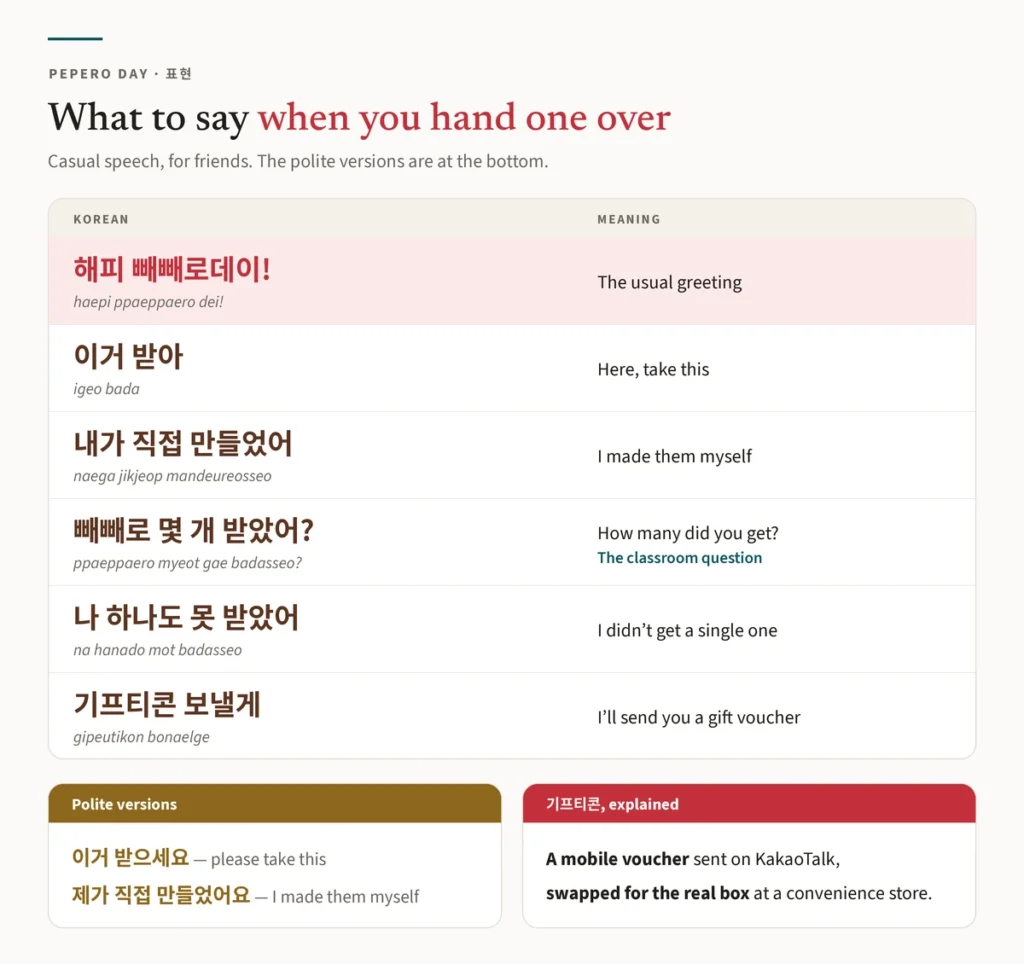
There is no fixed greeting for Pepero Day the way there is for Chuseok. People keep it light. Between friends this is all banmal, casual speech. With anyone you would normally speak politely to, switch to the polite forms: 이거 받으세요 (igeo badeuseyo), “please take this,” and 제가 직접 만들었어요 (jega jikjeop mandeureosseoyo), “I made them myself.”
| Korean | Romanisation | Meaning |
|---|---|---|
| 해피 빼빼로데이! | haepi ppaeppaero dei! | Happy Pepero Day! — the most common greeting |
| 이거 받아 | igeo bada | Here, take this |
| 내가 직접 만들었어 | naega jikjeop mandeureosseo | I made them myself |
| 빼빼로 몇 개 받았어? | ppaeppaero myeot gae badasseo? | How many Pepero did you get? |
| 나 하나도 못 받았어 | na hanado mot badasseo | I didn’t get a single one |
| 기프티콘 보낼게 | gipeutikon bonaelge | I’ll send you a gift voucher |
빼빼로 몇 개 받았어? is the question you will hear in every classroom on the afternoon of 11 November. It is half small talk, half scoreboard. And 나 하나도 못 받았어, usually followed by ㅠㅠ in a text, is the standard complaint; our guide to Korean texting slang explains the crying eyes.
The last line is the modern version of the whole day. A 기프티콘 is a mobile gift voucher, sent through KakaoTalk, that the other person exchanges for the real thing at a convenience store. Friends who live far apart, or who forgot until the last minute, send Pepero this way all the time. It is entirely normal and nobody considers it lazy — though a box handed over in person still lands better.
If You Are in Korea That Week
- The displays start in late October. By the first week of November, most convenience stores have a stand by the door. Prices are ordinary snack prices; the gift sets and baskets cost more.
- Buy early if you want the special editions. Limited flavours and character packaging can sell out in the last few days.
- If you are staying with a host family or working in an office, a few boxes go a long way. It is one of the easiest ways for a visitor to join in with something every Korean recognises.
- If you are in Busan, the city where it all started, the Busan Fireworks Festival over Gwangalli is on Saturday 7 November in 2026 — the same week. Our guide to the best time to visit Busan covers the rest of the season.
And if you are not in Korea at all: Pepero is now sold in around fifty countries, and Lotte has been taking the day abroad — in 2025 it held a Pepero Day event in New York’s Times Square for the second year running. If your local Asian supermarket has Korean snacks, it probably has Pepero in November.
Frequently Asked Questions
When is Pepero Day in 2026?
Wednesday, 11 November 2026. Pepero Day is always 11 November, whatever the day of the week. In 2027 it falls on a Thursday.
Is Pepero Day a public holiday in Korea?
No. Schools, offices, banks and shops are all open as normal — which is exactly why it is so visible, because the exchanging happens at school and at work. The official commemoration on the same date is Farmers’ Day, which is not a day off either.
Do I have to give Pepero to a Korean friend or partner?
You do not have to, and a foreign friend who forgets will be forgiven. But it costs very little, and a Korean partner will usually notice if 11 November passes without anything. Between friends, a single box or a 기프티콘 is plenty.
Buy Two Boxes
Pepero Day began as a joke between schoolgirls in Busan and grew into the one gift day in Korea with no rules about who gives to whom. If you want to join in, buy two boxes: one to give, and one for whoever gives you one back. Say 해피 빼빼로데이!, ask 몇 개 받았어? by the afternoon, and you will have done Pepero Day the way Koreans do.
Written by Minhyung Cha — 25 years teaching Korean, and 15+ years running an English academy in South Korea. I live and work in Busan, and every example on this site is checked as a native speaker. More about KEL.
Leave a Reply