Jjimjilbang, or 찜질방, is the Korean version of a day at the spa, except that it costs about as much as lunch, you wear a matching T-shirt and shorts, and the people around you are asleep on the floor. It is part bathhouse, part sauna and part living room. Families go, friends go, couples go, and nobody is in a hurry.
I grew up going with my family and my friends, and I still go now. This guide walks you through a visit from the front desk to the egg, explains the rooms and the rules, shows you how to fold the famous sheep towel, and gives you the Korean you will need. If you are nervous about the bathing part, you are in good company: that is the first thing foreign friends ask about, and it is simpler than you think.
What Is a Jjimjilbang?
찜질 (jjimjil) means warming the body with heat to ease it, and 방 (bang) means room. So a 찜질방 is literally a “heat-treatment room,” although today the word means the whole building: separate baths for men and women, then a large shared area of hot rooms, heated floors, snack counters and sleeping spaces.
The idea is old. Korea’s kiln saunas, called 한증막 (hanjeungmak), appear in records from the reign of King Sejong in the 15th century. The modern 찜질방 took shape in the early 1990s, when hot rooms from bathhouses were combined with Korea’s love of the heated floor, the 온돌 (ondol), and of sitting around together in a room. It soon became a place to spend a whole day rather than an hour.
It is also changing. Korea had more than 10,000 registered bathhouse businesses in 2001 and fewer than 5,700 in 2025, so small neighbourhood places are closing. Big modern ones are doing very well. At Spa Land in Busan, nearly half of the 470,000 or so visitors between January and July 2026 were foreigners, up from 17.9 percent in 2023. You will not be the only first-timer in the room.
How a Jjimjilbang Visit Works, Step by Step
Every place is a little different, but the order is nearly always the same.
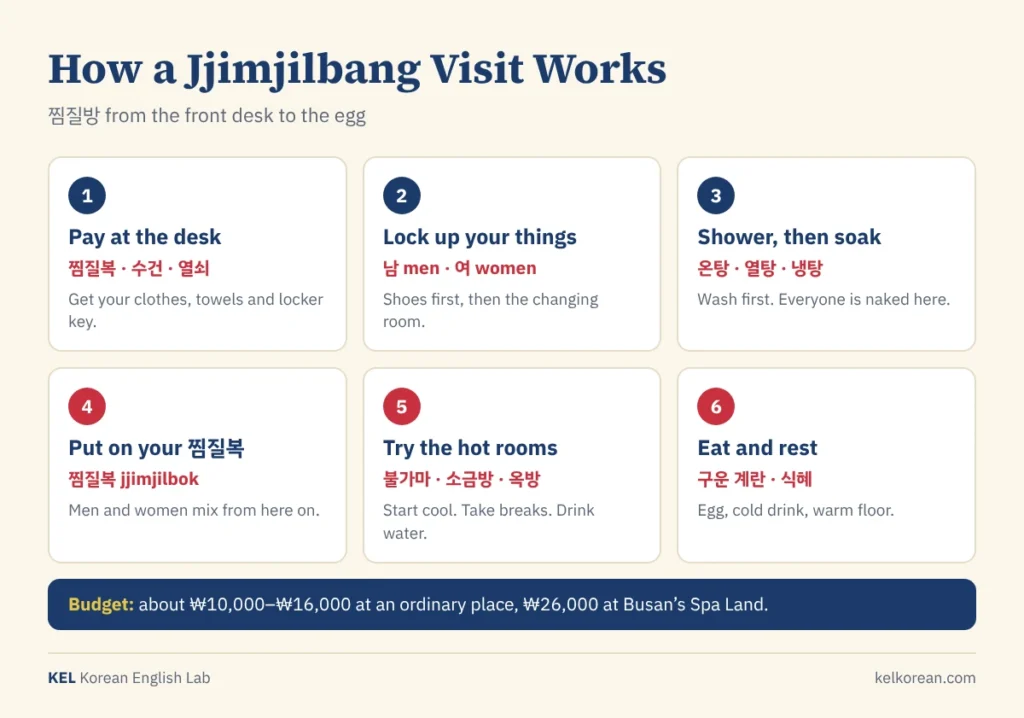
- Pay at the front desk. You pay on the way in, and you are given a locker key, a 찜질복 (jjimjilbok, the T-shirt and shorts) and towels. At many places the key or wristband also works as your tab for snacks, and you settle up when you leave.
- Leave your shoes. Shoes go in a small shoe locker near the entrance. From here on, you are barefoot.
- Go to the changing room. Follow the signs for 남 (men) or 여 (women). Our guide to reading Korean signs shows these two characters. Put your clothes in your locker.
- Shower. Wash properly with soap before you go near a bath. This is the one rule nobody bends. Yes, you are naked here, and so is everybody else, and nobody is looking.
- Soak, if you want to. The baths are optional, but they are lovely: 온탕 is warm, 열탕 is hot, 냉탕 is cold.
- Put on your 찜질복. Now you can walk out into the shared area, where men, women and children mix, all dressed the same.
- Move between the rooms. Heat, cool down, drink water, eat something, lie on the warm floor. This is the main event, and there is no schedule.
- Shower and leave. Hand back your key and clothes, and pay anything you have added to your tab.
The Rooms: Hot, Hotter and Very Cold
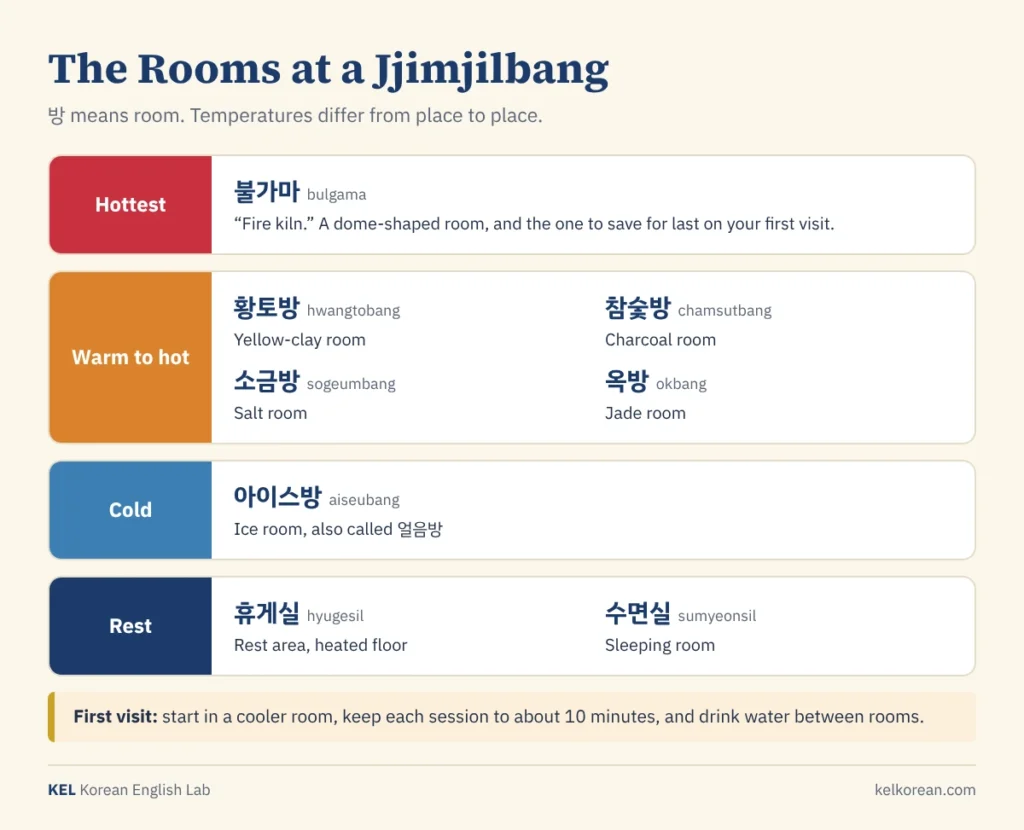
The hot rooms are the reason you came. Each is built around a material that Koreans believe gives a different kind of heat, and the names are easy to read once you know that 방 means room.
| Korean | Romanisation | Meaning |
|---|---|---|
| 불가마 | bulgama | “Fire kiln,” a dome-shaped room and usually the hottest |
| 황토방 | hwangtobang | Yellow-clay room |
| 참숯방 | chamsutbang | Charcoal room |
| 소금방 | sogeumbang | Salt room |
| 옥방 | okbang | Jade room |
| 아이스방 | aiseubang | Ice room, also called 얼음방 (eoreumbang) |
| 휴게실 | hyugesil | Rest area with a heated floor |
| 수면실 | sumyeonsil | Sleeping room |
Here is how I do it. I shower, put on my 찜질복 and go straight into the 불가마. I can stay for about 10 to 15 minutes, and then I move to rooms with lower temperatures. When I have plenty of time, I try a bit of every room.
That is my habit after many years, and it is not what I would suggest for a first visit. The hottest rooms can reach 80°C or more, so start in a cooler room, stay for a few minutes, and leave as soon as you feel uncomfortable. Korean health advice has long been to keep each session to about 10 minutes and to take breaks. Sit near the door, drink water between rooms, and skip the hot rooms altogether if you have been drinking. If you have high blood pressure or a heart condition, ask your doctor before you go.
The visit I remember best involved the 옥방. My legs were badly knotted that day, I did my 찜질 in the jade room, and the tightness simply went. I am not going to make medical claims for jade, but I have never forgotten how good that felt, and it taught me two very useful Korean verbs. Muscles that are knotted are 뭉치다 (mungchida), so you say 다리가 뭉쳤어요, “my legs are knotted.” When the tightness goes, the verb is 풀리다 (pullida), “to come undone,” so you say 다리가 풀렸어요. Our guide to being sick in Korean has the rest of the body words.
Eggs, 식혜 and the Snack Counter
Ask any Korean what you eat at a 찜질방 and you will hear the same answer. 구운 계란 (guun gyeran), roasted eggs with brown shells and a slightly chewy white, and 식혜 (sikhye), a sweet, cold rice drink, often served with ice. To me they are simply the best match there is: salty, warm egg, then a long, cold, sweet drink after you have sweated it all out. You may also see them called 맥반석 계란 (maekbanseok gyeran), after the hot stone they are cooked on.
Sometimes I have a 매실 (maesil) drink instead of 식혜. It is made from green plums, and its sweet, sour taste is very refreshing after the heat. Expect to pay around ₩1,000 to ₩2,000 for an egg and ₩3,000 to ₩4,000 for a 식혜 at an ordinary place.
The eggs are only the start. Larger places have proper restaurants, and a bowl of something hot after the rooms is part of the fun. Good food is one of the things I remember most happily about these days out. Our list of Korean food words will help you read the menu.
The Sheep Towel: 양머리
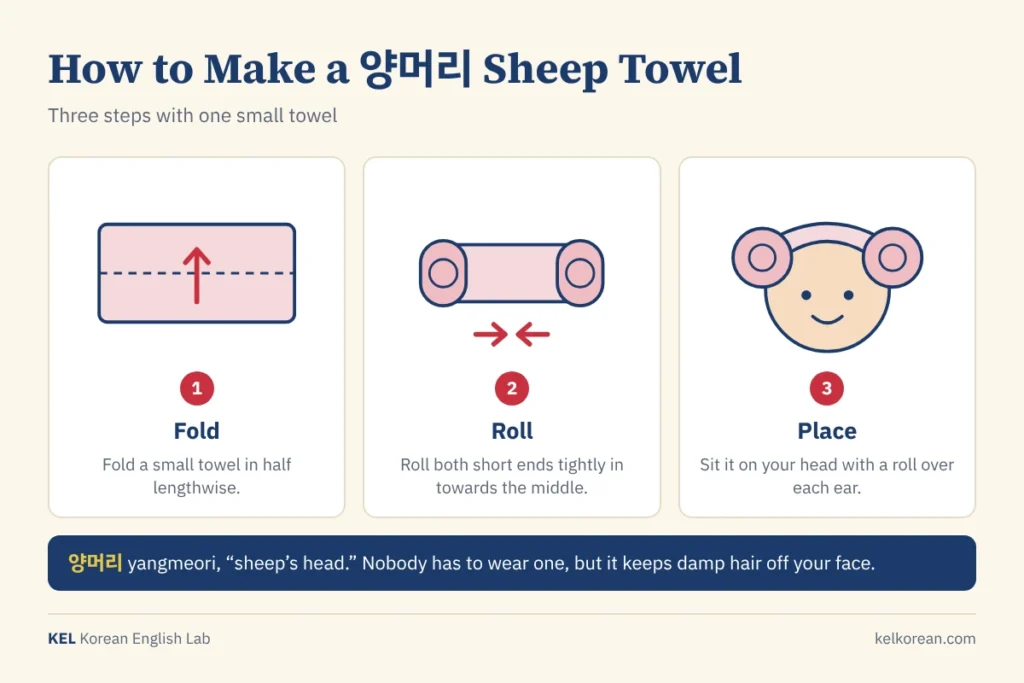
양머리 (yangmeori), “sheep’s head,” is the towel hat you have probably seen in K-dramas: a small towel rolled so that a curl sits over each ear. TV shows and dramas turned it into the symbol of the 찜질방, and our guide to K-drama Korean has more of the language you will meet on screen. It also has a practical use, keeping damp hair off your face. Nobody needs to wear one, but I have done it myself, and it is a happy memory.
- Fold a small towel in half lengthwise.
- Roll both short ends tightly in towards the middle.
- Place it on your head with a roll over each ear.
Old-School or Modern? Two Places in My Life
When I was young, I often went to a traditional 찜질방 called 천지원 (Cheonjiwon). These days my favourite is Spa Land, inside the Shinsegae department store in Busan’s Centum City. The difference between them is the story of how the 찜질방 has changed. It used to be mostly about the heat. Now there is so much else to do that the heat is only part of the day, and there are many different ways to rest.
If you are visiting Busan, Spa Land is an easy first 찜질방 because it is used to foreign guests. It is on the ground floor of Shinsegae Centum City, by Centum City Station on Line 2, and a short ride from Haeundae Beach. It has 18 hot-spring baths, rooms that include a 불가마, 황토방, 소금방 and 참숯방 as well as Finnish and Roman saunas, and an upper floor with a relaxation room, restaurant and café.
- Hours: daily from 9:00 to 22:00, last entry 21:00.
- Price: ₩26,000 for adults and ₩21,000 for students, the same every day.
- Time limit: 4 hours, then ₩5,000 an hour. Spend ₩10,000 inside and you get up to 6 hours.
- Age: from elementary school age, and children must be with a same-sex guardian.
- Suitcases: large cases go in the lockers in front of the ticket office, ₩3,000 for 5 hours.
These were the details on the official Shinsegae page when I wrote this, so check them before you go. An ordinary neighbourhood 찜질방 is much cheaper, often somewhere around ₩10,000 to ₩16,000, and has none of the polish. It is also where you will see how Koreans really use the place. Both are worth doing. On a cold day, you can pick up a bag of winter street food on the way home.
Rules and Etiquette
- Wash before you soak. Rinse off every bit of soap before getting into a bath.
- No swimsuits in the baths. The baths are separated by sex, and everyone is naked. In the shared area, everyone wears the 찜질복.
- Keep towels out of the water. Tie up long hair as well.
- No photos in changing rooms or baths. Leave your phone in your locker.
- Keep your voice down. People are sleeping, especially in the 수면실.
- Ask about tattoos. There is no national ban, and each place sets its own rule. Large modern places tend to be relaxed, but ask at the desk if yours are big.
- Do not plan on sleeping over without checking. Spending the night was once a classic cheap stay, but many places have not gone back to 24-hour opening since the pandemic, and Spa Land closes at 22:00. Where you can stay, expect a mat on the floor, noise and light. Under-19s are usually not allowed between 22:00 and 5:00 without a guardian.
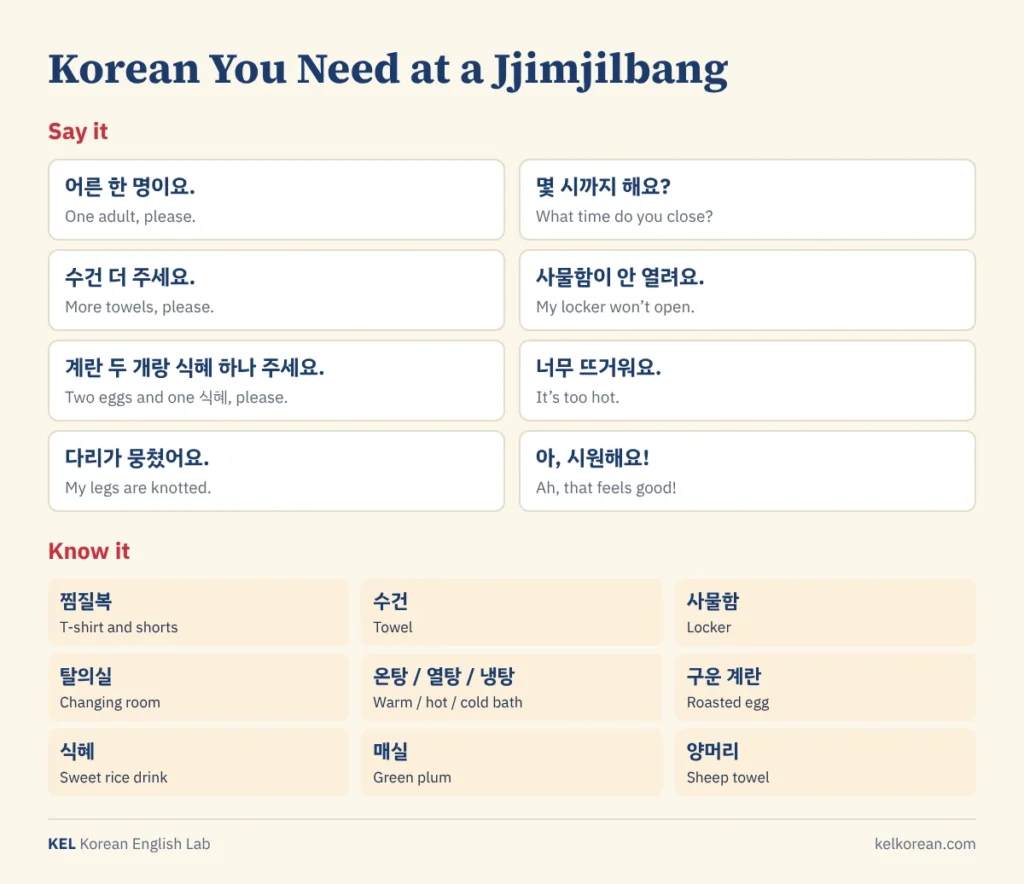
Korean You Need at a Jjimjilbang
| Korean | Romanisation | Meaning |
|---|---|---|
| 어른 한 명이요. | eoreun han myeong-iyo | One adult, please. |
| 몇 시까지 해요? | myeot sikkaji haeyo? | What time do you close? |
| 몇 시간 있을 수 있어요? | myeot sigan isseul su isseoyo? | How many hours can I stay? |
| 수건 더 주세요. | sugeon deo juseyo | More towels, please. |
| 찜질복 큰 걸로 주세요. | jjimjilbok keun geollo juseyo | A bigger 찜질복, please. |
| 사물함이 안 열려요. | samulhami an yeollyeoyo | My locker won’t open. |
| 문신 있어도 괜찮아요? | munsin isseodo gwaenchanayo? | Is it OK if I have tattoos? |
| 계란 두 개랑 식혜 하나 주세요. | gyeran du gaerang sikhye hana juseyo | Two eggs and one 식혜, please. |
| 너무 뜨거워요. | neomu tteugeowoyo | It’s too hot. |
| 아, 시원해요! | a, siwonhaeyo! | Ah, that feels good! |
That last one is the most Korean sentence in this article. 시원하다 (siwonhada) means “cool,” as in a cool breeze, so you might expect to hear it in the ice room. But Koreans also say it while lowering themselves into very hot water, or after a good sweat, or while eating boiling soup, and there it means something like “refreshing” or “that hits the spot.” If a Korean grandmother sinks into a steaming bath and sighs 아, 시원하다, she is not confused. She is happy. When you can say it in a 불가마 and mean it, you have understood the 찜질방.
Come for the Heat, Stay for the Egg
You do not need much for a good day at a 찜질방: a few hours, a little courage for the changing room, and an appetite. Start in a cool room, try the jade or the salt, eat your egg, drink your 식혜 and lie down on the warm floor with nothing to do. If you are in Korea in the cold months, it is one of the best ways to spend an afternoon, and our Busan season-by-season guide has more ideas for a winter trip. Roll up your towel, and when the tiredness finally leaves your legs, you will know exactly what to say: 아, 시원해요.
Written by Minhyung Cha — 25 years teaching Korean, and 15+ years running an English academy in South Korea. I live and work in Busan, and every example on this site is checked as a native speaker. More about KEL.
Leave a Reply