Most people who quit Korean do not quit because it is hard. They quit because they never knew what to do next.
You watch a drama, decide to learn the language, and open a browser. Within ten minutes you have found a Hangul chart, a list of 500 vocabulary words, a video about six speech levels, an app that wants you to name fruits, and a forum arguing about whether romanization ruins your accent. All of it is real information. None of it tells you what to do on Monday.
This roadmap is the answer to that. It lays out how to learn Korean from zero in the order the language actually builds, tells you honestly how long each stage takes, and points you to a free lesson for every step. No app subscriptions, no textbook required.
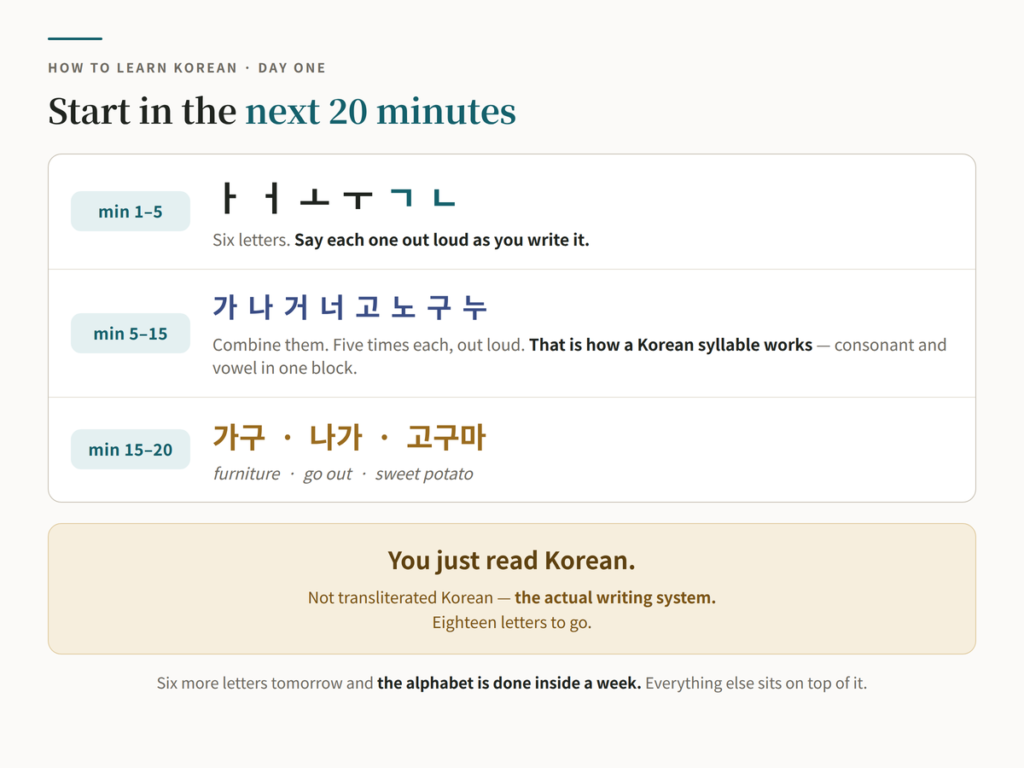
If you follow it, you will be able to read Korean in a week, build your own sentences in about a month, and hold a simple conversation in about three.
Start in the Next 20 Minutes
If you take nothing else from this page, take this. You can begin learning Korean today, for free, in twenty minutes, without buying or downloading anything.
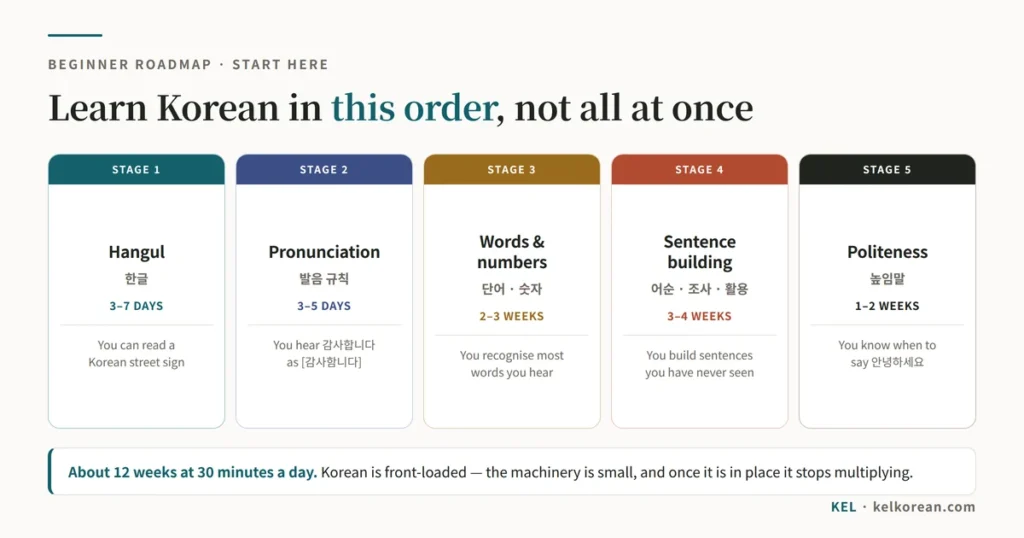
- Minutes 1–5. Learn six letters: ㅏ ㅓ ㅗ ㅜ ㄱ ㄴ. Say each one out loud as you write it.
- Minutes 5–15. Combine them. 가 · 나 · 거 · 너 · 고 · 노 · 구 · 누. Write each one five times, saying it as you go. That is how Korean syllables work — a consonant and a vowel packed into one block.
- Minutes 15–20. Read these out loud: 가구 (furniture) · 나가 (go out) · 고구마 (sweet potato).
You just read Korean. Not transliterated Korean — the actual writing system. Eighteen letters to go, and the rest of this page is the order to take them in.
Do that again tomorrow with six more letters and you will finish the alphabet inside a week. Everything else in Korean sits on top of it.
What This Roadmap Assumes
- You are starting from zero. No Hangul, no vocabulary.
- You are self-studying, not enrolled in a course.
- You can give it roughly 30 minutes a day. More is better, but consistency beats volume — twenty minutes daily beats three hours on Sunday.
- Your goal is practical Korean: understanding what you hear, and saying things people actually say.
If you have a different goal — passing TOPIK, reading webtoons, business Korean — the first three stages are identical. The path only splits after that.
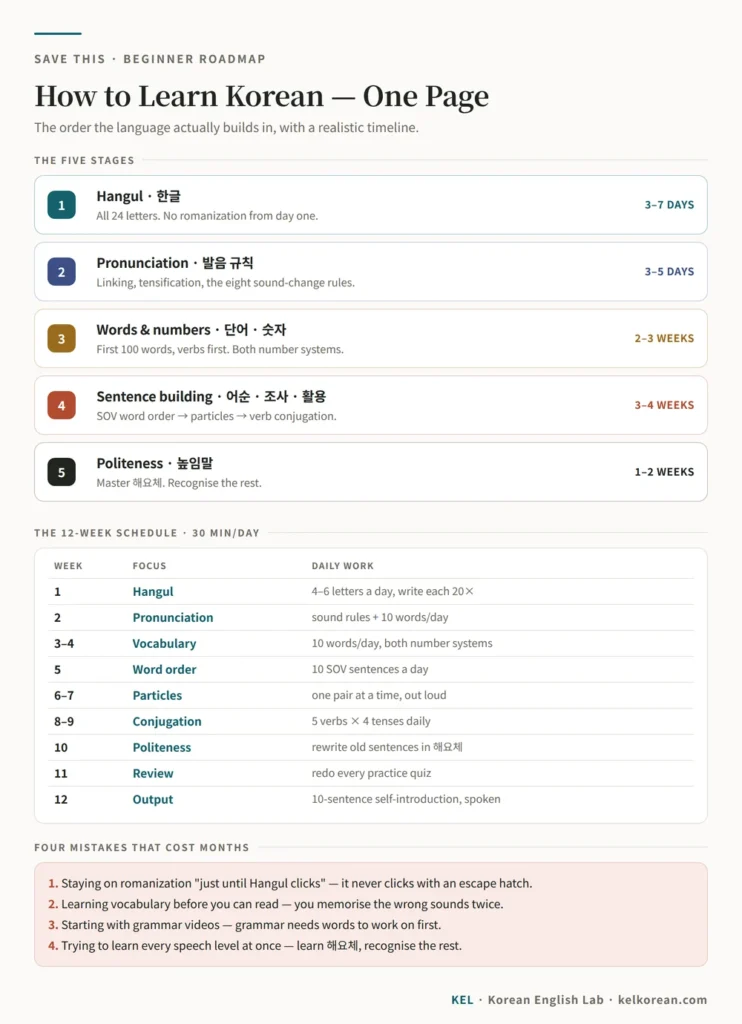
The Five Stages, In Order
| Stage | What you learn | Time | Why this order |
|---|---|---|---|
| 1 | Hangul — the alphabet | 3–7 days | Everything else depends on reading |
| 2 | Pronunciation rules | 3–5 days | Stops your listening from breaking later |
| 3 | Core vocabulary + numbers | 2–3 weeks | You need material before grammar has anything to work on |
| 4 | Sentence building | 3–4 weeks | Word order, particles, verb endings |
| 5 | Politeness levels | 1–2 weeks | Turns correct Korean into appropriate Korean |
Everything after that is expansion, not new machinery.
Stage 1 — Learn Hangul First. All of It. Right Now.
Time: 3 to 7 days. Do not skip. Do not use romanization as a crutch.
This is the one instruction almost every successful Korean learner gives, and almost every beginner ignores for a week before coming back to it.
Hangul is not Chinese characters. It is a 24-letter alphabet designed in the 1440s to be learnable in a morning, and the letter shapes are based on the shape your mouth makes. Most people can read — slowly — within three days.
Why romanization is a trap: Sinla, hangukeo, and chukha are all reasonable romanizations, and all three are pronounced differently from how they look. Romanization systems spell the letters, not the sounds. Every day you spend leaning on it is a day you spend learning the wrong pronunciation and having to unlearn it.
👉 Start here: How to Learn Hangul in a Week
You are done with this stage when: you can sound out a Korean street sign, slowly, without looking anything up. Not fast. Slow is fine.
Stage 2 — Fix Your Ears Before You Build Habits
Time: 3 to 5 days.
Here is where most roadmaps skip a step, and where most learners quietly develop a permanent accent.
Korean spelling and Korean speech are not the same thing. 같이 is written gat-i and pronounced [가치]. 감사합니다 has a ㅂ in it that nobody pronounces. 학교 is spoken [학꾜]. These are not exceptions — they are systematic rules, and there are only about eight of them.
Learning them now costs you three days. Learning them in six months costs you the effort of undoing every mispronounced word you have practised in between.
There are also a few vowels that English speakers reliably cannot hear apart at first, and 어 versus 오 is the big one — it is the difference between 서울 (Seoul) and 소울 (soul).
👉 Korean Pronunciation Rules: Why 같이 Sounds Like 가치 👉 Korean Vowels: 어 vs 오
You are done when: you can read 감사합니다 and say [감사함니다] without thinking about it.
Stage 3 — Build Raw Material
Time: 2 to 3 weeks.
Grammar is a set of instructions for arranging words. If you have no words, grammar has nothing to arrange. So before touching sentence structure, get a working vocabulary.
You do not need thousands of words. The first 100 well-chosen words cover a startling share of everyday Korean, because the most common words are common by an enormous margin.
Focus on:
- Verbs first — 가다, 먹다, 하다, 보다, 있다. Verbs carry Korean sentences.
- Everyday nouns — 물, 밥, 사람, 시간, 집.
- Numbers — Korean has two number systems and you need both. This trips up everyone, so handle it early rather than being ambushed by it when ordering food.
👉 100 Korean Words to Learn First 👉 Korean Numbers Explained: Sino-Korean vs Native Korean
How to actually memorise them: spaced repetition, ten new words a day, always in a short phrase rather than alone. 물 is harder to remember than 물 주세요.
You are done when: you recognise most words in a simple Korean sentence even if you cannot parse the grammar yet.
Stage 4 — Learn to Build Sentences
Time: 3 to 4 weeks. This is the real work.
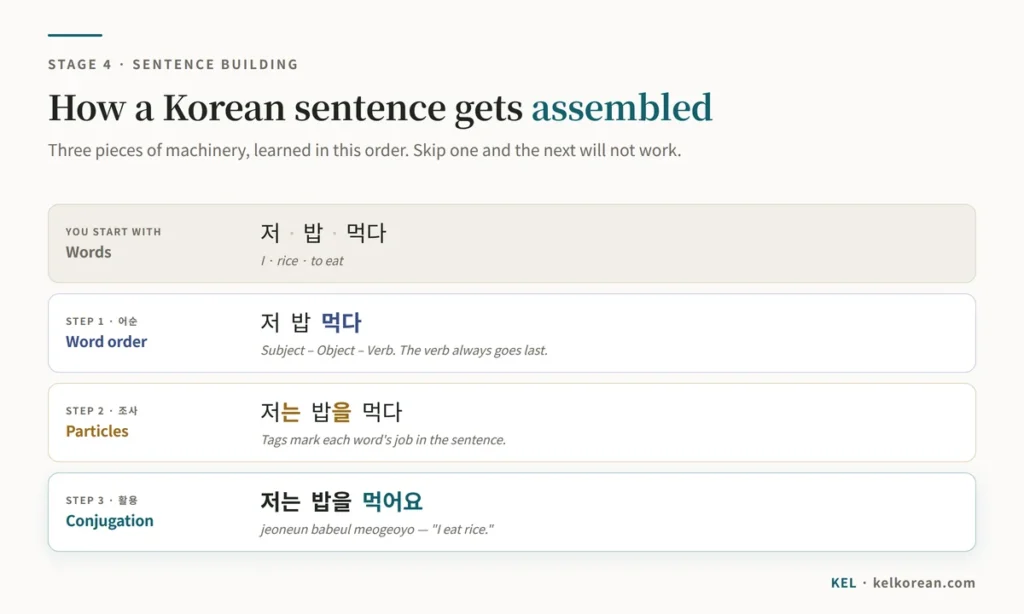
This stage has three parts, and they must go in this order.
4a. Word order
Korean is subject–object–verb. “I eat rice” becomes “I rice eat.” The verb always comes last — which is why you cannot understand a Korean sentence until the speaker finishes it.
👉 Korean Sentence Structure: A Beginner’s Guide to SOV Word Order
4b. Particles
Korean marks each word’s job with a small tag attached to it — 은/는, 이/가, 을/를, 에, 에서. This is why word order can be flexible: the tags carry the meaning, not the position.
Particles are the single most common source of “my sentence is grammatically correct but sounds wrong.” Give them real time.
4c. Verb conjugation
Now you make the verb do something. Present, past, future, negative. The good news: Korean verbs never change for person or number — 가요 works for I, you, he, she, we, and they.
👉 Korean Verb Conjugation for Beginners
You are done when: you can take three words you know and produce a correct sentence you have never seen before. That moment — building rather than reciting — is the actual milestone of beginner Korean.
Stage 5 — Say It the Right Way
Time: 1 to 2 weeks.
At this point your Korean is correct. This stage makes it appropriate.
Korean changes its endings depending on who you are talking to and who you are talking about. Use casual speech with a stranger and you sound rude; use formal speech with a close friend and you sound cold.
You do not need to master all of it. You need 해요체 — the polite everyday form — plus the ability to recognise the others when you hear them. That covers nearly every situation a learner will encounter.
👉 Korean Honorifics Explained Simply
You are done when: you know why 안녕 and 안녕하세요 are not interchangeable.
Stage 6 — Use It
Time: forever. This is the point.
Language you never use decays. Once you have Stages 1–5, put Korean into contact with reality.
If a trip to Korea is what started this, the practical Korean you need is narrower than you think — a few dozen phrases and the ability to read signs will carry you through most of a visit.
👉 10 Essential Korean Phrases for Travelers 👉 How to Use the Korean Subway 👉 Best Time to Visit Busan: A Season-by-Season Guide
If a trip is not on the table, use media instead: one drama scene per day with Korean subtitles, repeated until you can shadow it. Five minutes of shadowing beats an hour of passive watching.
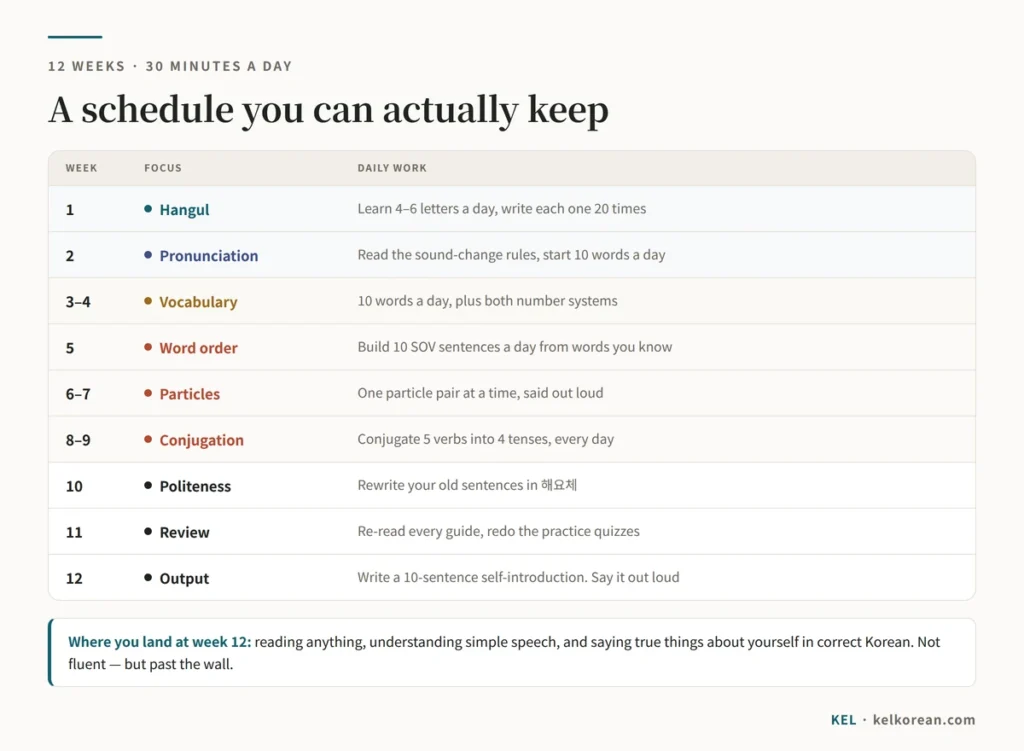
A Realistic 12-Week Schedule
Thirty minutes a day, six days a week.
| Week | Focus | Daily work |
|---|---|---|
| 1 | Hangul | Learn 4–6 letters a day, write each 20 times |
| 2 | Pronunciation + first words | Read the sound-change rules, start 10 words/day |
| 3–4 | Vocabulary + numbers | 10 words/day, both number systems |
| 5 | Word order | Build 10 SOV sentences a day from known words |
| 6–7 | Particles | One particle pair at a time, out loud |
| 8–9 | Verb conjugation | Conjugate 5 verbs into 4 tenses daily |
| 10 | Politeness levels | Rewrite old sentences in 해요체 |
| 11 | Review | Re-read every guide; redo the practice quizzes |
| 12 | Output | Write a 10-sentence self-introduction. Say it out loud |
At the end of week 12 you will not be fluent. You will be able to read anything, understand simple speech, and say true things about yourself in correct Korean. That is a real level, and it is where Korean stops feeling like a wall.
What to Actually Use
“Which app should I use?” is the first question almost everyone asks, and it is the wrong one — but you still need to put something on your phone. Here is an honest read on what each thing is good for and where it stops.
| Tool | Good for | Where it stops |
|---|---|---|
| Anki (free) | Vocabulary. Spaced repetition is the one study technique with real evidence behind it. | Ugly, fiddly to set up, teaches you nothing about grammar. |
| Duolingo (free tier) | Building a daily habit. The streak works. | Thin on explanation, and it mixes speech levels a beginner should keep apart. |
| Talk To Me In Korean | Structured grammar lessons with audio. The standard self-study backbone. | Free audio, paid books. Slow-moving early on. |
| Naver Dictionary (free) | Looking things up. Real example sentences, native audio for every entry. | Nothing — use this instead of Google Translate. |
| Papago (free) | Whole sentences. Noticeably better at Korean than general translators. | Still a translator. Do not learn grammar from it. |
| A tutor (paid) | Speaking practice and correction, from Stage 4 onward. | Expensive and largely wasted before you can build sentences. |
The minimum viable setup is two free things: a dictionary you trust (Naver) and a way to drill words (Anki, or paper cards — they work). Everything else is optional for the first three months.
And add the Korean keyboard to your phone in week 3. Typing forces active recall of letter positions in a way that reading does not, and it costs nothing.
How to Actually Understand Spoken Korean
This is the complaint that arrives around month two: I can read it, I know the words, and I still cannot understand a single sentence anyone says.
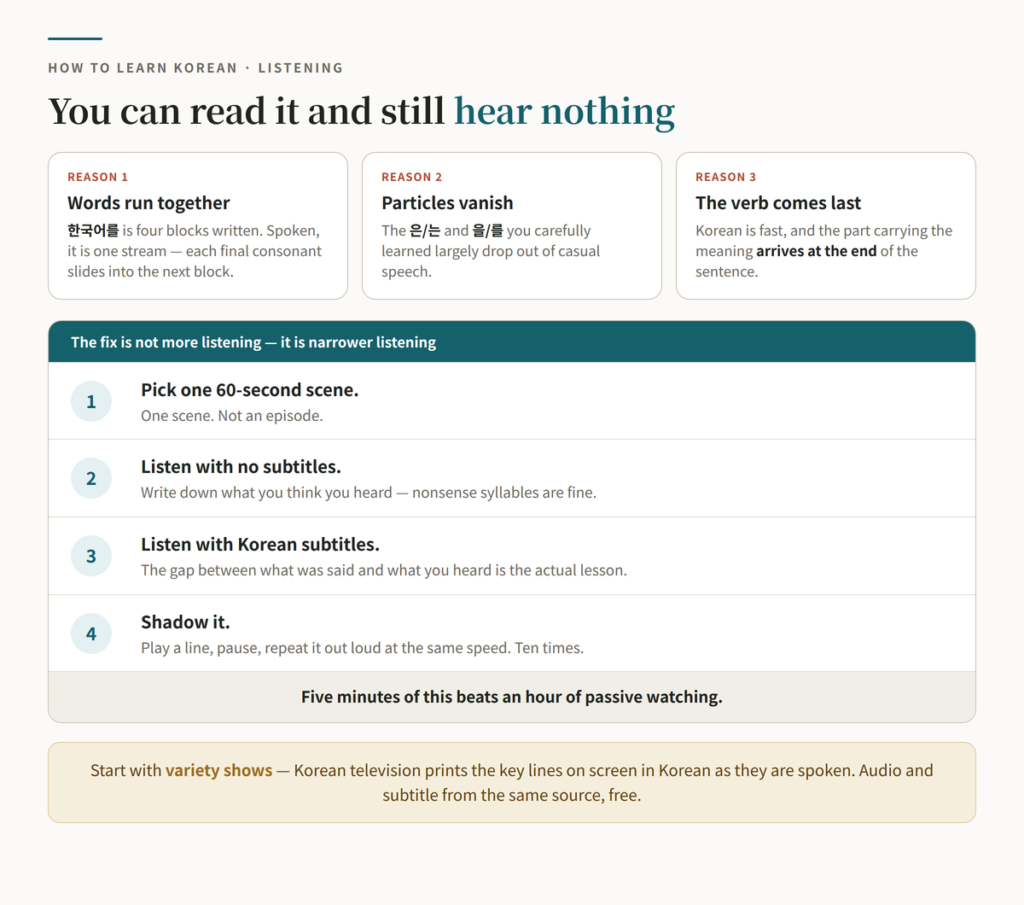
That is not a vocabulary problem. Three things are happening at once:
- Words run together. 한국어를 written out is four blocks; spoken it is one stream, and the final consonant of each block slides into the next.
- Particles get dropped. The 은/는 and 을/를 you carefully learned largely vanish in casual speech.
- It is fast. Spoken Korean is quick even by native speakers’ standards, and the verb — the part carrying the meaning — arrives last.
The fix is not more listening. It is narrower listening. Passive hours of drama with English subtitles build almost nothing. This does:
- Pick one scene of about 60 seconds. One. Not an episode.
- Listen with no subtitles. Write down what you think you heard, even if it is nonsense syllables.
- Listen with Korean subtitles. Now you see the gap between what was said and what you heard — and that gap is the actual lesson.
- Shadow it. Play a line, pause, repeat it out loud at the same speed. Ten times.
Five minutes of that beats an hour of passive watching, and the effect compounds — the sound changes you keep tripping over are the same eight rules every time.
Variety shows are the easiest starting material, because Korean television prints the key lines on screen in Korean as they are spoken. You get audio and subtitle from the same source, free.
Four Mistakes That Cost People Months
1. Staying on romanization “just until Hangul clicks.” It never clicks while you have an escape hatch. Delete the crutch in week one.
2. Learning vocabulary before you can read. You end up memorising English approximations of Korean sounds, then relearning every word later.
3. Starting with grammar videos. Grammar explanations are satisfying to watch and produce almost no ability. Grammar is only useful once you have words to put into it.
4. Trying to learn all the speech levels at once. Learn 해요체 properly. Recognise the rest. That is the correct allocation for at least your first year.
What Comes After Beginner
Once the five stages are done, the road forks depending on your goal.
- Conversation — more listening, more shadowing, more common expression patterns like -고 싶어요 and -할 수 있어요.
- TOPIK — the standardised proficiency exam. Levels 1–2 are within reach shortly after this roadmap. Always check current dates and fees on the official site.
- Reading — webtoons and children’s books are the usual on-ramp, because the vocabulary is bounded and the pictures carry context.
All three routes build on the same foundation. None of them requires starting over.
Frequently Asked Questions
How long does it take to learn Korean?
To a comfortable beginner level — reading fluently, simple conversation — about three months at 30 minutes a day. To conversational fluency, most self-studiers need one to two years. The US Foreign Service Institute classifies Korean as one of the hardest languages for English speakers, estimating around 2,200 class hours to professional proficiency. That number frightens people unnecessarily: it measures professional working fluency, not “can hold a conversation.”
Do I need a textbook or an app?
No. Apps are useful for spaced-repetition vocabulary drilling and not much else. What you actually need is a clear order, explanations you understand, and daily output. This roadmap and the guides it links to cover the beginner stage completely.
Is Korean harder than Japanese or Chinese?
Different, not strictly harder. Korean’s writing system is by far the easiest of the three — days, not years. Its grammar is the hardest part for English speakers, especially particles and speech levels. Chinese has simpler grammar but a writing system that takes years.
Should I learn to type in Korean?
Yes, early — around week 3. Typing forces you to recall letter positions actively, which reinforces Hangul far better than reading does. Add the Korean keyboard on your phone and use it for vocabulary notes.
What if I miss days?
Missing days is normal and not fatal. Missing weeks is what kills progress, because relearning costs more than it would have cost to maintain. If you fall off, restart at the stage you were in — do not start over from Hangul out of guilt.
Can I learn Korean just from dramas and K-pop?
They are excellent for motivation and listening exposure, and poor as a primary method — the input is unstructured and often uses speech levels you should not copy as a beginner. Use them as the reward, not the curriculum.
How do I start learning Korean?
Learn Hangul first, before any vocabulary or grammar. You can begin in twenty minutes with six letters — ㅏ ㅓ ㅗ ㅜ ㄱ ㄴ — and combine them into real syllables the same day. Six new letters a day finishes the alphabet inside a week, and everything else in Korean builds on it.
Can I learn Korean by myself?
Yes, at least through the beginner stage. What self-study lacks is not explanation — it is correction and speaking practice, and those only start to matter once you can build sentences. A tutor is worth paying for from Stage 4, not before.
How do I learn Korean for free?
The whole beginner stage can be done at zero cost. A dictionary (Naver), a spaced-repetition tool for vocabulary (Anki, or paper cards), free grammar lessons, and Korean-subtitled video for listening. Paid resources buy convenience and correction, not access.
Is Korean hard to learn for English speakers?
It is front-loaded rather than uniformly hard. The alphabet takes days, not years. The genuinely difficult parts are particles, speech levels and word order — a few weeks of work each — after which the machinery stops multiplying. There is no character memorisation to grind through.
Why can’t I understand spoken Korean even though I can read it?
Because spoken Korean links words together, drops particles and moves fast, and the verb arrives last. The cure is narrow, repeated listening — one 60-second scene, played without subtitles, then with Korean subtitles, then shadowed line by line. Five focused minutes beats an hour of passive watching.
How long does it take to learn Korean step by step?
About twelve weeks at thirty minutes a day to reach a real beginner level: reading fluently, understanding simple speech, and saying true things about yourself. One to two years of continued study for conversational fluency.
Final Thoughts
The thing nobody tells beginners is that Korean is front-loaded. The alphabet takes a week. The pronunciation rules take three days. The grammar machinery — word order, particles, verb endings — is genuinely only a few weeks of work, and then it stops multiplying. There is no equivalent of the years of character memorisation that other East Asian languages demand.
What that means practically: the hardest part of learning Korean is the first month, and it is hard mostly because of disorganisation, not difficulty. Fix the order and the difficulty largely dissolves.
Start today with Hangul. Not tomorrow, not after you have researched the best app. Learn the alphabet this week, and let the rest of this roadmap take care of the order.
Keep learning with Korean English Lab. Our bilingual Korean–English worksheets and printable workbooks are designed for self-study learners who want structured practice, not just theory.
Written by Minhyung Cha — 25 years teaching Korean, and 15+ years running an English academy in South Korea. Every example on this site is checked as a native speaker. More about KEL.
Leave a Reply